Theologian: Ecumenical Patriarch supported war just like Moscow Patriarch
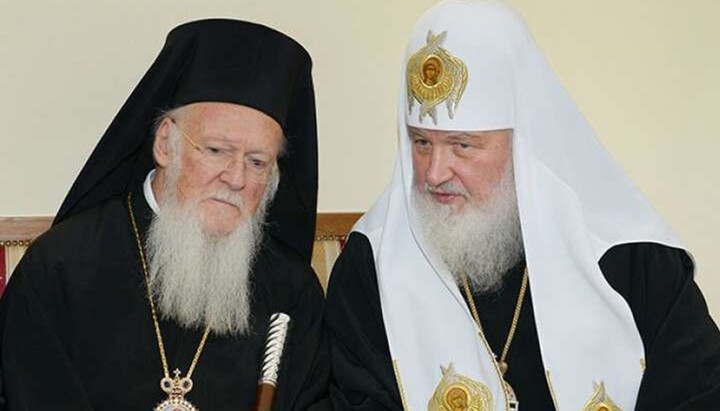
Ecumenical Patriarch Bartholomew and Moscow Patriarch Kirill. Photo: Espreso
Greek canonist, theologian, and church writer Presbyter Anastasios Gotsopoulos, in his work criticizing Ukraine’s State Ethnopolitical Expertise, stated that military actions, no matter how cruel or destructive, should not influence ecclesiastical-canonical matters.
He noted that the Ukrainian government effectively demands that the UOC proclaim autocephaly, arguing that “the Church of Ukraine cannot have its center in a hostile state. Otherwise, if it fails to meet the government’s demand, the Church will be declared illegal (see Law 8371/20.8.2024).”
“The relationships between Orthodox Churches and their canonical status have deep historical roots and centuries-old traditions, which not only do not align with any other sphere of human activity (politics, economics, geopolitics) but also predate the formation of modern states,” the theologian wrote.
According to him, “The war in Ukraine is undoubtedly a sad and destructive event, for which those responsible for its declaration, continuation, and escalation are accountable to history.” At the same time, all of this “cannot serve as a governmental alibi for attempting to destroy a historic Church whose origins date back to the first millennium.”
“Of course, the war will end soon; we all sincerely wish for this. Therefore, it is unthinkable for a three-year event, however unacceptable, cruel, and destructive, to erase or redefine the spiritual, canonical, and historical relationships between Orthodox Churches, forged and shaped over centuries based on Orthodox ecclesiology and canonical tradition in conditions just as, if not more, severe,” Fr. Anastasios said.
He argued that the fact of Patriarch Kirill’s blessing of the war in Ukraine does not grant his critics the right to sever relations with both him and the entire Russian Church.
“Those who passionately cite the argument that Patriarch Kirill ‘blessed arms against Ukraine’ forget that Ecumenical Patriarch Bartholomew, in a similar case, ‘blessed’ Turkish troops for Operation Olive Branch against Syria,” he underscored, recalling a letter from Ecumenical Patriarch Bartholomew to the Turkish president, in which he expressed support for Erdoğan’s expansion into Syrian territory.
“The decisive stance of President Erdoğan, which strictly prohibits associating religion with terrorism, is reflected in global public opinion. We pray that you and the Turkish armed forces achieve success and that Operation Olive Branch brings peace to the region, as its name promises,” Patriarch Bartholomew wrote in 2018.
“Of course, no one thought to condemn the Ecumenical Patriarch or to suggest that the Antiochian Patriarchate should break communion with the Ecumenical Patriarchate due to the blessing of the Turkish invasion of Syria,” the Greek theologian concluded.
Earlier, the UOJ reported that a Greek theologian explained why the DESS examination of the UOC is not creditable.
Read also
Volodymyr-Volynskyi Eparchy marks 30 years since restoration
The Pantanassa Icon and relics of Prince Volodymyr have arrived in Kovel and will visit churches across the Volodymyr-Volynskyi Eparchy to mark the 30th anniversary of the restoration of the episcopal see.
Bukovyna faithful bring humanitarian aid to Kherson region residents
The UOC’s Chernivtsi Eparchy delivered food to Holy Spirit Cathedral in Kherson.
Ukraine must have its own faith: Poroshenko's party lays out peace terms
Poroshenko’s party European Solidarity described church policy as a matter of national sovereignty and said there can be no compromises in this area.
432 UOC churches damaged in Ukraine during war, report says
According to the Religion on Fire project, 807 religious buildings in Ukraine have been damaged or destroyed as a result of hostilities.
DESS official gives number of clergy exempt from mobilization in Ukraine
A DESS representative said the actual number of clergy exempt from mobilization is significantly lower than the number of religious organizations designated as critical.
Cabinet keeps gas prices unchanged for religious organizations
The Cabinet has fixed gas prices for religious organizations through the end of the 2026–2027 heating season.