On Zelensky’s statements regarding the "Moscow Patriarchate"
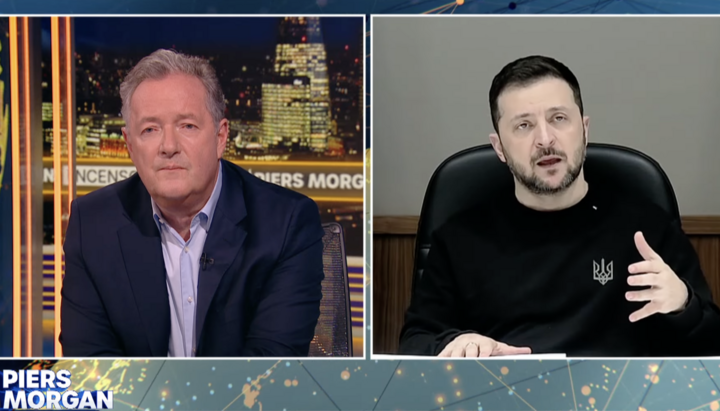
Piers Morgan and Volodymyr Zelensky. Photo: a screenshot from Morgan’s YouTube channel
President Volodymyr Zelensky’s interview with British journalist Piers Morgan, in which he mentioned the Ukrainian Orthodox Church (UOC), left a disturbing impression. Here’s why. Essentially, Zelensky’s comments were a response to Tucker Carlson, the well-known American journalist, who accused him of dictatorial tendencies, including the ban on the UOC. So, what does Zelensky offer in return?
1. The claim that the All-Ukrainian Council of Churches and Religious Organizations (UCCRO) excluded the "Moscow Patriarchate" from its ranks.
The President clearly confused this with UCCRO’s support for the law banning the UOC. This, in itself, is a disgraceful position for Ukraine’s religious denominations, but it does not constitute an expulsion from UCCRO. The official UCCRO website still lists Metropolitan Onuphry as "Metropolitan of Kyiv and All Ukraine." Notably, there is no mention of the "Moscow Patriarchate".
2. The claim that the entire population is against the Moscow Patriarchate, as strange as that may sound.
It is entirely unclear how Zelensky determined this. Did he derive it from the anti-church hysteria in Ukrainian media or from polls funded 90% by the controversial USAID? According to Ukraine’s State Ethnopolitics experts, the UOC has around 6 million believers and thousands of parishes. Has Zelensky simply excluded all these people from the population of Ukraine?
3. The claim that there is a legal connection between the UOC and the ROC: "The Moscow Patriarchate is being closed, there can be no legal connection. They must be a Ukrainian Church, legally in Ukrainian jurisdiction."
The only connection between the UOC and the Russian Orthodox Church (ROC) is Eucharistic communion. Legally, the "Moscow Patriarchate" does not exist and never has existed in Ukraine. The UOC has always been and remains under Ukrainian jurisdiction.
This is yet another incorrect statement by the President.
4. The claim that the ban on the UOC is "all lies. That is Putin’s narrative."
But if Zelensky admits that the ban exists and even justifies it, then why does he call it a "Putin's narrative"? What does Putin have to do with this at all?
We acknowledge that the President may not be well-informed on church matters, and it is possible that he has been misled. However, he is now spreading this misinformation worldwide, while simultaneously opposing a massive portion of his own country’s population. Very sad indeed.
Read also
Why is it legal to kill a person before birth but not after?
Children are the most privileged members of society. Yet that same society officially permits children to be killed – and on a massive scale.
Honoring the Bolsheviks’ successors at Kyiv Lavra
It was under the Reserve that the relics of the saints were desecrated, Lavra churches were turned into an atheism museum, and toilets were installed in sanctuaries.
"Degenerates" and "stupid animals": anti-UOC activists turn on children
Future historians will wonder how a vast country’s information agenda could have been shaped for so long by people so petty, vicious, and utterly contemptible.
Zelensky sees murder of Polish priest but not of Sviatohirsk monk
Why does Zelensky react so emotionally and swiftly to the murder of a Catholic cleric while remaining completely silent about the murder of an Orthodox monk?
UOC vs. OCU numbers: pollsters count, social media recount
Official polling suggests Dumenko’s structure has an overwhelming lead in the number of parishioners, while social media polls paint a very different picture. Which should we believe?
Who is working for the Kremlin in Poland? OCU, Uniates and Catholics versions
Who in the conflict between Poland and Ukraine is "an agent of the Russian Federation"? Zelensky, who gave the UPA name to an AFU special operations center? Nawrocki, who stripped him of an order for it? Polish MEPs?