New German Chancellor does not read the phrase about God during his oath
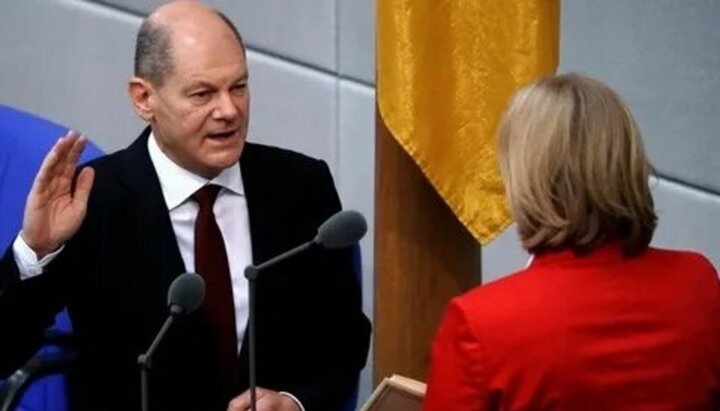
Olaf Scholz takes the oath. Photo: twitter.com/bianet_org
On December 8, 2021, the new Chancellor of Germany, Olaf Scholz, took the oath of office renouncing the mention of God in the text. This was reported by the Bundestag website.
The text of the oath provided for in the Basic Law reads as follows: I swear to use my strength for the welfare of the German people, to multiply their benefits, to divert threats from them, to respect and protect the Constitution and laws of the Federation, to perform my duties properly and to be fair to everyone. May God help me."
The last sentence is pronounced by politicians at their discretion, but only two of the nine chancellors have rejected it – Gerhard Schroeder and the newly elected Scholz.
Also, unlike his predecessors, Scholz does not belong to any of the denominations, specifies Sonntagsblatt. He used to belong to the Evangelical Church, but left it a few years ago.
At the same time, the politician does not consider himself an atheist and emphasizes that the faith and the church shaped him.
"As a politician, I am in favor of everyone appreciating the Christian nature of our culture," he explained in an autumn interview with the Katholischen Nachrichtenagentur (KNA).
Earlier, the UOJ wrote that atheists in the United States demanded that the phrase "May God help me" be removed from the text of the oath.
Read also
Lionel Messi thanks God for his achievements as he ends international career
Argentine football star Lionel Messi credited God for his success as he brought his international career to a close, saying he could never have achieved so much without God's will.
Odesa’s St. Elijah Monastery honors memory of its founder
Metropolitan Agafangel led celebrations at St. Elijah Monastery in Odesa on the feast day of St. Gabriel of Mount Athos.
OCU cleric rejects suspension, accuses ruling bishop of usurping power
An OCU cleric called the decree suspending him "canonically null and void" and accused "Bishop" Semanchuk of attempting to seize parishes and using mobilization threats as blackmail.
Supreme Court: Religious beliefs do not exempt citizens from mobilization
The Supreme Court has clarified that Ukrainian law does not provide for alternative civilian service under martial law.
Ukraine birth rate drops 17%, demographer says
The head of a department at Ukraine’s Institute of Demography has reported a sharp decline in the country's birth rate.
Khust Eparchy honors memory of St. Job of Uholka
A Liturgy is served in Mala Uholka, a birthplace of St. Job of Uholka, on the saint's feast day.