On Poroshenko's treason and alliance with Bartholomew and Dumenko
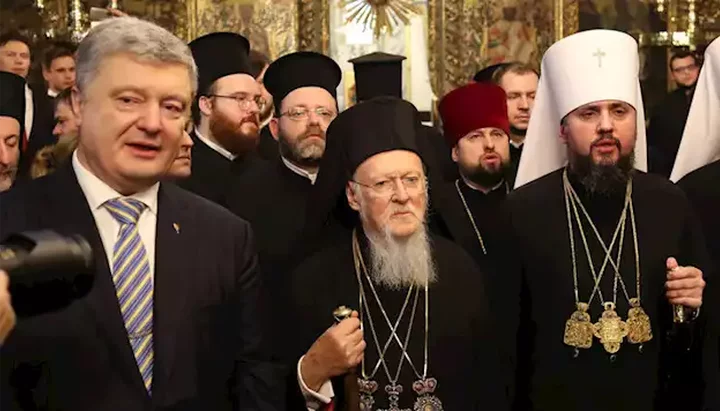
Petro Poroshenko, Patriarch Bartholomew, Epifaniy Dumenko. Photo: Zerkalo Tyzhnia
Attempts were made to serve him with a summons on December 18, but they were rather ineffective. The former president jumped into a car, shouting, "Let's go, damn it!" (in the occupier's language), and sped off to the airport, from where he flew to Turkey.
In Istanbul, Poroshenko immediately went to the Phanar to see Patriarch Bartholomew. Former MP (and Filaret supporter) Ihor Mosiychuk commented on this, saying, "It's good to have people who will always shield you from receiving a suspicion notice from the SBI."
On December 20, the State Bureau of Investigation confirmed the suspicion against Petro Poroshenko for treason and financing terrorism. What can be said about this?
The moral character of Petro Poroshenko has long been clear to everyone. This is a man who, during the 2014 presidential campaign, promised to end the war within hours, but later said, "Our children will go to schools and kindergartens, and theirs will be sitting in basements." This is the man who called for the destruction of the UOC as the "tentacles of the aggressor country", while simultaneously subserviently telling Putin, "I shake your hand."
This is a man who did not hesitate to use the church issue as a "gimmick" in the 2019 presidential campaign. We all remember the persecution of UOC hierarchs, the directives to local authorities to mass transfer UOC communities to the OCU, the "Tomos tours" across Ukrainian cities with Epifaniy and Filaret, his pre-election speeches from the pulpits of OCU churches, and so on.
And this "authoritative" person was equated with Saint Prince Volodymyr by Dumenko, who declared that the OCU sees only Poroshenko as president. Poroshenko's name is inscribed in golden letters in the OCU Tomos by Patriarch Bartholomew. Poroshenko signed an agreement with Bartholomew to transfer several churches and monasteries to the Phanar, which was not implemented only due to the change of government in Ukraine.
In short, for Patriarch Bartholomew and Serhiy Dumenko, Petro Poroshenko is a close and kindred spirit, an ally. And this fact speaks volumes about both the head of the Phanar and the head of the OCU.
We have no particular illusions about the investigation against Petro Oleksiyovych, but there is no one who does not see the discrepancy between the real moral character of the ex-president and the honors bestowed upon him by the Phanar and the OCU.
Every Christian knows the words from Psalm 146 of the Psalter, which calls not to trust in princes, because there is no salvation in them. These words are thousands of years old, but they are still relevant today. The Poroshenko-Bartholomew-Dumenko alliance vividly confirms this relevance.
Read also
Why is it legal to kill a person before birth but not after?
Children are the most privileged members of society. Yet that same society officially permits children to be killed – and on a massive scale.
Honoring the Bolsheviks’ successors at Kyiv Lavra
It was under the Reserve that the relics of the saints were desecrated, Lavra churches were turned into an atheism museum, and toilets were installed in sanctuaries.
"Degenerates" and "stupid animals": anti-UOC activists turn on children
Future historians will wonder how a vast country’s information agenda could have been shaped for so long by people so petty, vicious, and utterly contemptible.
Zelensky sees murder of Polish priest but not of Sviatohirsk monk
Why does Zelensky react so emotionally and swiftly to the murder of a Catholic cleric while remaining completely silent about the murder of an Orthodox monk?
UOC vs. OCU numbers: pollsters count, social media recount
Official polling suggests Dumenko’s structure has an overwhelming lead in the number of parishioners, while social media polls paint a very different picture. Which should we believe?
Who is working for the Kremlin in Poland? OCU, Uniates and Catholics versions
Who in the conflict between Poland and Ukraine is "an agent of the Russian Federation"? Zelensky, who gave the UPA name to an AFU special operations center? Nawrocki, who stripped him of an order for it? Polish MEPs?