Thousands of Chernivtsi St Nicholas Church believers reaffirm loyalty to UOC
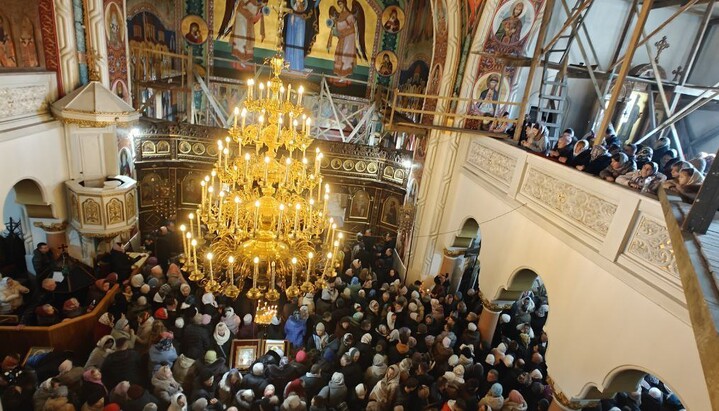
Voting at the St. Nicholas Parish of the UOC in Chernivtsi, February 23, 2025. Photo: Chernivtsi Eparchy
On February 23, 2025, the St. Nicholas Parish of the UOC in Chernivtsi held a religious community meeting. According to the Chernivtsi Eparchy’s press service on its Telegram channel, a massive congregation gathered in the church.
"The parishioners filled the entire church, all the balconies, the choir loft, the scaffolding, the lower church, the narthex, and many more stood outside with no room left to enter," the statement reads.
Parishioner Maria shared her emotions: "There were so many of us today, just like in the Church of the Holy Sepulchre when the Holy Fire descends. Such joy! Such joy!"
The diocese noted that a great number of believers gathered for the vote, choosing to remain steadfast in their Orthodox faith.
As previously reported, the St. Nicholas religious community of the UOC was set to discuss two key issues during the meeting:
- "The loyalty and commitment of our community to professing the Orthodox Faith as handed down to us by the Holy Fathers of the Ecumenical Councils – St. Nicholas the Wonderworker, St. Basil the Great, and St. Gregory the Theologian."
- "The loyalty and commitment of our community to professing the Orthodox Faith within the Ukrainian Orthodox Church under the leadership of His Beatitude Metropolitan Onuphry."
Read also
Met. Meletiy consecrates house of worship for UOC community in Dankivtsi
Members of the persecuted UOC Intercession parish in Dankivtsi have converted a house into a place for communal prayer and worship services.
OCU eparchy sells church center site to developer for housing
The OCU’s Volyn Eparchy sold land intended for a spiritual center to a private developer planning to build townhouses and residential buildings.
SBU names UOC priest’s wife a suspect in Cherkasy region
The SBU accused Matushka Kateryna Prykotenko of “spreading enemy propaganda” through correspondence with parishioners.
UGCC cleric calls Russian Orthodox literature dangerous for clergy
While examining the causes of divisions within the UGCC, Yustyn Boiko concluded that Russian Orthodox literature had influenced Greek Catholic clergy.
UOC will play major role in achieving peace, says Vadym Novynskyi
UOC Protodeacon Vadym Novynskyi believes the Church will help bring about reconciliation within Ukrainian society after the war ends.
Catholic media outraged by forcible conscription of Uniate cleric
The Vatican’s Apostolic Nunciature has demanded the return of a forcibly mobilized Greek Catholic cleric.