The Church сelebrates the Finding of the Head of John the Forerunner
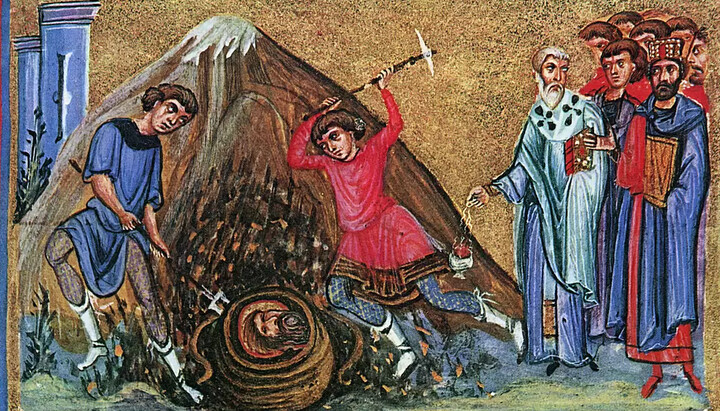
The Finding of the Head of John the Forerunner. Photo: Open Sources
March 9 (February 24 according to the Julian calendar), the Church commemorates the First and Second Finding of the Honorable Head of the Holy and Glorious Prophet, Forerunner, and Baptist of the Lord, John.
After the beheading of John the Forerunner by order of King Herod Antipas, his disciples secretly took and buried his body in Sebaste. However, according to tradition, the impious Herodias, at whose instigation the prophet's head was severed, did not allow it to be buried with the body. She buried the head in an unclean place within the palace. Only Herodias’ pious servant, Joanna, the wife of Chuza, Herod’s steward, knew of this. Moved by reverence, she secretly retrieved the sacred head from this dishonorable place, placed it in a clay vessel, and buried it on the Mount of Olives, in one of Herod’s estates.
The First Finding
Many years later, during the reign of Emperor Constantine the Great (4th century), when Christianity was no longer a persecuted religion, a pious landowner named Innocent decided to build a church on the Mount of Olives. While digging a trench for the foundation, a clay vessel containing the relic was discovered. Due to special signs and the fragrance emanating from the head, it was determined to be the head of John the Baptist.
Before his death, Innocent, fearing that the relic might be lost or desecrated during the time of Emperor Julian the Apostate, hid the head once again in the same place. After his passing, the church fell into neglect, and the location of the burial was forgotten.
The Second Finding
The second finding occurred at the end of the 4th – beginning of the 5th century. The story tells that Archimandrite Marcellus, abbot of the monastery on the Mount of Olives, received a vision of John the Forerunner, who revealed the location where his head was hidden. This happened in 452.
According to another version, the head was discovered by two pilgrim monks who also had a vision of John the Baptist. They found the vessel with the head and set off homeward. On the way, they encountered a poor potter from the Syrian city of Emesa (modern-day Homs) and, due to their exhaustion, entrusted him with the precious relic. The potter reverently kept the sacred treasure in his home and, before his death, placed it in a water jar and handed it over to his sister.
From this potter, the relic came into the possession of a monk named Eustathius, who was infected with the Arian heresy. He exploited the miraculous power emanating from the head to attract people to his false teaching. When his deception was exposed, he was expelled from the cave where he lived, and the cave became a dwelling place for pious monks, later developing into a monastery.
The Archbishop of Emesa, Uranios, received a vision revealing the location of the sacred relic. He solemnly transferred the head of John the Forerunner to a newly built church, where numerous miracles and healings began to occur through it.
The celebration of the First and Second Finding of the Head of John the Forerunner is one of the significant days in the Orthodox calendar, especially during Great Lent, when the faithful are particularly attentive to the theme of repentance, preached by the great prophet.
Read also
Upper Lavra court hearing postponed
The next court hearing in the Upper Lavra case has been scheduled for November 3.
UOC priest blesses ambulances at Kamianske medical center
A UOC priest in Kamianske blessed ambulances for a medical facility and wished its doctors God's help in their work.
Dumenko to German ambassador: Law targeting UOC also applies to other groups
Epifaniy Dumenko sought to defend Ukraine’s law restricting religious organizations during a meeting with the German ambassador.
Activists bused to court hearings in UOC cases, media say
A minibus has been spotted transporting protesters to and from courthouses where UOC cases are being heard.
Firefighters save historic UOC church from fire in Zakarpattia
A fire broke out at a UOC church in the Tiachiv district, damaging the altar and church furnishings.
Volyn Eparchy faithful collect six tons of aid for Sviatohirsk Lavra
Believers in Volyn collected food and warm clothing for people displaced by the war who have found shelter at Sviatohirsk Lavra.