National University discusses ways of combating UOC in Ukraine and abroad
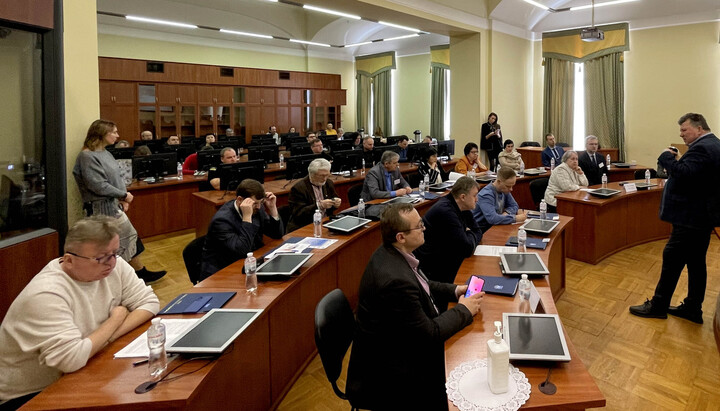
Participants of the conference on combating the UOC. Photo: National University website
From March 14 to 17, 2025, Kyiv National University named after Shevchenko hosted events under the title "Russia's Religious Policy as a Weapon of Hybrid Warfare: Implementation Directions and Counteraction Mechanisms," the university’s website reports.
The conference was organized by the Research Institute of Ukrainian Studies at KNU in partnership with the Office of the General Prosecutor, the Security Service of Ukraine (SBU), the Department of Religious Studies of the Institute of Philosophy of the National Academy of Sciences of Ukraine, the National Holodomor-Genocide Museum, with support from the All-Ukrainian Council of Churches and Religious Organizations, the State Service of Ukraine for Ethnopolitics and Freedom of Conscience, and several other institutions.
The conference program included four panel discussions:
- Legal challenges and strategies for counteracting Russia's religious policy in hybrid warfare;
- The ROC’s activities abroad: A network of churches as centers for spreading Russian propaganda and subversive operations;
- The ROC’s destructive activities and those of its affiliates in Ukraine:
- Non-Orthodox denominations in Russia following the ‘Russian World’ doctrine: Causes, motives, and consequences.
Speakers at the event included:
- Yaroslav Yurchyshyn (head of the Verkhovna Rada Committee on Freedom of Speech);
- Andriy Oleynyk (representative of the General Prosecutor's Office);
- Eduard Lytvynenko (expert from the Kyiv National Institute for Strategic Studies, known for writing expert opinions in the UOJ case);
- Roman Fedinyshyn and Oksana Serbinenko (representatives of the SBU);
- Religious scholars Serhii Shumylo and Oleksandr Sashan;
- UGCC cleric O. Petriv, and others.
Reports indicate that these speakers "shared interesting cases regarding the subversive activities of the Russian Church, its concealed strategies of influence on specific communities with the aim of destabilization."
Participants claimed that "such cases are increasingly occurring in EU countries" and labeled UOC parishes in the diaspora as "destructive agents of the ROC both abroad and in Ukraine."
According to the organizers, the discussions should lead to practical steps in two strategic directions:
- Improving legislation and procedural frameworks, ensuring public oversight over compliance with current laws and enforcement of court rulings.
- Broad public awareness efforts about the destructive role of the ROC and systematically presenting evidence of its subversive activities to European partners and the public.
Earlier, the UOJ reported that a Ukrainian MP accused UOC parishioners abroad of espionage due to their husbands' service in the Armed Forces of Ukraine.
Read also
Khust Eparchy honors memory of St. Job of Uholka
A Liturgy is served in Mala Uholka, a birthplace of St. Job of Uholka, on the saint's feast day.
UOC parish in Cologne donates ultrasound machine to Kharkiv region hospital
In Cologne, UOC believers raised funds for an ultrasound machine for the Kehychivka district hospital in the Kharkiv region.
Shevchuk tells Pope Leo of Ukraine's preparations for "another harsh winter"
The head of the UGCC expressed "special gratitude" to the Pope for his phone calls with Putin and Zelensky.
Berlin hierarch comments on Phanar document published by UOJ-USA
Metropolitan Mark called the information about the 2018 "Unification Council" alarming if confirmed, and expressed hope that Patriarch Bartholomew will reconsider his position.
UOC marks Synaxis of All Saints of Volyn Land at Lutsk cathedral
Metropolitan Serhiy of Ternopil and Kremenets led the Liturgy on the feast day of the Lutsk cathedral of All Saints of the Volyn Land.
SBU detains OCU cleric who organized draft evader's escape for money
In Transcarpathia, law enforcement officers detained a clergyman of the OCU who arranged for a draft evader to be smuggled into Slovakia for $15,000.