Yelensky avoids question on UOC cathedral “transfer” legality in Chernivtsi
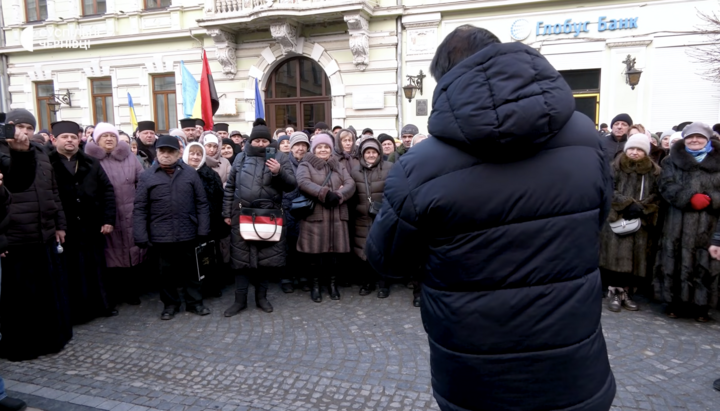
Unknown individuals voting to “transfer” the UOC cathedral in Chernivtsi to the OCU. Photo: Suspilne
Viktor Yelensky, head of Ukraine’s State Service for Ethnopolitics and Freedom of Conscience, failed to give a clear response when asked about the legitimacy of a gathering that claimed to “transfer” the Holy Spirit Cathedral of the Ukrainian Orthodox Church (UOC) in Chernivtsi to the Orthodox Church of Ukraine (OCU). This was evident in his interview published on the Suspilne portal.
When the journalist asked whether it was legal for city residents – unaffiliated with the parish – to vote on the jurisdictional status of the cathedral, Yelensky sidestepped the question.
“This, again, depends on the statute. It’s straightforward if there’s a list of community members. I know that such lists are now being approved in cities, and members of the community have specific rights and responsibilities in the church. This generally facilitates the functioning of a religious organization,” the ethnopolitics chief replied.
Rather than clarifying the legality of a specific gathering – where unknown individuals voted to transfer the Chernivtsi-Bukovyna diocesan cathedral to the OCU – Yelensky shifted the discussion to the law banning the Russian Orthodox Church.
“But what we’re really talking about is the law that bans the activities of the Russian Orthodox Church as a foreign organization. The law explains why it prohibits the ROC,” he said.
Elsewhere in the interview, Yelensky stated that, by law, only the religious community itself determines who its members are.
However, he did not comment on how a gathering held outside the church – while the actual religious community was holding its own meeting inside – could be considered legitimate.
To recap: on February 16, 2025, a gathering took place outside the gates of the Holy Spirit Cathedral in Chernivtsi, where unknown individuals, waving flags and shouting slogans like “Death to enemies!”, voted – without legal basis – to transfer three of the city’s main churches to the OCU. Parishioners later identified some of the participants as members of UGCC and OCU communities.
At the same time, inside the cathedral, 4,000 UOC parishioners voted to remain faithful to their Church. Similar votes were held in other UOC parishes across Chernivtsi.
Nonetheless, on February 26, 2025, three major UOC churches in Chernivtsi – Holy Spirit Cathedral, St. Nicholas Cathedral, and the Saints Peter and Paul Church – were re-registered under the name of OCU “bishop” Theognost (Yaroslav) Bodoriak.
It was later revealed that the illegal re-registration was carried out by Solomiya Hryniv, an official of the Lviv Regional Administration and an active supporter of the OCU. In 2024, Serhii Dumenko (Epifaniy) awarded her a certificate of merit “For Services to the OCU”.
Read also
Khust Eparchy honors memory of St. Job of Uholka
A Liturgy is served in Mala Uholka, a birthplace of St. Job of Uholka, on the saint's feast day.
UOC parish in Cologne donates ultrasound machine to Kharkiv region hospital
In Cologne, UOC believers raised funds for an ultrasound machine for the Kehychivka district hospital in the Kharkiv region.
Shevchuk tells Pope Leo of Ukraine's preparations for "another harsh winter"
The head of the UGCC expressed "special gratitude" to the Pope for his phone calls with Putin and Zelensky.
Berlin hierarch comments on Phanar document published by UOJ-USA
Metropolitan Mark called the information about the 2018 "Unification Council" alarming if confirmed, and expressed hope that Patriarch Bartholomew will reconsider his position.
UOC marks Synaxis of All Saints of Volyn Land at Lutsk cathedral
Metropolitan Serhiy of Ternopil and Kremenets led the Liturgy on the feast day of the Lutsk cathedral of All Saints of the Volyn Land.
SBU detains OCU cleric who organized draft evader's escape for money
In Transcarpathia, law enforcement officers detained a clergyman of the OCU who arranged for a draft evader to be smuggled into Slovakia for $15,000.