Orthodox сhurches to hold “Standing of St. Mary” services
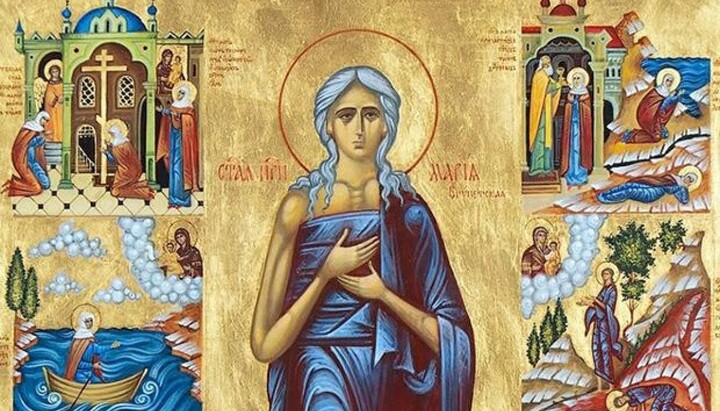
Icon of St. Mary of Egypt. Photo: open sources
On April 2, 2025, Orthodox churches will host a special Great Lent service known as the “Standing of St. Mary,” traditionally held during the fifth week of the Lenten period. Although according to the Typikon this service belongs to Thursday, it is commonly celebrated on Wednesday evening.
The defining feature of this Matins service is the full reading of the *Great Penitential Canon* of St. Andrew of Crete and the *Life of St. Mary of Egypt*. The Life is divided into two parts: the first is read after the *kathisma*, the second after the 3rd Ode of the Canon.
St. Mary of Egypt lived in the 6th century and is venerated for her remarkable journey of spiritual transformation. She spent the first 17 years of her youth in a life of immorality in Alexandria. One day, she joined a group of pilgrims traveling to Jerusalem for the Feast of the Exaltation of the Cross. As she attempted to enter the Church of the Holy Sepulchre, an invisible force prevented her. Realizing the depth of her sin, Mary prayed to the Mother of God in deep repentance and was then allowed to venerate the Cross. After this experience, she withdrew to the Jordanian desert, where she lived in complete solitude for 47 years in prayer and fasting, attaining great holiness.
The reading of the *Great Canon* of St. Andrew of Crete is the central element of this service. This practice is believed to have originated in the 9th century, linked to an earthquake that struck Constantinople on March 17, 790. During this disaster, the nuns of the Monastery of St. Patapius gathered in the city square and began chanting the Canon in repentance.
Eventually, the Great Canon became associated with remembrance of the earthquake, and by the second half of the 9th century, it was assigned to the Thursday of the fifth week of Lent.
Starting in the 11th century, the service for this day was supplemented with the *Life* and *troparia* in honor of St. Mary of Egypt. In her life, the saint embodied the ideal of true and profound repentance outlined by St. Andrew in his Canon.
Due to the length of the service and the fact that the Canon is listened to while standing, it came to be known as a *“standing”* service; and because of the reading of St. Mary’s Life, it became popularly known as the *“Standing of St. Mary.”* This term does not appear in official liturgical books, but is widely used colloquially and has even entered liturgical literature in the 21st century due to its popularity.
For believers, the *Standing of St. Mary* is a significant spiritual event that helps them reflect more deeply on the meaning of repentance and prepare for the celebration of Pascha.
Earlier, the UOJ reported that the Kyiv City Council addressed whether the curfew would be shortened for Pascha.
Read also
Zelensky says 9.5M Ukrainians expected to return home from abroad
Zelensky stated that 9.5 million Ukrainians who left abroad are expected to return home to rebuild the country.
German theologian criticizes Ukrainian authorities' pressure on UOC
German theologian Regina Elsner has said that pressure from the authorities on the Ukrainian Orthodox Church places an additional heavy burden on believers during the war.
Poland bans entry to Lviv official over SS Galicia and UPA glorification
Polish Foreign Minister initiates entry ban on Lviv Regional Council deputy who proposed declaring 2027 the Year of the UPA.
OCU award winners stage provocations at UOC court hearings, media report
Rallies outside courts hearing UOC cases are organized by activists who received awards from Dumenko.
Khust Eparchy priest who shot people in Vyshkovo banned from ministry
The Khust Eparchy of the UOC has notified police that it has banned from ministry a priest suspected of killing three people in Vyshkovo, Transcarpathia.
Metropolitan Onuphry congratulates Georgia on 1,700 years of Christianity
The Primate of the UOC sent a message to Patriarch Shio III on the anniversary of Christianity becoming the state religion in Georgia.