Serbian priest condemns “examination” of relics in Kyiv Pechersk Lavra
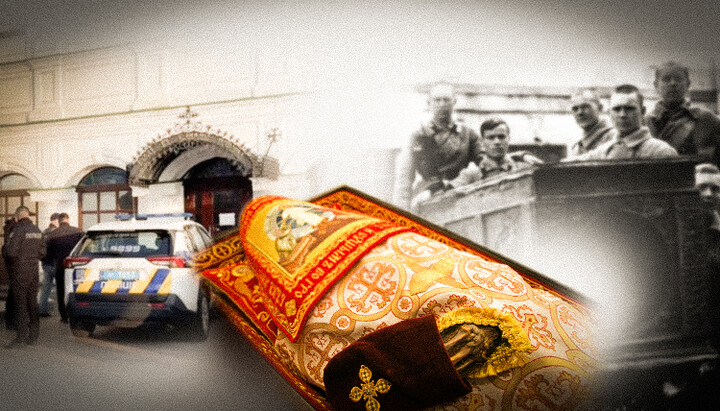
Serbian priest condemns “examinations” of relics in the Lavra. Photo: UOJ
A priest of the Serbian Orthodox Church, Fr. Siniša Buvač, strongly condemned the actions of the commission that arrived at the Kyiv Pechersk Lavra on March 28 to “inventory and inspect” the holy relics. The statement was reported by the Serbian edition of the Union of Orthodox Journalists.
“I was genuinely shocked by this news. I have friends from Kyiv and Montenegro who were there just before the monks were expelled from the Kyiv Pechersk Lavra,” Fr. Siniša shared in an interview with the UOJ.
The priest categorically disagreed with claims that the monastery and its sacred items are state property. “Why expel the monks and attack the Church? I see no reason except political ones. Politics must be separated from the Church, and the Church from politics,” he emphasized.
According to Fr. Siniša, touching relics for the sake of “scientific research” constitutes a religious crime. “It is unacceptable, dear brothers and sisters in Christ Jesus, our Lord, to desecrate God’s sanctity. Empires may exist, but they all come to an end. Everything has an expiration date – except for the Lord Jesus Christ,” he stated.
He compared the situation at the Kyiv Pechersk Lavra to attacks on Serbian Orthodox Church shrines in Montenegro, Republika Srpska, and Kosovo and Metohija. He recalled an incident in Trebinje during the communist era, when an icon of the Most Holy Theotokos was confiscated and began to weep blood. “They examined it and found nothing. The DNA was unknown, and the substance – unidentifiable. No chemical code exists to explain it,” the priest recounted.
The situation at the Lavra is especially painful for Fr. Siniša, who once spent the night in its catacombs. “I was deeply moved, I felt like the disciples of Christ who gathered to pray at the tombs of the righteous. As a clergyman, I cannot justify these actions. Though I belong to the Serbian Orthodox Church, it doesn’t matter whether the voice comes from a Serbian, Greek, or Russian priest – we are all Orthodox Christians. The desecration of relics is a grave sin,” he stressed.
He emphasized that people should not focus on confessional labels, but instead “love their own and respect others.” “Whoever respects their own will never lose their identity,” he added, recalling his own experience defending church property of the Serbian Orthodox Church with the help of people from various faiths.
Fr. Siniša concluded by calling on the faithful to pray to the saints and return sacred objects to their rightful place. “Let us forgive one another, even if someone has wronged us... One should never tamper with relics or sacred things, and no one who desecrated the saints or sacred objects has ever ended well,” the priest concluded.
Previously, the UOJ reported that the monks of Mount Athos had condemned the desecration of relics in the Kyiv Pechersk Lavra.
Read also
Khust Eparchy honors memory of St. Job of Uholka
A Liturgy is served in Mala Uholka, a birthplace of St. Job of Uholka, on the saint's feast day.
UOC parish in Cologne donates ultrasound machine to Kharkiv region hospital
In Cologne, UOC believers raised funds for an ultrasound machine for the Kehychivka district hospital in the Kharkiv region.
Shevchuk tells Pope Leo of Ukraine's preparations for "another harsh winter"
The head of the UGCC expressed "special gratitude" to the Pope for his phone calls with Putin and Zelensky.
Berlin hierarch comments on Phanar document published by UOJ-USA
Metropolitan Mark called the information about the 2018 "Unification Council" alarming if confirmed, and expressed hope that Patriarch Bartholomew will reconsider his position.
UOC marks Synaxis of All Saints of Volyn Land at Lutsk cathedral
Metropolitan Serhiy of Ternopil and Kremenets led the Liturgy on the feast day of the Lutsk cathedral of All Saints of the Volyn Land.
SBU detains OCU cleric who organized draft evader's escape for money
In Transcarpathia, law enforcement officers detained a clergyman of the OCU who arranged for a draft evader to be smuggled into Slovakia for $15,000.