UOC spokesman: Our faithful treat OCU and Uniates better than they treat us
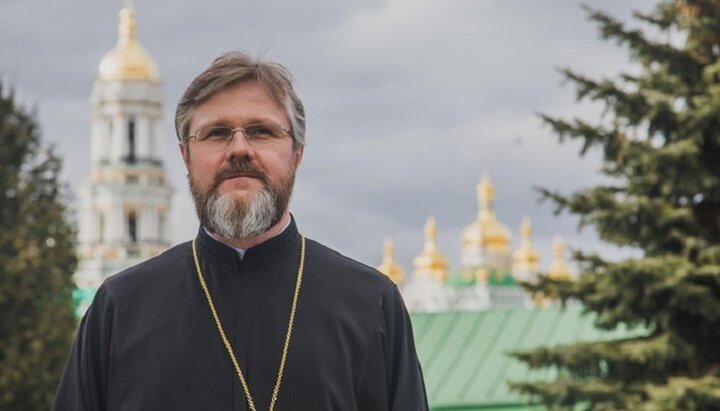
Archpriest of the UOC Nikolai Danilevich. Photo: UOJ
Archpriest of the UOC Nikolai Danilevich participated in the meeting of the Razumkov Center. He announced this on his Facebook page. Sociologists presented the results of a large-scale study of the religious situation in the country, which the priest commented on.
“It is clear that this is more a sociology of sympathy than the actual number of believers by confession, but there are many other interesting questions in the research, the answers to which are very interesting,” writes Archpriest Nikolai Danilevich.
Particular attention of the speaker of the UOC was drawn to the Informational Materials page, which speaks about the attitude of the faithful of different confessions to each other.
“While a positive attitude of those who are faithful to the UOC (MP) towards the OCU prevails over a negative one (42% and 12%), the share of those loyal to the OCU who feel negative in relation to the UOC (MP) prevails (29% and 37% ), on the contrary,” the priest quotes the edition.
He draws attention to the analysis of relations between the faithful of the UOC and the UGCC.
“The UGCC faithful (respectively 10% and 53%) have an even more negative attitude towards the UOC (MP), while the vast majority (76%) of the UGCC faithful have a positive attitude towards the OCU (2% of those who have a negative attitude). In turn, the faithful of the OCU are predominantly positive towards the Greek Catholics (respectively 46% and 5%). A positive attitude towards Greek Catholics also prevails (although not so clearly) among the faithful of the UOC (MP) (30% and 3%, respectively), Fr. Nikolai notes.
Archpriest Nikolai Danilevich is sure that the statements that are sometimes made by opponents about the UOC in cultivating hatred for others are unfair. The numbers show a very different picture.
“I think this is also the result of the work of our local priests. It is nice that a Christian attitude is being brought up (or at least there is no hostility) towards people of other faiths, even though representatives of other faiths have a different attitude towards us,” writes the priest.
In his opinion, the problem of the negative attitude of the faithful of the OCU and the UGCC towards the UOC lies in the information war in the media and the pitting of confessions.
“I think that the media, in general, need to reduce the degree of hatred so as not to turn people against each other. Although not the last factor is the attitude of the clergy of those confessions towards the UOC, namely what they say to their faithful,” sums up the spokesman of the UOC.
Earlier, the UOJ wrote that the head of the Ukrainian Greek Catholics, Sviatoslav Shevchuk, spoke about the plan to unite the UGCC and the OCU.
Read also
Metropolitan Onuphry congratulates Georgia on 1,700 years of Christianity
The Primate of the UOC sent a message to Patriarch Shio III on the anniversary of Christianity becoming the state religion in Georgia.
Zakarpattia marks 25th anniversary of Alexis of Carpatho-Russia's glorification
An all-night vigil was served at St. Nicholas Monastery in the village of Iza-Karputlash to celebrate the 25th anniversary of the glorification of St. Alexis of Carpatho-Russia.
DESS finds Balta Eparchy of UOC affiliated with ROC
Yelensky-headed state service said it found signs of affiliation of the Balta Eparchy Administration of the UOC with the ROC.
Upper Lavra court hearing postponed
The next court hearing in the Upper Lavra case has been scheduled for November 3.
UOC priest blesses ambulances at Kamianske medical center
A UOC priest in Kamianske blessed ambulances for a medical facility and wished its doctors God's help in their work.
Dumenko to German ambassador: Law targeting UOC also applies to other groups
Epifaniy Dumenko sought to defend Ukraine’s law restricting religious organizations during a meeting with the German ambassador.