Video online explores the connection between mathematics and faith in God
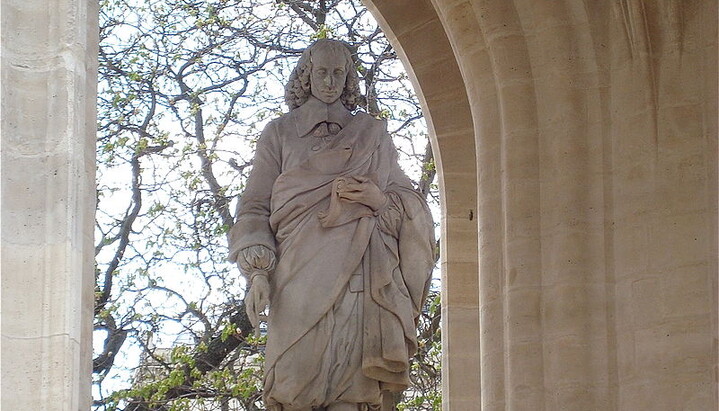
Statue of Blaise Pascal in Paris. Photo: open sources
On April 27, 2025, the DOGMA HACKER YouTube channel published a video titled “Mathematics – The Language of God: Why Great Mathematicians Were Not Atheists.” The creators highlight that many great scientists were deeply religious and regarded mathematics as an expression of Divine order.
The video notes that Isaac Newton believed he was not merely studying physical laws but uncovering the design of the Creator. He spent years studying Holy Scripture, convinced that God had left clues within it. For Newton, each formula was a bridge between Earth and Heaven.
“I do not know what the world was like before it was created, but I am certain it was created according to the laws I study.” – Isaac Newton
Blaise Pascal, the inventor and mathematician, argued that if God exists, you gain everything; if He does not, you lose nothing. His famous “Pascal’s Wager” was not just a clever argument but a deeply personal conviction of a man seeking God with both reason and heart. Kurt Gödel, the author of the incompleteness theorem that shook the foundations of mathematics, even proposed a formal proof for the existence of God. For Gödel, logic and faith were not mutually exclusive but complementary.
“Mathematics is not merely an art – it is a means by which we strive to understand the nature of God.” – Kurt Gödel
The creators of the video argue that these minds were not exceptions. Rather, it was the depth of their thought that led them to believe in a Creator, since mathematical laws are universal and omnipresent.
The video challenges the popular myth that scientific progress and religious belief are incompatible. Statistics suggest otherwise. According to studies by the Pew Research Center and the U.S. National Academy of Sciences, 30–40% of scientists believe in God or acknowledge the existence of a higher intelligence.
The video also points out that atheism among scientists often stems not from logic but from cultural or personal experiences. Some lose faith due to disappointment or negative life experiences, not because of scientific discoveries per se.
The video references several Nobel Prize laureates who have openly spoken about their faith. Werner Heisenberg, a founder of quantum mechanics and a Christian, believed that science helps us understand God rather than deny Him. Arthur Compton, a physics laureate, stated:
“The more we study nature, the more we see evidence that behind its laws stands a Mind.”
Charles Townes, inventor of the laser and Nobel Prize winner in physics, asserted that science and religion are two sides of the same coin – both striving for truth.
In conclusion, the authors say that for many scientists, faith is a logical result of contemplating the order and beauty of the universe.
Earlier, the UOJ reported on church-led projects in England dedicated to exploring the connection between science and religion.
Read also
Upper Lavra court hearing postponed
The next court hearing in the Upper Lavra case has been scheduled for November 3.
UOC priest blesses ambulances at Kamianske medical center
A UOC priest in Kamianske blessed ambulances for a medical facility and wished its doctors God's help in their work.
Dumenko to German ambassador: Law targeting UOC also applies to other groups
Epifaniy Dumenko sought to defend Ukraine’s law restricting religious organizations during a meeting with the German ambassador.
Activists bused to court hearings in UOC cases, media say
A minibus has been spotted transporting protesters to and from courthouses where UOC cases are being heard.
Firefighters save historic UOC church from fire in Zakarpattia
A fire broke out at a UOC church in the Tiachiv district, damaging the altar and church furnishings.
Volyn Eparchy faithful collect six tons of aid for Sviatohirsk Lavra
Believers in Volyn collected food and warm clothing for people displaced by the war who have found shelter at Sviatohirsk Lavra.