"Dogma Hacker" explains how to recognize occultists in temple
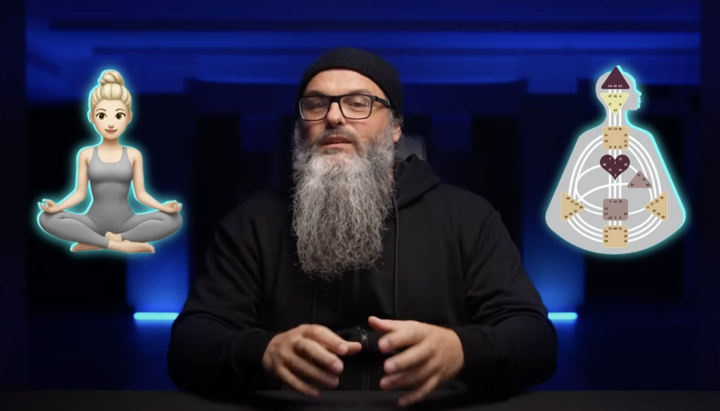
"Dogma Hacker" warns against "Orthodox" occultism. Photo: YouTube channel "Dogma Hacker"
The author of the popular Orthodox YouTube channel "Dogma Hacker" released a video material warning about the widespread occurrence of occult practices among church people and providing recommendations for recognizing them.
According to the channel's author, occultism in churches is encountered much more frequently than is commonly thought. Among the parishioners, one can find people interested in cosmoenergetics, human design, regression therapy, transcendental meditation, and other esoteric practices.
The church blogger presented a "checklist" for identifying people with occult thinking:
1. Religious relativism. The first alarming signal is statements that Orthodoxy is just one of the religions, and "God is one everywhere" and "all religions are different paths to Him". This position, according to the author, indicates "a complete misunderstanding of the essence of the Orthodox faith by the person."
2. Occult vocabulary. The use of terms like "higher self," "egregor," "thought form," and similar concepts invented by open occultists. The channel's author particularly warns against the concept of "higher self," which, according to Helena Blavatsky's teachings, implies the embodiment of some spirit in a person.
3. Flattering compliments and "insights". People who claim to see "super abilities" or "gifts" in others pose a special danger. "A person who says they see some gift in you may indeed see something," notes the author, but emphasizes that such people "are in deep delusion" and "are in contact with demons".
4. Pseudoscience. The use of scientific terms in an anti-scientific context: "neutrinos", "torsion fields", "vibrations", wrapped in "a halo of spirituality". The channel's author urges: "If you don't understand how it works completely – don't try it."
5. Hard-heartedness. Occultists perceive God not as a personality, but as a "faceless absolute" that can be manipulated. This leads to a lack of true mercy and contempt for "low-vibrating" unfortunate people.
The danger of "Orthodox" occultists
Particular concern for the church blogger arises from the fact that carriers of an occult worldview can receive communion in Orthodox churches for years. He explains this by stating that people "who are in delusion do not understand that they are sinning against the Lord and therefore may not confess their fascination with their murky practices at all."
At the same time, the priest quotes the Apostle Paul about the possibility of communion "to condemnation": "Whoever eats and drinks unworthily eats and drinks condemnation to himself, not discerning the Lord's body."
"DogmaHacker" advises believers:
- to study the primary sources of any proposed practices;
- to remember that "difficulties are given to us for spiritual growth," not for solving "with the help of magic";
- to follow the call of the Apostle John the Theologian to "test the spirits, whether they are of God";
- to remember that "the best vaccine against all temptations of occult practices is the ability to trust God plus taking responsibility for one's own life".
Earlier, the UOJ reported that "Dogma Hacker" spoke about the connection between mathematics and faith in God.
Read also
Khust Eparchy honors memory of St. Job of Uholka
A Liturgy is served in Mala Uholka, a birthplace of St. Job of Uholka, on the saint's feast day.
UOC parish in Cologne donates ultrasound machine to Kharkiv region hospital
In Cologne, UOC believers raised funds for an ultrasound machine for the Kehychivka district hospital in the Kharkiv region.
Shevchuk tells Pope Leo of Ukraine's preparations for "another harsh winter"
The head of the UGCC expressed "special gratitude" to the Pope for his phone calls with Putin and Zelensky.
Berlin hierarch comments on Phanar document published by UOJ-USA
Metropolitan Mark called the information about the 2018 "Unification Council" alarming if confirmed, and expressed hope that Patriarch Bartholomew will reconsider his position.
UOC marks Synaxis of All Saints of Volyn Land at Lutsk cathedral
Metropolitan Serhiy of Ternopil and Kremenets led the Liturgy on the feast day of the Lutsk cathedral of All Saints of the Volyn Land.
SBU detains OCU cleric who organized draft evader's escape for money
In Transcarpathia, law enforcement officers detained a clergyman of the OCU who arranged for a draft evader to be smuggled into Slovakia for $15,000.