The Church reveres Equal-to-the-Apostles Saints Cyril and Methodius
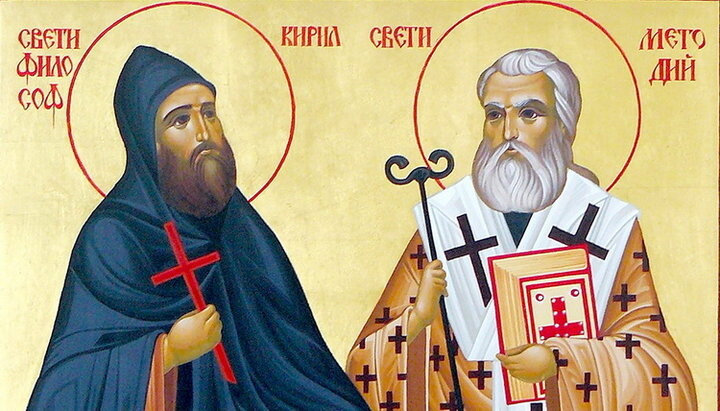
Icon of Saints Cyril and Methodius. Photo: Barikáda
On May 24 (May 11 according to the Julian calendar), the Church celebrates the Feast of the Holy Equal-to-the-Apostles Cyril and Methodius – the Enlighteners of the Slavic peoples and the creators of the Slavic alphabet.
Origins and Early Life
The holy brothers were born in the Byzantine city of Thessalonica (modern-day Thessaloniki, Greece) into the family of a military commander named Leo. Constantine (later Cyril) was born around the year 827, and his elder brother Methodius around 815. Their father held a high position in the imperial administration, which allowed the children to receive an excellent education.
The younger brother, Constantine, showed exceptional aptitude for science and languages from an early age. He received an outstanding education in Constantinople, studying philosophy, dialectics, rhetoric, mathematics, and astronomy. For his scholarly achievements, he earned the title “Philosopher.” Methodius pursued a military career and for some time served as a governor in a Slavic region, which gave him familiarity with the Slavic languages and customs.
Monastic Path and Missionary Work
Both brothers embraced monastic life in their adulthood. Methodius became abbot of the Polychron Monastery on the Asian shore of the Sea of Marmara, while Constantine taught philosophy in Constantinople and participated in theological debates.
In 860, the brothers were sent by Emperor Michael III on a religious mission to the Khazar Khaganate. Later, in 863, they received a special commission to travel to Great Moravia at the request of Prince Rastislav, who had asked for teachers capable of preaching in the Slavic language.
Mission in Great Moravia
Great Moravia was a medieval Slavic state that existed in the 9th–10th centuries on the territory of present-day Czech Republic, Slovakia, and parts of Hungary, Poland, and Austria. Today, this region includes Moravia – now the eastern part of the Czech Republic, with Brno as its center – where Cyril and Methodius are especially venerated as national saints and enlighteners.
Creation of the Slavic Alphabet
In preparation for their mission to Moravia, the brothers created the first Slavic alphabet – Glagolitic – based on Greek script but adapted to represent the sounds of the Slavic language. They translated the core liturgical texts into Slavic, including the Gospel, the Epistles, the Psalter, and other church books.
Their ministry in Moravia lasted over three years. They taught literacy, conducted services in the Slavic language, and ordained local clergy. However, their efforts faced resistance from the German clergy, who insisted on the exclusive use of Latin in worship.
Final Years and Legacy
In 867, the brothers traveled to Rome to seek support from Pope Adrian II. The pope approved their mission and blessed the liturgical books they had translated. Constantine took monastic vows under the name Cyril and reposed in Rome on February 14, 869, at the age of 42. Methodius was consecrated Archbishop of Moravia and Pannonia and continued his missionary work until his death on April 6, 885.
Through the labors of Cyril and Methodius, the Slavic peoples were able to learn the Christian faith in their native language, which fostered literacy and cultural development. Their disciples brought Slavic literacy to Bulgaria, from where it spread to Serbia, Rus’, and other Slavic lands.
The Feast Day of the Holy Equal-to-the-Apostles Cyril and Methodius is observed on May 24 (New Calendar) and is one of the important commemorations in the Orthodox Church. In several Slavic countries, this day is also celebrated as a national holiday of literacy and culture.
Previously, the UOJ published 10 facts about Saints Cyril and Methodius.
Read also
SBU told Phanar many UOC bishops would join OCU in 2018, report says
According to a Phanar representative’s account, Ukrainian security services told the Constantinople delegation that many UOC representatives were prepared to attend the OCU’s “Unification Council.” In the end, only two did.
Catholic cardinal visits Ukrainian POWs during trip to Russia
During three days of consultations in Moscow, Cardinal Matteo Zuppi discussed prospects for ending the war in Ukraine.
Ukrainians help restore Serbian Orthodox church in Paris
Orthodox Ukrainians have become regular parishioners of St. Sava Church in Paris and have taken part in its restoration.
Bulgarian Church clergy and laity oppose Phanar head’s visit
More than 2,000 clergy and laity have called for the Ecumenical Patriarch’s visit to be canceled, citing disagreement with his actions and concerns that the visit could legitimize schism.
Unknown intruders break down doors at two UOC churches in Sloviansk
Archbishop Paisiy said OCU activists are suspected of breaking into the churches in Sloviansk, and police have launched an investigation.
Sviatohirsk Lavra prays for murdered monk on 40th day after death
The brethren of the Sviatohirsk Lavra held a memorial service for murdered Monk Varsonofiy, calling on the faithful to pray for the newly departed monk.