OCU: To steal and seize
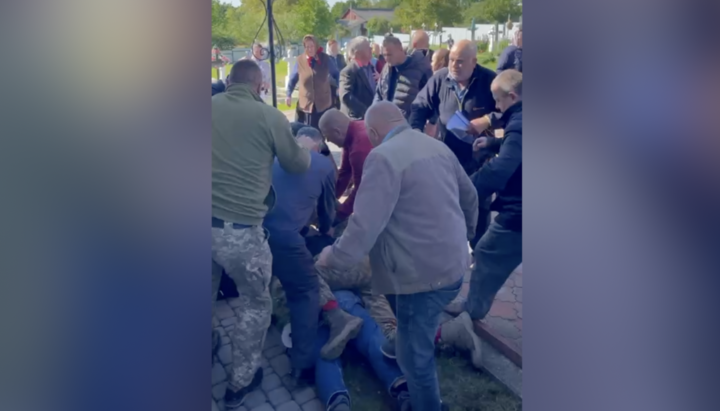
In Zabolottia, chaplains and men in camouflage beat one of the parishioners. Photo: UOJ
In recent months, the epicenter of church seizures targeting the Ukrainian Orthodox Church (UOC) has shifted to Bukovina. Nearly every week, in one village or another, we witness attacks and violence orchestrated by the same traveling "chaplain corps" of OCU clergy, led by Roman Hryshchuk. Sometimes they are reinforced by radical militants from the Ivano-Frankivsk region. Lately, however, even these aren’t needed – the police now provide the muscle for church raids.
The scheme is always the same.
Stage One: The "chaplain corps" arrives in a village with a crowd to stage a vote on transferring the local church to the OCU. Sometimes they manage to find a few local supporters – a dozen or two – but often they rely entirely on outsiders. The real parish community is barred from the vote.
Stage Two: Forged documents concerning the supposed "transfer" are handed over to corrupt registrars, who promptly re-register the parish under the OCU.
Stage Three: The “chaplains” launch a violent assault or break in during the night – depending on the local UOC community’s resistance.
And here one has to wonder – what does any of this have to do with the law?
By law, it is the members of a specific church community – those who regularly confess, commune, and participate in parish life – who gather and decide whether or not to change jurisdiction.
But in video footage from villages across Bukovina (and beyond), we see a very different picture: parishioners defending their church from complete outsiders, who arrive with angle grinders, knives, bolt cutters, crowbars, and other tools, attempting to force entry into churches to which they have absolutely no connection.
Clergy – or at least, people in cassocks – are seen punching and kicking believers, throwing them to the ground, and engaging in other acts of violence utterly unthinkable for anyone claiming to be a clergyman.
Were it not for today’s political climate, we might say outright that these individuals have nothing to do with the priesthood – they are simply thugs and street gangs in robes. But given that even a sidelong glance at the OCU can now result in treason charges, we will refrain.
On the other hand, it may be appropriate here to recall Richard Patterson’s famous “duck test”:
“If it looks like a duck, swims like a duck, and quacks like a duck – then it probably is a duck.”
Read also
Who destroyed and restored Kyiv Lavra? MinCulture's video reveals the truth
The Culture Ministry’s propaganda about the Kyiv-Pechersk Lavra has inadvertently revealed the truth.
Ternopil post on Feast of Intercession: Has calendar reformn failed?
A significant number of believers have rejected the new church calendar introduced by the OCU and UGCC with government support.
Shoulder straps or a cassock: who writes the script for UOC "fighters"?
Everything indicates that both Veliar and Pshenychny are ordinary performers of someone else's script. There is only one question – does the scriptwriter wear shoulder straps or a cassock?
Why is it legal to kill a person before birth but not after?
Children are the most privileged members of society. Yet that same society officially permits children to be killed – and on a massive scale.
Honoring the Bolsheviks’ successors at Kyiv Lavra
It was under the Reserve that the relics of the saints were desecrated, Lavra churches were turned into an atheism museum, and toilets were installed in sanctuaries.
"Degenerates" and "stupid animals": anti-UOC activists turn on children
Future historians will wonder how a vast country’s information agenda could have been shaped for so long by people so petty, vicious, and utterly contemptible.