Festive cross procession held in Belgrade on the Feast of the Ascension
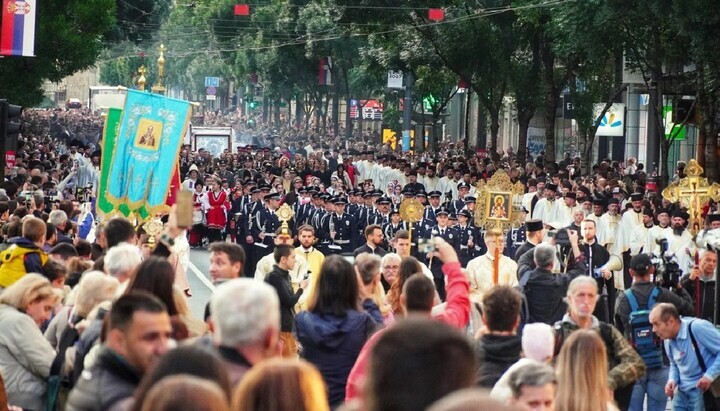
Photo: Religious procession in Belgrade. Source: UOJ Serbia
On May 29, 2025, the capital of Serbia hosted the traditional Spasovdan (Ascension Day) procession, made especially significant this year by the presence of the holy relics – the left hand of Saint Sava, the first Archbishop of Serbia, brought from the Mileševa Monastery, reports UOJ Serbia.
A Procession with Centuries of History
The celebration of the Ascension of the Lord has ancient roots. The tradition began in 1403, when Despot Stefan Lazarević moved the capital of Serbia to Belgrade. After the liberation from Ottoman rule in 1862, the procession tradition was revived and continues to this day.
The procession is traditionally led by the Patriarch, bishops, clergy, and monastics from various eparchies. This year, the honor of carrying the holy cross was given to Renato Grbić – a fisherman and restaurant owner who has saved thirty-three people from the waters of the Danube.
A Symbol of Endurance and Faith
The procession made its way from the Church of the Ascension to the Church of Saint Sava in Vračar, where the majestic bells rang to announce the arrival of the faithful. A new route, established in 2021, allows more people to join the evening procession.
For the Serbian people, Spasovdan is a symbol of rising from the ashes, unwavering hope, and steadfast faith. As an old church banner from 1938 reads: “Whoever celebrates the name of the Cross – it will protect and help them.”
Remembering the City’s Defenders
The prayer stops along the route hold deep meaning: at the Terazije Fountain, prayers are offered for the health of the people; at the Patriarchal Palace – for peace and prosperity; and at the Church of the Ascension – for the repose of the souls of Belgrade’s fallen defenders.
Belgrade, as a hero city, has received some of the highest honors for its bravery in war: the Karađorđe’s Star with Swords in 1939 and the French Legion of Honor in 1924 – an award given to only five cities in the world for exceptional heroism.
This tradition has not been interrupted even during the darkest times – not during the war years of 1941–1945, nor during the NATO bombings. The only exception was the year 2020, when pandemic restrictions forced the celebration to be held in a smaller format.
After the tradition was banned by the communist authorities in 1947, it was revived in 1992 by the late Patriarch Pavle, who lovingly and patiently restored Orthodox traditions among the people of Belgrade.
Today, the Church of Saint Sava in Vračar – one of the largest churches in the world – stands as a symbol of Orthodoxy and of the Serbian people’s fidelity to their roots, built on the very spot where the Turks once burned the relics of the saint in an attempt to break the Serbian spirit.
Earlier, the UOJ reported that the Serbian Patriarch explained why he granted autocephaly to the Macedonian Church.
Read also
Metropolitan Onuphry congratulates Georgia on 1,700 years of Christianity
The Primate of the UOC sent a message to Patriarch Shio III on the anniversary of Christianity becoming the state religion in Georgia.
Zakarpattia marks 25th anniversary of Alexis of Carpatho-Russia's glorification
An all-night vigil was served at St. Nicholas Monastery in the village of Iza-Karputlash to celebrate the 25th anniversary of the glorification of St. Alexis of Carpatho-Russia.
DESS finds Balta Eparchy of UOC affiliated with ROC
Yelensky-headed state service said it found signs of affiliation of the Balta Eparchy Administration of the UOC with the ROC.
Upper Lavra court hearing postponed
The next court hearing in the Upper Lavra case has been scheduled for November 3.
UOC priest blesses ambulances at Kamianske medical center
A UOC priest in Kamianske blessed ambulances for a medical facility and wished its doctors God's help in their work.
Dumenko to German ambassador: Law targeting UOC also applies to other groups
Epifaniy Dumenko sought to defend Ukraine’s law restricting religious organizations during a meeting with the German ambassador.