Poltava Eparchy offers prayers on anniversary of mass clergy execution
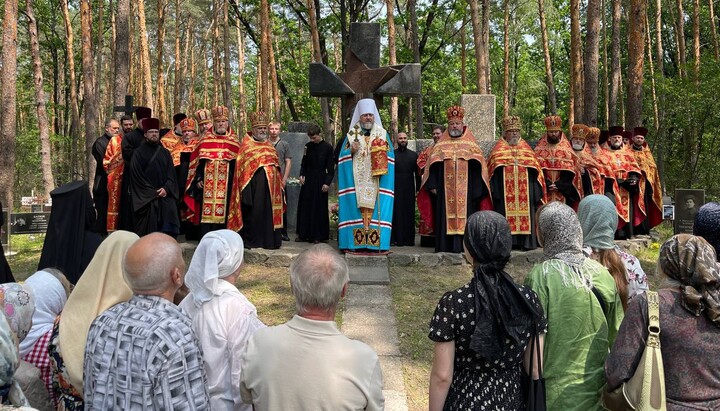
The 87th anniversary of the mass execution of the Poltava clergy in the Triby tract near Poltava. Photo: Poltava Eparchy
On June 2, 2025, on the 87th anniversary of the mass execution of the Poltava clergy in the Triby tract near Poltava, Metropolitan Philip of Poltava and Myrhorod led the Divine Liturgy and memorial service, reports the press service of the Poltava Eparchy.
During the service at the St. Macarius Cathedral in Poltava, the metropolitan was concelebrated by the clergy of the Poltava Eparchy.
During the Liturgy, special prayers were offered for peace in Ukrainian land.
At the end of the service, the clergy, led by the bishop, performed a memorial litany.
After the services, the hierarch and the priests of the eparchy went to the Triby tract near Poltava, where they served a memorial service for all those executed for the faith of Christ during Soviet times.
Metropolitan Philip addressed the clergy and laity with words of guidance, thanked them for their joint prayer, and blessed everyone.
The authorities repressed Ukrainian intelligentsia, clergy, and so-called unreliable individuals. People were deprived of voting rights, "dekulakized" (refers to the Soviet policy of "dekulakization", which was the forced elimination of kulaks, wealthier peasants, as a class) and then simply exterminated. Later, the repressions spread to broader segments of the population. Even party workers and NKVD officers became victims. The Poltava region is one of the most affected by Stalin's totalitarian regime policies. According to historians, starting from 1929, more than 400,000 residents were repressed in the Poltava region.
The memorial sign for the victims of repression in the Triby tract is the only one in Poltava. It was erected in 1995 after, in the early 90s, during excavations in a nearby quarry, human remains were found. Experts and scientists established that these people were executed. The authorities decided to bury the bodies in one place and erect a memorial sign for the victims of the 1930s repressions.
As reported by the UOJ, the foundation of a church destroyed by the Bolsheviks was accidentally found in Poltava.
Read also
UOC hierarch celebrates Liturgy at relics of St. Nicholas in Bari
Archbishop Ambrose of Zghurivka, UOC clergy serving in Italy, and KDAiS students prayed at the myrrh-streaming relics of St. Nicholas the Wonderworker in Bari.
Police pledge increased security at UOC Kyiv Metropolia court hearing
UOC lawyers secured additional police presence following repeated provocations and direct pressure on the legal team outside the courthouse.
“Imperialist”: OCU cleric explains why Hieromartyr Vladimir is not venerated
An OCU representative claimed that Hieromartyr Vladimir supported “imperial policies” and was killed over money rather than for his faith in Christ.
Metropolitan Nektarios: Global system seeks to create “universal religion”
The Greek hierarch warned of the dangers posed by the global system.
OCU supporters stage provocation at soldier’s funeral in Polytsi
Relatives of the fallen soldier demanded that an OCU cleric conduct the funeral service inside a UOC church.
UOC Chancellor on OCU formation report: pressure, fear and suspicion
Metropolitan Anthony says the atmosphere of December 2018 described in the Phanar cleric’s report was the complete opposite of the love and freedom in which the Holy Spirit works.