Islamists in Nigeria slaughter 200 Christians
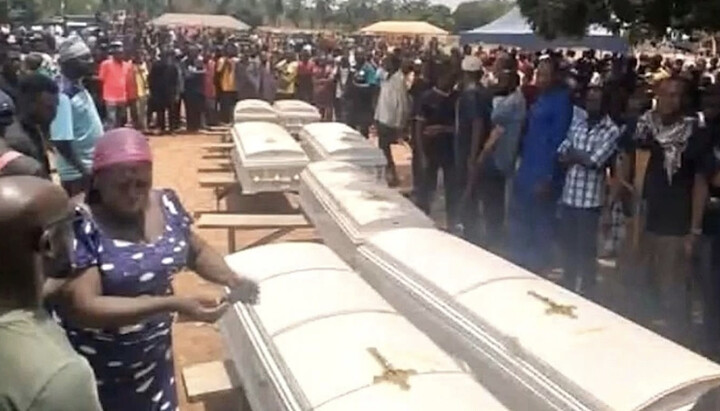
Burial of murdered Christians in Nigeria. Photo: christianpost.com
On the evening of Friday, June 13, a massacre of Christians took place in Benue State, Nigeria, with the death toll possibly reaching 200, according to the Catholic charity Aid to the Church in Need (ACN), referred to by Christian Post.
The attack occurred in the town of Yelewata, where internally displaced persons had previously sought refuge after fleeing violence by radicalized Islamist members of the Fulani herder tribe.
Eyewitnesses report that the militants attacked the camp, set up in a market square, shouting "Allahu Akbar." They set fire to the buildings where people were sleeping and opened fire on those trying to flee. Those who managed to run were hunted down and killed with machetes.
“When we heard the shots and saw the militants, we committed our lives to God. This morning, I thank God I am alive," parish priest, Father Ukuma Jonathan Angbianbee, told ACN. Angbianbee said he and others dropped to the floor of the church’s presbytery when they heard the shots fired. “What I saw was truly gruesome. People were slaughtered. Corpses were scattered everywhere.”
At the time of the attack, St. Joseph’s Church was sheltering over 700 people. Clergy report that police had previously repelled an attempt to storm the church.
Amnesty International Nigeria reports at least 100 people killed and hundreds more wounded, many of whom were left without medical assistance. The Catholic Diocese of Makurdi estimates the death toll at closer to 200, making this the deadliest tragedy in the region in recent years.
“The death toll makes it the single worst atrocity in the region, where there have been a sudden upsurge in attacks and increasing signs that a concerted militant assault is underway to force an entire community to leave,” the ACN report states.
According to ACN, attacks on Christians in Benue have intensified. In just the past three weeks, 100 people have been killed in Gwer West district, and over 5,000 have become displaced. The violence is occurring amid widespread population displacement, which some church leaders believe may be part of a deliberate campaign of ethnic and religious cleansing.
According to a Global Christian Relief report published in January 2025, nearly 10,000 Christians were killed in Nigeria between November 2022 and November 2024.
Christian farming communities in Nigeria’s central “Middle Belt” remain particularly vulnerable. While not all members of the Fulani ethnic group espouse extremist ideologies, a portion are linked to radical beliefs similar to those of ISIS and Boko Haram.
International human rights organizations continue to call on the global community to pay attention to the ongoing violence, pointing to signs of genocide.
The UOJ previously reported that Boko Haram Islamists had killed seven Christians during a worship service in Nigeria.
Read also
Ukrainians help restore Serbian Orthodox church in Paris
Orthodox Ukrainians have become regular parishioners of St. Sava Church in Paris and have taken part in its restoration.
Bulgarian Church clergy and laity oppose Phanar head’s visit
More than 2,000 clergy and laity have called for the Ecumenical Patriarch’s visit to be canceled, citing disagreement with his actions and concerns that the visit could legitimize schism.
Unknown intruders break down doors at two UOC churches in Sloviansk
Archbishop Paisiy said OCU activists are suspected of breaking into the churches in Sloviansk, and police have launched an investigation.
Sviatohirsk Lavra prays for murdered monk on 40th day after death
The brethren of the Sviatohirsk Lavra held a memorial service for murdered Monk Varsonofiy, calling on the faithful to pray for the newly departed monk.
Polish Culture Ministry funds restoration of Armenian cathedral in Lviv
An international project supported by Poland aims to preserve the unique artistic heritage of the Armenian Cathedral in Lviv.
Persecuted UOC parish in Rakiv Lis celebrates patronal feast in new church
The faithful marked the fifth anniversary of the consecration of the church built to replace the one that was seized, as well as its patronal feast, in the Volyn village of Rakiv Lis.