Constantinople hierarch in Estonia supports anti-Church law
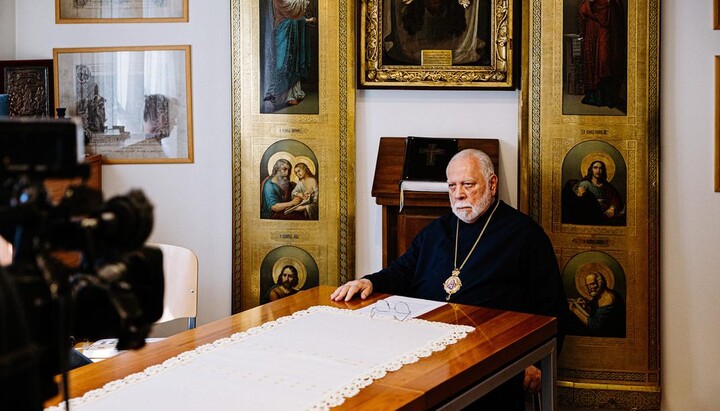
Metropolitan Stephanos. Photo: Priit Mürk/ERR
On June 18, 2025, the hierarch of the Constantinople Patriarchate, Metropolitan Stephanos of Tallinn and All Estonia, publicly expressed support for the new amendments to the law “On Churches and Parishes”, which strengthen state control over religious organizations. He shared this in an interview with ERR.
Metropolitan Stephanos of the Estonian Apostolic Orthodox Church believes that the new law, which increases state control over religious organizations, does not restrict freedom of religion at all but rather benefits believers.
“Orthodoxy has been placed in a difficult position not only here, but also in Ukraine,” he noted. “As Christians and Orthodox believers, our primary calling in society is to build peace and bring people together – not to stir up anxiety or create division.”
The hierarch assured that the new law “is not targeted at just one church. It applies to everyone – both religious institutions and, more broadly, non-religious organizations – that could pose a threat to national security through their activities”. At the same time, Metropolitan Stephanos acknowledged that those who maintain ties with the Estonian Orthodox Church may face “societal and legal consequences”,
Metropolitan Stephanos stated: “In other words, law is law and we must respect it. As religious organizations and churches, we have a duty to remain churches and to carry out the mission of Christian churches – not to play political games or engage in manipulation.”
Metropolitan Stephanos proposed creating a vicariate for the faithful of the Estonian Orthodox Church. “My proposal involves the creation of a vicariate. Of course, the term vicariate has a specific meaning, but in using it here, I've extended it beyond its usual definition,” he said.
The hierarch of the Constantinople Patriarchate in Estonia said he proposed a model that would allow the Estonian Orthodox Church to maintain its recognition in society, especially in the event that it decides to break its current ties with the Moscow Patriarchate. He assured that this offer is not about submission or merging with his jurisdiction but is “an outstretched hand” and “support in a difficult situation”.
“My proposed solution was to offer them a way to preserve their canonical status and ecclesiastical identity even if they break communion with the Moscow Patriarchate — so they wouldn't become a sect in the eyes of Orthodoxy,” he said.
Metropolitan Stephanos emphasized: “I am not asking anything in return, except one thing: that, as a sign of communion, their bishops mention my name during liturgies. I have the right to be commemorated. That was my first proposal.”
The Metropolitan also stated that he had shared his initiative with the Ecumenical Patriarchate and stressed that the state cannot help in this matter: “It resolves legal issues but does not interfere in canonical affairs.”
Earlier, the UOJ reported that the Estonian authorities adopted amendments to the anti-Church law.
Read also
OCU activist admits breaking into UOC church in Sloviansk
Oleksandr Onyshchenko said that the OCU held its first "service" at the Seraphim Church, which had previously been broken into by forcing the locks and doors.
Archimandrite Ioustinos, longtime keeper of Jacob's Well, dies in Jordan
Archimandrite Ioustinos (Mamallos), the keeper of Jacob's Well in Nablus, has died after a prolonged illness.
Pilgrim group from Kyiv Theological Seminary visits Mount Athos
KTS students are making a pilgrimage to the holy sites of Romania, Greece, Mount Athos and Italy.
UOC cathedral celebrates its patronal feast in Ternopil
The service in the cathedral of the Holy Martyrs Faith, Hope, Love and their mother Sophia was led by Metropolitan Serhii of Ternopil, concelebrated by four hierarchs.
MinCulture marks centenary of Soviet-era reserve at Lavra's Refectory Church
Representatives of the Ministry of Culture presented awards to the Reserve's employees on the occasion of the anniversary at the Refectory Church of the Lavra.
Conference to mark 1700th anniversary of Christianity adoption held in Georgia
In Georgia, representatives of the Church and the state noted the defining role of Christianity in the country's cultural development.