“Moscow-style” funeral service for Bandera
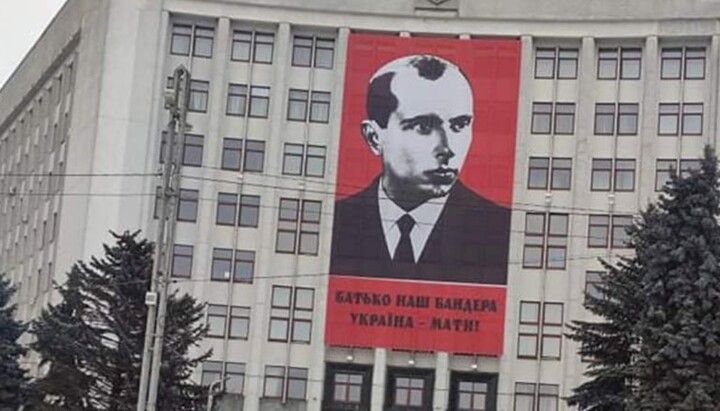
Portrait of Bandera on the building of the Ternopil Regional Administration. Photo: Korrespondent
Today, many in the OCU and UGCC call the Church Slavonic language “Moscow language.” Yet it is used not only by the Russian Orthodox Church but also in the Serbian, Bulgarian, Macedonian, Polish, American Churches, and the Church of the Czech Lands and Slovakia – in other words, in nearly half of all Local Orthodox Churches.
Recently, the UOJ received a link to archival footage of the funeral service for Stepan Bandera, leader of the OUN and now a national hero of Ukraine. Paradoxically, the Greek Catholic clergy can be seen conducting his funeral entirely in that same Church Slavonic. Yes, it’s the Kyiv recension, whose pronunciation differs from what is heard today in many UOC churches. But it is still not Ukrainian – it is the same language of Cyril and Methodius.
As people here often say, "treachery came from where it was least expected."
Read also
Why is it legal to kill a person before birth but not after?
Children are the most privileged members of society. Yet that same society officially permits children to be killed – and on a massive scale.
Honoring the Bolsheviks’ successors at Kyiv Lavra
It was under the Reserve that the relics of the saints were desecrated, Lavra churches were turned into an atheism museum, and toilets were installed in sanctuaries.
"Degenerates" and "stupid animals": anti-UOC activists turn on children
Future historians will wonder how a vast country’s information agenda could have been shaped for so long by people so petty, vicious, and utterly contemptible.
Zelensky sees murder of Polish priest but not of Sviatohirsk monk
Why does Zelensky react so emotionally and swiftly to the murder of a Catholic cleric while remaining completely silent about the murder of an Orthodox monk?
UOC vs. OCU numbers: pollsters count, social media recount
Official polling suggests Dumenko’s structure has an overwhelming lead in the number of parishioners, while social media polls paint a very different picture. Which should we believe?
Who is working for the Kremlin in Poland? OCU, Uniates and Catholics versions
Who in the conflict between Poland and Ukraine is "an agent of the Russian Federation"? Zelensky, who gave the UPA name to an AFU special operations center? Nawrocki, who stripped him of an order for it? Polish MEPs?