What citizenship remains when you’re stripped of Ukrainian?
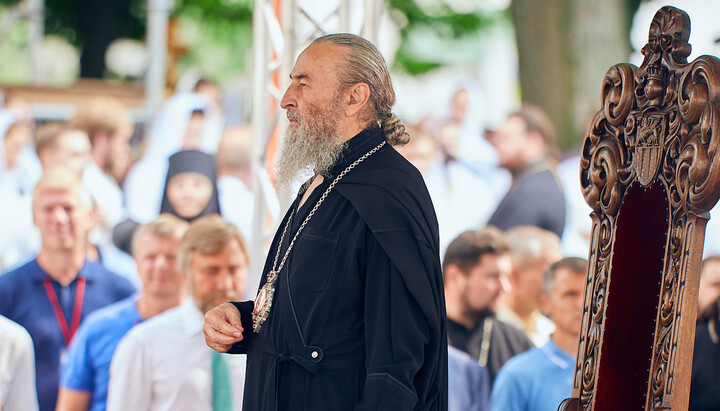
Metropolitan Onuphry. Photo: UOJ
From a legal perspective, this is outright lawlessness.
Politically speaking, the authorities have taken yet another significant step toward catastrophe for our country. Working so zealously to destroy the state and inflame division in society can only serve the interests of its enemies. Let’s not try to predict exactly how today’s decision by Zelensky will come back to haunt our country in the end. But haunt us it certainly will. The authorities think they have struck a blow against the Church of Christ. In reality, they have struck a blow against Ukraine – and against themselves.
But what about the spiritual perspective? What spiritual meaning lies behind all this? Let us recall the righteous Job. To an outside observer, he simply suffered one disaster after another. Terrible calamities. One after another. But we know what was really happening beyond our visible world. We know how the devil doubted Job’s righteousness and asked God for permission to test him.
It seems the meaning of the persecution of the Church and its Primate is this.
There are things that other people or circumstances can take away from you: your property, health, friends, homeland, citizenship. And if, by God’s providence, this happens, the question arises: what remains? Is there anything no one can ever take from you? The Apostle Paul says it is the love of God: “Who shall separate us from the love of Christ? Shall tribulation, or distress, or persecution, or famine, or nakedness, or danger, or sword?” (Romans 8:35).
They took away your church building – but do you have the love of God within you? They called you a traitor and a collaborator – but do you have the love of God? They stripped you of earthly citizenship – but do you see yourself as a citizen of the Kingdom of God?
Of course, Volodymyr Zelensky and the other authorities are merely instruments in God’s hands. Through them, we are taught not to cling to what is earthly – it can be taken from us. Not to prize our citizenship too highly – it can be revoked. Not to place our country above all else – we can be cast out of it. But to separate ourselves from the love of God is something only we can do to ourselves.
If someone keeps that love despite everything, they will discover that they have truly lost nothing at all. The story of Job proves this in full measure.
And to the persecutors of the Church, one would like to remind them of the words of the Apocalypse: “Let the evildoer still do evil, and the filthy still be filthy, and the righteous still do right, and the holy still be holy. Behold, I am coming soon, bringing my recompense with me, to repay everyone for what he has done” (Revelation 22:11–12).
Read also
Who destroyed and restored Kyiv Lavra? MinCulture's video reveals the truth
The Culture Ministry’s propaganda about the Kyiv-Pechersk Lavra has inadvertently revealed the truth.
Ternopil post on Feast of Intercession: Has calendar reformn failed?
A significant number of believers have rejected the new church calendar introduced by the OCU and UGCC with government support.
Shoulder straps or a cassock: who writes the script for UOC "fighters"?
Everything indicates that both Veliar and Pshenychny are ordinary performers of someone else's script. There is only one question – does the scriptwriter wear shoulder straps or a cassock?
Why is it legal to kill a person before birth but not after?
Children are the most privileged members of society. Yet that same society officially permits children to be killed – and on a massive scale.
Honoring the Bolsheviks’ successors at Kyiv Lavra
It was under the Reserve that the relics of the saints were desecrated, Lavra churches were turned into an atheism museum, and toilets were installed in sanctuaries.
"Degenerates" and "stupid animals": anti-UOC activists turn on children
Future historians will wonder how a vast country’s information agenda could have been shaped for so long by people so petty, vicious, and utterly contemptible.