KDA associate professor slams DESS study on UOC's alleged affiliation to ROC
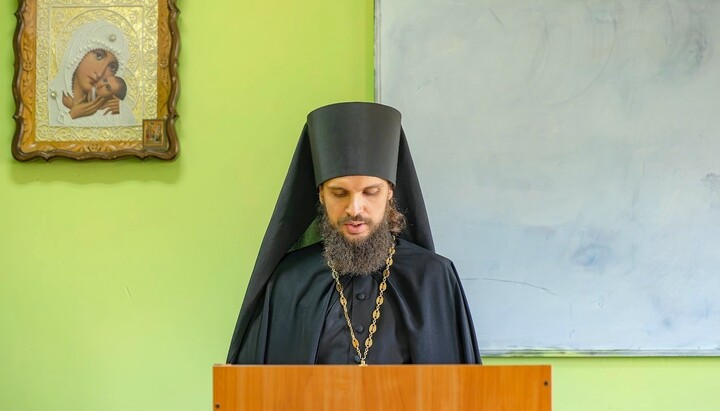
Hieromonk Herman (Kovach). Photo: Fr. Herman’s Facebook page
Hieromonk Herman (Kovach), Associate Professor of the Kyiv Theological Academy and Secretary of the UOC Synodal Theological and Canonical Commission, publicly criticized the new study on the basis of which the State Service for Ethnopolitics and Freedom of Conscience (DESS) concluded there were “signs of affiliation between the Kyiv Metropolis of the Ukrainian Orthodox Church and the Russian Orthodox Church.”
Commenting on the published study on his Facebook page, Fr. Herman noted that it “apparently tried to correct some of the errors found in DESS’s previous expert opinion. Nevertheless, this did not meaningfully improve the quality of the research, because the level of competence of the research group remained the same as that of the DESS expert group.”
The KDA associate professor stressed that most of the criticisms he voiced in his previous article on the 2023 expert opinion remain equally valid for this new study. He also drew attention to several key points.
DESS, he explained, now focuses on whether the UOC was granted autocephaly by the ROC, even though previously the service had considered even autonomous status sufficient.
The study fails to distinguish between legal affiliation and canonical connection, which, in Fr. Herman’s view, demonstrates a fundamental misunderstanding of church nature. “In this new study, the Kyiv Metropolis of the UOC is treated as a religious organization – a legal entity acting on behalf of the religious association, the UOC, representing it in both organizational and canonical matters.” Fr. Herman emphasizes that this is utterly absurd, since in a secular court the concept of “canonical law” simply does not exist.
The KDA lecturer also pointed out that the study repeatedly resorts to manipulation by selecting only those documents that can be interpreted in its desired direction.
For example, DESS cites several tomoses of autocephaly granted to seven Local Churches.
“It’s unclear what exactly justifies the use of these Synodal tomoses. The group, for some reason, ignores the Charter granted to the Church of the Moscow Tsardom (which was mentioned in the HESS Commission’s earlier conclusion), as well as the Synodal tomoses of the Church of Greece and the Serbian Church. Regarding the latter, it likely would have undermined the artificial ‘structure’ DESS tried to create for defining autocephaly, since it mentions the autocephalous Orthodox Churches of Karlovci and Montenegro. Evidently, DESS simply didn’t know how to use this in an ‘objective’ study – and certain parallels with these documents would have complicated their analysis of Patriarch Alexy II’s Charter and disrupted the rhetorical framework they wanted,” Fr. Herman notes.
According to Fr. Herman, it is crucial for DESS that the word “autocephaly” appear in the UOC’s official documents. Officials seem to believe, he writes, that “some magic would then occur” – that if the Church simply called itself autocephalous, it would instantly become autocephalous.
“When discussing autocephalous Churches as ‘subjects of the diptychs,’ the research group somehow ignores the fact that in the ROC, which is itself listed in those same diptychs, there is no document explicitly confirming its autocephalous status by using the term ‘autocephaly,’” he adds.
Most importantly, the priest argues, “HESS is searching for signs of autocephaly granted or recognized by the ROC, but considers ‘true autocephaly’ only that which is granted by the Church of Constantinople – Moscow, in their view, cannot grant ‘true autocephaly,’ it can only recognize ‘genuine independence.’”
One of the supposed proofs of autocephaly, according to officials, is inclusion of a Church in the diptychs. Yet, the study itself acknowledges that Churches granted autocephaly by the ROC did not subsequently enter the diptychs.
As the UOJ previously reported, Hieromonk Herman (Kovach) earlier published an extensive analysis titled “Analysis of the Main Provisions of the DESS Religious Studies Expert Opinion of January 27, 2023, in the Context of Church and Canon Law.”
Read also
Vinnytsia Eparchy venerates miraculous Brailiv Icon of Holy Theotokos
A Divine Liturgy and a religious procession were held at the Holy Trinity Brailiv Convent of the UOC on the feast day of the Brailiv-Pochaiv Icon of the Mother of God.
UOC Social Department aids 100 displaced families in Kyiv
Another charity event in support of refugees was held in the capital.
Khmelnytskyi TRC detains UOC priest in Cherepivka village
TRC officers mobilized the rector of the parish of Saint John the Theologian, Apostle and Evangelist, in Cherepivka, Khmelnytskyi region.
OCU outlet calls 2018 detention of Phanar delegation protection from Moscow
OCU representatives comment on Phanar official's report on 2018 "Unification Council".
Council of Churches urges Zelensky to establish military chaplain day
UCCRO said establishing Military Chaplain Day would help develop chaplaincy services in the Ukrainian Armed Forces.
Priest at Lavra prayer vigil explains why saints feared nothing
During a prayer vigil outside the Kyiv-Pechersk Lavra on the feast day of St. John the Theologian, Fr. Georgiy reminded the faithful that love casts out fear.