Patriarch Bartholomew speaks of creating a “common sacred worldview”
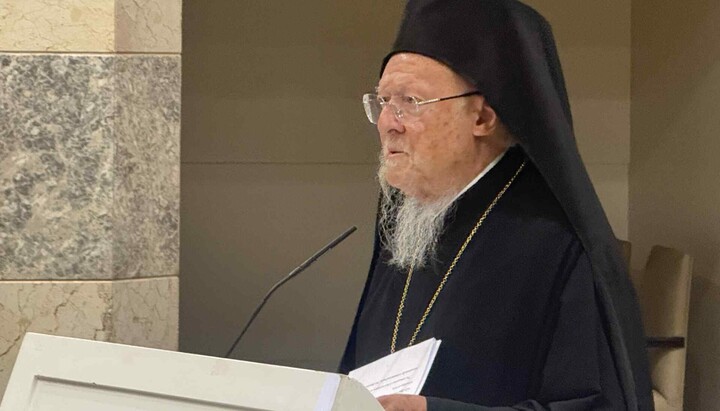
Patriarch Bartholomew. Photo: Press Service of the Ecumenical Patriarchate
On July 29, 2025, in Istanbul, Ecumenical Patriarch Bartholomew delivered a keynote address at the Meeting of the World Council of Religions for Peace titled “Contradictions and Preconditions of Interreligious Dialogue,” in which he presented a vision for the creation of a “common sacred worldview” as a response to the challenges of the modern world.
Patriarch Bartholomew identified the primary problem of our time as the dominance of a “reductive materialist worldview” which, he said, “reduces human flourishing exclusively to its material dimension and systematically excludes any reference to the Sacred.”
According to the Patriarch, this worldview leads to the “distortion of the concept of human completeness” which in turn “promotes isolation, exploitation, and environmental destruction.” In such a paradigm, “ceases to be conceived as a relational being, founded on a transcendent reality, and is converted into an autonomous unit that claims its well-being at the expense of others and of the natural world.”
As a countermeasure, Patriarch Bartholomew proposed the creation of a “common sacred worldview” – a framework intended to serve as “a theoretical foundation for collective sacred flourishing.” He emphasized that this is not “an attempt to create a new, syncretistic religion, nor a substitution for the unique worldviews that characterise each religious tradition.”
“This framework is articulated around four fundamental pillars, which constitute a holistic view of reality. At the centre lies the Sacred itself, the ultimate, absolute reality, which is expressed in various ways, as God, Allah, Brahman or as the Luminous Void,” the Patriarch said. He explained that human beings are “by definition relational, precisely because they are founded on the Sacred.”
He noted that the power of such a “common sacred worldview” lies “in the attempt to bridge the chasm between faith and science.”
“Drawing from the modern discoveries of quantum mechanics and biology, it challenges the dominant mechanistic models of the universe, projecting instead an image of purposefulness and interconnected wholeness that coordinates with the spiritual perspectives,” Patriarch Bartholomew declared.
He further stressed that “the polyphony of religions, like the multiplicity of languages, is a barrier that must be overcome.”
According to the Patriarch, the aim of this “common sacred worldview” is “the creation of a meta-linguistic system of reference, of a meeting place that will permit the 'translation' of the individual sacred truths into a commonly understood terminology, capable of articulating speech towards the contemporary world.”
“We are not called, therefore, to compose a new global religion of consensus. We are called, each from the standpoint of his faith, to constitute a global alliance of conscience, a prophetic testimony that will keep open the horizon of transcendence in a world threatened with asphyxiation within the confines of the material. Our unity is not founded on what we believe in common, but on our common love for humanity and on our common reference to the mystery of the one God. This is the only viable peace,” concluded Patriarch Bartholomew.
Earlier, the UOJ reported that Archbishop Elpidophoros of the Constantinople Patriarchate stated that all religions are myriad paths leading to the one God.
Read also
Upper Lavra court hearing postponed
The next court hearing in the Upper Lavra case has been scheduled for November 3.
UOC priest blesses ambulances at Kamianske medical center
A UOC priest in Kamianske blessed ambulances for a medical facility and wished its doctors God's help in their work.
Dumenko to German ambassador: Law targeting UOC also applies to other groups
Epifaniy Dumenko sought to defend Ukraine’s law restricting religious organizations during a meeting with the German ambassador.
Activists bused to court hearings in UOC cases, media say
A minibus has been spotted transporting protesters to and from courthouses where UOC cases are being heard.
Firefighters save historic UOC church from fire in Zakarpattia
A fire broke out at a UOC church in the Tiachiv district, damaging the altar and church furnishings.
Volyn Eparchy faithful collect six tons of aid for Sviatohirsk Lavra
Believers in Volyn collected food and warm clothing for people displaced by the war who have found shelter at Sviatohirsk Lavra.