His Beatitude: Even if the heart refuses, we must forgive
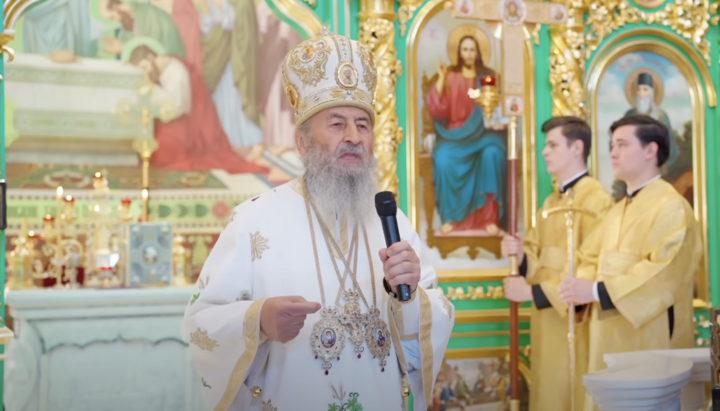
His Beatitude Onuphry. Photo: UOC Press Service
On August 24, 2025, His Beatitude Metropolitan Onuphry, Primate of the UOC, delivered a sermon in the Agapitus Church of the Kyiv-Pechersk Lavra dedicated to the Gospel parable of the unmerciful debtor. In his address, the Primate explained to the faithful the spiritual meaning of Christ’s parable about the king and two debtors, emphasizing the necessity of forgiving our neighbor in order to receive God’s forgiveness.
He stressed that repentance alone is not sufficient for the forgiveness of sins – one must also forgive one’s neighbor. “If we do not forgive our neighbor, then God does not forgive our sins. This happens not because the Lord does not want to forgive, but because we cannot contain forgiveness within ourselves. If we cannot show a small forgiveness toward our neighbor, how can we receive the great forgiveness?” Metropolitan Onuphry explained.
His Beatitude paid particular attention to situations where it is difficult for a person to forgive a serious grievance. “It may happen that the grievance is so heavy that the person cannot – the heart refuses to forgive. With the mind he understands that he must forgive, God commands to forgive, yet the heart resists. Let it be so. Still, with the mind one must say: ‘Yes, Lord, I cannot yet humble my heart, but with my mind I understand and confess: I forgive my neighbor,’” the Primate declared.
Calling the faithful to spiritual labor over themselves, Metropolitan Onuphry noted: “The Lord has given us free will so that we compel ourselves to do what must be done. We must compel ourselves to do good. A person must always compel himself.” The Primate stressed that forgiveness is not merely an emotion but a conscious decision that a person can make even against the pull of his feelings.
His Beatitude Onuphry also warned of the consequences of unforgiveness: “If there is no forgiveness, we will simply destroy ourselves with mutual malice. Forgiveness destroys sins, but anger and cruelty multiply sins that ruin a person.”
In conclusion, the Primate urged the faithful to live a life of prayer, fasting, and repentance, forgiving others their debts, so as to be found worthy of “eternal salvation in heaven in Christ Jesus.”
The sermon was based on the Gospel parable from the 18th chapter of the Gospel of Matthew, where Christ teaches the necessity of forgiving “up to seventy times seven.”
Earlier, the UOJ reported that, according to His Beatitude, if one lives according to the laws of holiness, one becomes holy oneself.
Read also
Sumy Eparchy venerares miraculous Korsun-Shpylivka Theotokos Icon
Celebrations honoring the Mother of God’s icon known as the “Restorer of Sight” were held at Sumy Cathedral and concluded with a car procession around the city.
Receding Dniester in Khmelnytskyi region exposes foundation of flooded church
The foundation of St. John the Theologian Church, submerged during the construction of a hydroelectric power plant, has emerged for the first time in 45 years.
Medieval сhurch сrumbles as Culture Ministry сites missing agreement
The 14th–15th-century St. Nicholas Church in Chesnyky, Ivano-Frankivsk Region, is falling into disrepair.
Poland сondemns Lviv Regional Council's decision to declare 2007 year of UPA
Polish Prime Minister Donald Tusk says the Lviv Regional Council's decision to dedicate 2027 to the UPA and Roman Shukhevych is harmful to Ukraine.
OCU seeks court recognition of ownership of seized Cherkasy cathedral
The Cherkasy Regional Commercial Court will hear an OCU lawsuit seeking ownership of St. Michael's Cathedral, which was seized from UOC believers.
Lithuanian bishop: Ukraine is no model for believers' rights
Vicar of Vilnius Diocese voices concern over attempts to import Ukraine's religious conflict into Lithuania.