In Pereyaslav, bulldozers excavate burial sites of monks near monastery
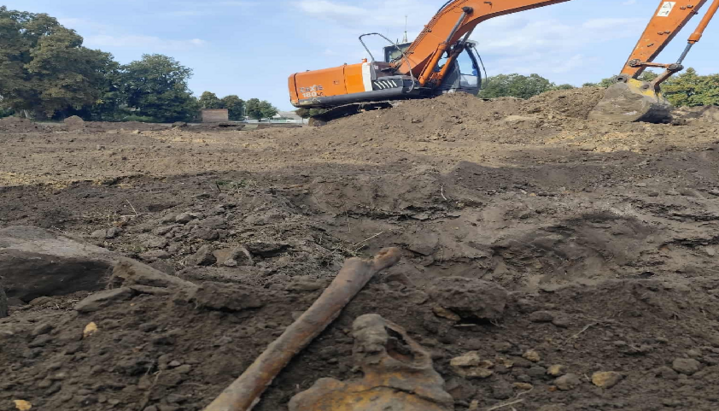
The mayor of Pereyaslav disturbed the remains of the monks of the Ascension Monastery. Photo: Mykola Tomenko's Facebook
On August 27–28, 2025, on the grounds of the ancient Ascension Monastery in Pereyaslav, municipal services illegally conducted earthworks under the direction of Mayor Vyacheslav Saulko. During these actions, ancient burials of the monastery's brethren were discovered: human remains and burial monuments were found, as reported by the website ps.informator.ua.
Despite Saulko's assurances of the legality of such actions, it is noted that they were carried out without the permissions of the Institute of Archaeology and the approval of the Ministry of Culture.
Scientists from Pereyaslav National Historical and Ethnographic Reserve identified among the finds the obelisk of Archimandrite Gennady (1857–1905), the abbot of the monastery. The monument was moved to the monastery necropolis.
The event caused a wide resonance among the public and scientists.
MP Yuriy Bobrovnyk noted on his Facebook page: "This is the holy land of Ukraine." Commenting on Saulko's explanation, he emphasized that the mayor "disturbed the monks' ashes", after which he "called in tame priests to pray for the mayor's sin". "Naive. In the times of ancient Pereiaslav, chroniclers called such as Saulko accursed," he added.
Yuriy Bobrovnyk published a video on his YouTube channel, showing the found obelisk of Archimandrite Gennady and the "excavation" site.
"And here Saulko wants to set up a dance stage and dance on the graves. That is, these are the best traditions of Soviet power. To erase the historical memory of the Ukrainian people and arrange a disco there," emphasized the people's deputy.
Chairman of the organizing committee "7 Wonders of Ukraine" Mykola Tomenko called the incident a gross violation of the law and an outrage against a national shrine: "We are talking about one of the most sacred places in Ukrainian history – the ensemble of the Ascension Monastery, where Hryhoriy Skovoroda worked and which was depicted by Taras Shevchenko. Illegal excavations on such holy ground are an example of black archaeology and ignorance."
Experts from the Pereyaslav National Historical and Ethnographic Reserve confirmed that the illegal earthworks have caused damage to the cultural layer of the monument of national significance.
In connection with the incident, statements have already been filed against the Pereyaslav mayor with the General Prosecutor’s Office of Ukraine and the Ministry of Culture, demanding a legal assessment of his actions.
As reported by the UOJ, Greek media wrote that the Ukrainian authorities obstructed the UOC pilgrimage to Pochaiv.
Read also
Khust Eparchy honors memory of St. Job of Uholka
A Liturgy is served in Mala Uholka, a birthplace of St. Job of Uholka, on the saint's feast day.
UOC parish in Cologne donates ultrasound machine to Kharkiv region hospital
In Cologne, UOC believers raised funds for an ultrasound machine for the Kehychivka district hospital in the Kharkiv region.
Shevchuk tells Pope Leo of Ukraine's preparations for "another harsh winter"
The head of the UGCC expressed "special gratitude" to the Pope for his phone calls with Putin and Zelensky.
Berlin hierarch comments on Phanar document published by UOJ-USA
Metropolitan Mark called the information about the 2018 "Unification Council" alarming if confirmed, and expressed hope that Patriarch Bartholomew will reconsider his position.
UOC marks Synaxis of All Saints of Volyn Land at Lutsk cathedral
Metropolitan Serhiy of Ternopil and Kremenets led the Liturgy on the feast day of the Lutsk cathedral of All Saints of the Volyn Land.
SBU detains OCU cleric who organized draft evader's escape for money
In Transcarpathia, law enforcement officers detained a clergyman of the OCU who arranged for a draft evader to be smuggled into Slovakia for $15,000.