Social ministry in Rus': From Prince Vladimir to monastic hospitals
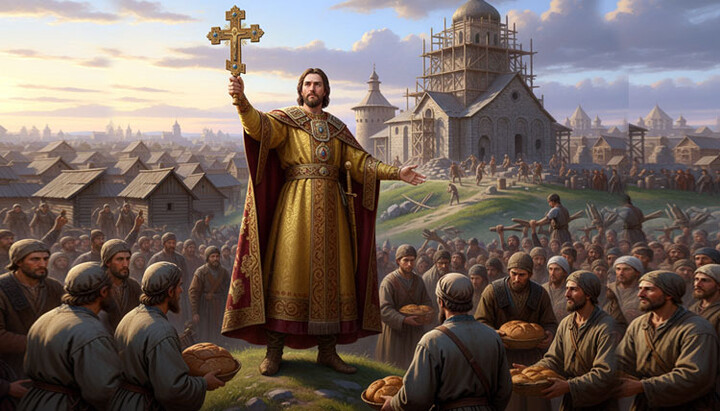
Social ministry in Rus' is a transition from pagan customs to Christian mercy. Photo: UOJ
In previous articles, we examined the social ministry during the apostolic period and its development in Byzantium, now we turn to the traditions of mercy in Rus' during the princely period (10th–13th centuries).
Even before the Baptism of Rus', the East Slavic tribes practiced clan forms of assistance. With the emergence of the state (8th–9th centuries), new forms appeared, partially laid down in the first legal acts. In treaties with Byzantium (907, 911, 944), there is mention of the ransom of Rus' people from captivity at the expense of the treasury.
Princely guardianship was not so much a moral obligation as it was a tool for strengthening power and reducing social tension.
Christian mercy after the Baptism of Rus'
With the adoption of Christianity in 988, the approach to social ministry changed radically. If previously princely assistance was primarily a state tool, it now began to be perceived as a Christian virtue. Princes began to be guided by the principle of love for the poor, inspired by the Gospel commandments.
A vivid example is the Equal-to-the-Apostles Prince Vladimir the Great, who, according to the "Tale of Bygone Years", began to generously give to the poor, the blind, and the lame after baptism.
His charity included not only the distribution of money but also feeding the needy at the princely court, as well as delivering food throughout the city to those who could not come in person. All of this reflected a new, Christian view of social service as a path to the salvation of the soul.
Prince Vladimir’s initiatives were continued by his son, Yaroslav the Wise, who founded a school for 300 children in Novgorod, one of the first true educational institutions in Rus’. His most well-known achievement was the compilation of the first written code of laws, the "Russkaya Pravda" (“Russian Truth”), which, among other things, included socially-oriented articles.
During this period, the Church also “Christianized” ancient pagan customs, such as the bratchina (a communal feast), giving them a Gospel-centered meaning – caring for the sick, burying the dead, and offering mutual support.
Church-monastic ministry
In the 10th–11th centuries, pilgrim's guesthouses, hospital cells, libraries, and schools appeared at churches and monasteries. Monasteries became centers where the needy could receive food, treatment, and education.
The most famous was the Kiev Caves Monastery. From its earliest years, monastic medicine began to develop there. The Kievan Caves Patericon (13th century) contains many mentions of monks known for their medical skills, such as the venerable Agapitus of the Caves, the unmercenary physician.
The monks performed hard work caring for the sick, including the mentally ill, showed patience, and avoided personal enrichment.
Other monasteries also played a significant role. For example, St. George's (Yuriev) Monastery (11th century) served as a center of care, providing shelter to wanderers and assistance to the poor. The Saviour Monastery of St. Euthymius (founded in the 14th century but continuing the traditions of the princely period) engaged in charity, supporting widows and orphans, especially during periods of famine.
Challenges and сhanges
Despite extensive activities, social ministry faced serious challenges such as feudal fragmentation, internecine wars, and epidemics. This increased public needs and weakened the role of princes.
Under these conditions, the Church took on increasing responsibility, developing forms of care and guardianship that became the predecessors of later state institutions.
The princely period laid a strong foundation for future traditions of charity, where secular philanthropy developed in close connection with the Church.
Conclusion
Social ministry in Rus' during the princely period is a transition from pagan clan customs to Christian mercy. The young state and the Church formed a system of assistance that influenced all subsequent history.
The Church gained enormous authority among the people, united them, and demonstrated an example of Gospel love in action.
Chronicles like the Tale of Bygone Years help us see lessons from that era that remain relevant to this day for uniting society in the face of modern challenges.
Read also
Trial of a dead pope
Once in Rome, the body of a deceased pope was seated on the throne and put on trial. The accusation relied on a church canon that had once saved his see.
Monastery built in defiance of king
When Orthodox believers in Minsk were left with just one church, townspeople decided to build another – and even a royal decree did not stop them.
Young Mother and Sleeping Christ
Michelangelo carved a Virgin Mary who looks younger than her Son – and signed his name in marble for the only time in his life. Neither of these peculiarities was accidental.
Orthodox books from a Uniate printing press
In the 18th century, Uniate monks at Pochaiv printed books used in prayer by Orthodox Christians and Old Believers alike.
The story of the honey brotherhood
The Mogilev Brotherhood began with members pooling money to brew honey drinks for feast days – and eventually grew to have its own printing press.
Golgotha in the midst of a pogrom
In the autumn of 1938, the Jewish artist Marc Chagall painted the crucified Christ. Synagogues burn and refugees flee around the cross, while the Crucified One Himself is wrapped in a prayer shawl.