Round table in Paris addresses persecution of UOC
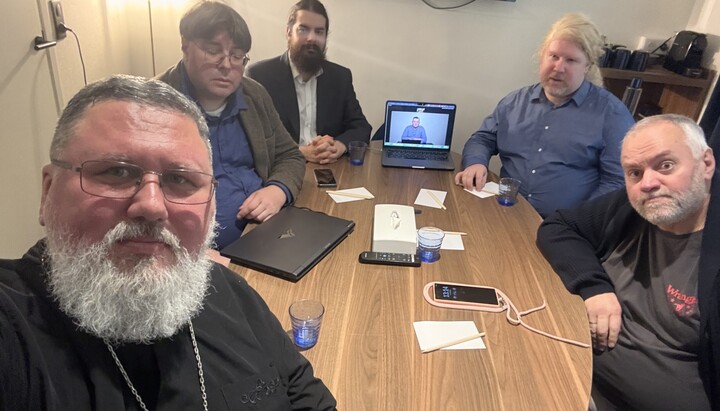
Participants of the round table in Paris. Photo: baznica.info
A round table titled “The Ukrainian Orthodox Church: Challenges and Prospects” was held in Paris, organized by European human rights defenders, theologians, and analysts in response to the ongoing pressure exerted by the Ukrainian authorities on the Ukrainian Orthodox Church (UOC).
Participants in the discussion included theologian Dimitrie Crikhan, sociologist Nikolai Mitrokhin, human rights activist and Lutheran pastor Pavel Leushkan, human rights defender Denis Lapin, and Orthodox writer Ilya Zabezhinsky.
Moderator Pavel Leushkan recalled that this discussion continues a series of meetings previously held in Berlin and Brussels, where participants spoke at the European Commission and the European Prayer Breakfast.
“We shared our concerns with European politicians – and we were heard. Our counterparts in the European Commission fully understand that the situation faced by the UOC is unacceptable from the standpoint of basic human rights,” he stated.
According to Leushkan, the actions of the Ukrainian authorities – the revocation of legal registration, pressure on eparchies, and forced transfers of parishes – have become systematic.
“This is an attempt to provoke internal division, create chaos, and undermine the Church’s standing,” he emphasized.
Human rights advocate Denis Lapin stressed that what is happening constitutes large-scale pressure on freedom of conscience:
“Unfortunately, it is very difficult to speak of freedom of speech in Ukraine today. State media are under complete control, independent voices are being silenced. Even at the level of local administrations, a campaign is being waged against the UOC – teachers are dismissed, people are taken to court for praying at home, and church seizures take place with the involvement of armed groups.”
Lapin cited a case in the Chernivtsi region, where a young English teacher was forced to leave her village because of her religious affiliation.
“People are losing not only their churches, but also their jobs and their right to freely profess their faith,” he said.
Sociologist and researcher Nikolai Mitrokhin presented a systemic analysis of the situation. According to him, the campaign against the UOC is an attempt to create the image of an ‘internal enemy’, using Soviet and post-Soviet repressive methods.
“In Russia, the security services found a convenient target in the Jehovah’s Witnesses. In Ukraine – in the UOC. These are groups that do not resist, are unarmed, and pose no danger. They are easy to ‘process’ for the sake of statistics, medals, and promotions,” Mitrokhin noted.
The researcher reminded that between 2022 and 2025, more than 1,300 searches were conducted, yet espionage charges were brought against only eight clergy members.
“This is not about security but about a nationalist project in the religious sphere – the creation of a single, ‘true’ Ukrainian Church. For that goal, they are willing to imprison, discredit, and seize churches,” emphasized the sociologist.
At the same time, he noted that even within Ukraine there is no unity on the issue.
“Local administrations in Transcarpathia, Volyn, and Chernivtsi sometimes refuse to participate in seizures. It all depends on the presence of activists from the Svoboda party and its youth wing. If they are there – churches are seized. If not – the Church survives.”
According to data presented during the meeting, more than 1,300 parishes have been seized since the start of the war. In the Chernivtsi region, about 50 churches have formally changed jurisdiction, but only 17 have been officially registered as part of the OCU.
Most seized churches are not functioning normally: “empty buildings, grass waist-high, utility workers clearing the yard just to make it look ‘decent’ on camera.”
“The attendance of OCU churches has always been low – about one-third of capacity. Meanwhile, at UOC liturgies in Kyiv districts, people stood outside in the snow. That is the objective reality – despite the pressure, people remain faithful,” Mitrokhin concluded.
The participants of the round table called to:
- ensure international monitoring of the situation with religious freedom in Ukraine;
- support believers who refused to change their confession under pressure;
- recognize that persecution of the largest religious organization in Ukraine is unacceptable in a democratic state;
- remind that freedom of conscience is not a war crime.
Earlier, the UOJ reported that the UN had accused Ukraine of persecuting clergy, communities, and journalists of the UOC.
Read also
Medieval сhurch сrumbles as Culture Ministry сites missing agreement
The 14th–15th-century St. Nicholas Church in Chesnyky, Ivano-Frankivsk Region, is falling into disrepair.
Poland сondemns Lviv Regional Council's decision to declare 2007 year of UPA
Polish Prime Minister Donald Tusk says the Lviv Regional Council's decision to dedicate 2027 to the UPA and Roman Shukhevych is harmful to Ukraine.
OCU seeks court recognition of ownership of seized Cherkasy cathedral
The Cherkasy Regional Commercial Court will hear an OCU lawsuit seeking ownership of St. Michael's Cathedral, which was seized from UOC believers.
Lithuanian bishop: Ukraine is no model for believers' rights
Vicar of Vilnius Diocese voices concern over attempts to import Ukraine's religious conflict into Lithuania.
Hundreds of believers honor St. Alexis of Carpatho-Russia in Khust Eparchy
At the St. Nicholas Monastery in the village of Iza-Karputlash, Metropolitan Mark of Khust led a festive liturgy, concelebrated by six metropolitans, five archbishops and three bishops.
Court upholds UOC parish appeal in Voloshky over OCU switch dispute
The Northern Commercial Court of Appeal has upheld the appeal of the St. Nicholas parish of the UOC in the village of Voloshky, Volyn region, in a dispute over a transfer to the OCU.