Intercession of the Theotokos: From Constantinople’s defense to guarding our hearts from evil
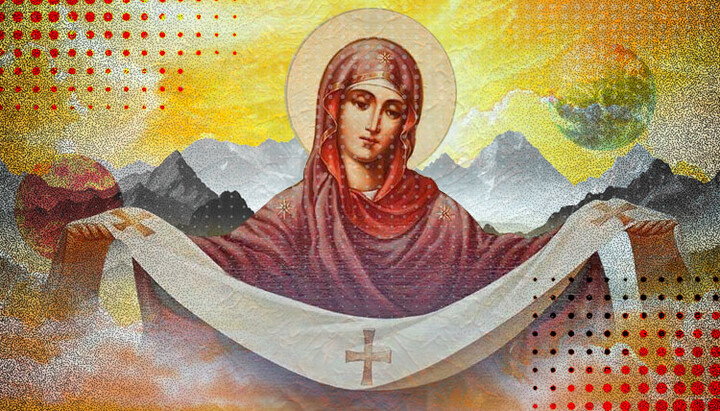
The Intercession of the Holy Theotokos extends over all believers. Photo: UOJ
The faithful people have always felt the special help of the Most Holy Theotokos. In the most difficult moments, when strength was failing, people turned in prayer to the Queen of Heaven, and She immediately came and continues to come to their aid. Today we recall one such story.
The miracle in the Blachernae Church
The beginning of the 10th century. Constantinople, the capital of the Byzantine Empire, is surrounded by countless hordes of Saracens. The situation seemed hopeless. But the city's residents, gathering their last strength, came to the Blachernae Church, where, together with the imperial couple, they fervently prayed to God for deliverance.
And during the all-night vigil in the church, the Most Holy Theotokos Herself appeared, accompanied by angels and a host of saints.
Rising above the parishioners, She joined their prayer, and then, as a sign of protection from visible and invisible enemies, spread Her shining Omophorion (veil) over them.
This miraculous apparition was seen by only two of the praying: Saint Andrew, the Fool-for-Christ, and his disciple Epiphanius. But soon all the residents learned about it. Encouraged and filled with hope, they strengthened their faith anew, and soon the formidable enemy was driven away from the walls of Constantinople. According to another, more widespread version in Slavic tradition, this miracle is associated with the Rus' campaign against the Byzantine capital in 860, repelled by the prayers of the Most Pure Virgin. But this historical detail does not change the spiritual essence of the miracle.
The Protection over the Cossack Army and the Church
The memory of the Theotokos' intercession was carefully preserved, and in honor of this event, the Feast of the Protection was established. In our Homeland, it is especially revered, as the Mother of God became the patroness of the Zaporizhian Cossacks. According to legend, in 1641, during the siege of the Azov fortress by the Turks, the Cossacks found themselves in the same dire situation as the residents of Constantinople once did. Eight thousand warriors faced a vast army of Janissaries and Tatars.
The siege lasted more than three months, and the Cossacks' strength was exhausted. But they did not despair and prayed fervently. And so, on the very Feast of the Protection of the Most Holy Theotokos, the besieged city was enveloped in a thick fog, and the Cossack army was able to leave the fortress unhindered, reaching the banks of the Don without a single encounter with the enemy.
On this significant day, we offer fervent prayers for the Orthodox army defending their Homeland.
But our Holy Church, experiencing persecution and oppression, is in no less need of protection now.
Today we see how external hostility is compounded by internal strife—between brothers and sisters in Christ, between believers and clergy with differing views on the future of the Church. Amid such disputes, we forget that this hostility occurs among co-religionists, among those whom the Most Holy Theotokos has covered and continues to cover under a single Omophorion.
One of the Patriarchs once said: "The Church is the body of Christ, crucified for the salvation of its tormentors." These words, relevant to the present, sound both terrifying and encouraging.
Terrifying, because our Mother Church is still tormented by persecutors and opposing "camps" of believers. But also encouraging, because, as the crucified Christ prayed for His murderers, so now He desires salvation even for those who persecute the Church.
Therefore, each of us, whether on the front line or working in the rear, is called to become a defender of our Church, a prayer warrior for Her integrity. And then, in response to our weak prayers, the Most Holy Theotokos will join them with Her strong prayer and once again cover us with the Omophorion of Her love.
The lesson of Saints Andrew and Epiphanius: simplicity and contemplation
Recalling the miraculous apparition of the Theotokos, we should not forget about the two people who witnessed it. One of them was a fool-for-Christ, the other a blessed one. By human standards, such people might be considered mentally ill. But in the eyes of God, they attained holiness for their special spiritual feat.
It is noteworthy that on that day, countless people were praying in the church, but only two were deemed worthy of witnessing the miracle.
Outwardly, they did not stand out; on the contrary, due to their foolishness, they might have seemed eccentric. But internally, they were distinguished by a special attitude towards prayer.
Being in large cathedrals, we often find ourselves thinking that excessive solemnity or general hustle and bustle distracts us from the main thing – prayer. We have to stop the whirlwind of thoughts to at least partially grasp what the choir is singing or the reader is chanting. Saints Andrew and Epiphanius not only managed to perform internal prayer amidst the crowd but also managed to elevate it to the realm of contemplation, where the surrounding material world ceases to exist for a person.
Saint Ignatius (Brianchaninov) reminds us that learning to pray should become the work of a Christian's entire life.
The spiritual world is comprehended in soulful simplicity.
We can learn to pray only when everything superficial falls away from the soul, leaving only sincere belief that without repentant purification of the heart, we can never become true men of prayer.
Following the example of Saints Andrew and Epiphanius, let us strive in this complex and rapidly changing world to remain sincere towards God and people. Simplicity is often regarded as naivety now. Yet it is only through it that genuine prayer is born – a prayer that every Christian should seek to attain.
Read also
Stories of the Ancient Church. Level of Governance: Patriarch
How did several episcopal sees rise above the rest, why did the church map begin to repeat the map of the empire, and is the patriarchate a sacred form of Church organization?
A Chronicle Without an Author
We are used to calling the "Tale of Bygone Years" the work of St. Nestor. But the signature on it was left by a different monk, and the chronicle itself was passed from hand to hand.
How a wedding stopped a war
The young princess of Slutsk was married off to keep two powerful noble families from drowning the city in blood. Soon afterward, a Uniate metropolitan complained that Orthodoxy had been reborn in Slutsk.
Man before the forces of nature
A solitary figure on the shore seems insignificant before the immense power of the sea, yet it is he who stands before the Creator.
The mysteries of Golgotha in the light of archaeology
The veil of centuries obscures what really happened in the fourth century. Archaeology and ancient texts shed light on the true history of one of Christianity’s greatest sacred sites.
Zaporozhian Cossacks defend the persecuted faith
The story of how Cossacks drew their sabers to defend abused priests – while sometimes causing violent disturbances inside churches themselves.