MP: Bartholomew granted Tomos on condition of no seizures and hostility
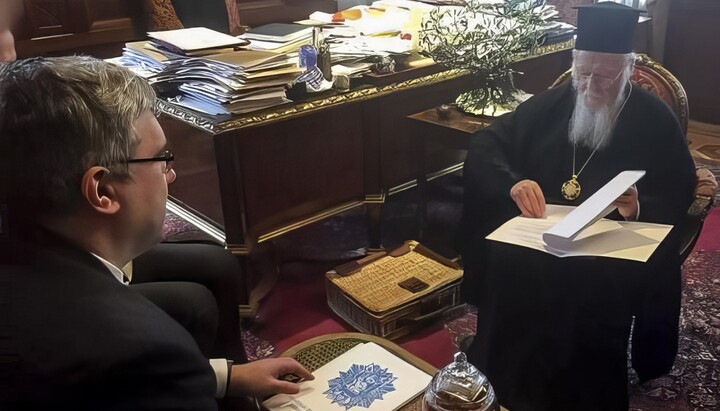
Rostyslav Pavlenko at a meeting with Patriarch Bartholomew. Photo: Pavlenko's Facebook
MP Rostyslav Pavlenko, who oversaw the track of obtaining the Tomos, shared details of Poroshenko's negotiation process with Patriarch Bartholomew.
According to him, Poroshenko instructed him to start working with the Phanar at the end of 2014. In 2015, Petro Poroshenko wrote a letter to Patriarch Bartholomew "with a request to use his unique status in the Orthodox world and grant this status to the Ukrainian church". Pavlenko claims that this year "a slightly different scenario could have been implemented, where the UOC-KP and UAOC were supposed to announce their unification at the Council."
"This Church could have received recognition from the Ecumenical Patriarch and negotiated as equals with the UOC-MP about further unification," Pavlenko stated and lamented that this scenario did not work out due to the vagaries of the UAOC reps.
But in 2016, Pavlenko recounts, Poroshenko and Patriarch Bartholomew agreed on a new attempt. According to him, the Patriarch asked for "some signals to come from Ukraine". As such signals, the authorities organized an appeal from the Rada to the Phanar. And after the Council of Crete, Pavlenko "went again to the Ecumenical Patriarch with a letter from President Poroshenko, where it was clearly stated what specific steps we are asking from the Ecumenical Patriarchate".
The MP assured that the failure of the Council of Crete, which the ROC and several other Churches did not attend, "the Ecumenical Patriarch perceived as a personal affront," and the negotiations "significantly intensified".
According to Pavlenko, before the final stage of negotiations, Patriarch Bartholomew set several conditions.
"If we decide to grant the Tomos, it will only be if we understand: first – it will contribute to the welfare of the Ukrainian people; second – it will not cause a real religious war, because one of the Russians’ arguments was: ‘That’s it, a war will start here, a nightmare. There is already a war, you started it, and now the war will really begin.’ Representatives of the Ecumenical Patriarchate had to be convinced that this war would not happen. And third – that it will be a path of unification," Pavlenko conveyed the Patriarch's words.
He explained that Poroshenko assured the Phanar that everything would be exactly as the Patriarch wanted.
"Therefore, it was so important for the transitions of parishes to begin, for the process of unification to start. And then the state had to support this process, not leave it to chance," Pavlenko said.
He also assured that Poroshenko did not pay Patriarch Bartholomew for the Tomos, but simply supplied the Phanar with his sweets.
Earlier, the UOJ wrote that Patriarch Bartholomew justified the Tomos for the OCU with an ecological agenda.
Read also
TRC officers draft UOC priest in Chernihiv
TRC officers have detain Archpriest Pavlo Tovstohon of the Christ's Nativity Church.
Patriarch Bartholomew and Shevchuk discuss obstacles to ecumenical unity
The head of the UGCC said that replacing Christian patriotism with the idea of loyalty to a "warring god" is an obstacle to ecumenical dialogue.
Ukraine’s Foreign Ministry plans advocacy visits abroad for UCCRO
Members of the All-Ukrainian Council of Churches and Religious Organizations have planned advocacy visits abroad following a meeting with Ukraine’s deputy foreign minister.
UOC priest detained by recruitment officers in Kyiv sent to training ground
UOC priest Maksym Kostiuchenko, who was detained on his way to a church service in Kyiv, has been sent to a military training ground in Chernihiv Region.
25 tons of humanitarian aid from Volyn reach Sviatohirsk Lavra
Around 25 tons of food donated by believers of the UOC Volyn Eparchy arrived at Sviatohirsk Lavra on October 22.
UOC West European Vicariate holds children's camp in Germany
A children’s camp was held in the UOC’s Western Deanery in Germany from October 19 to 23.