Ex-Intel CEO to build "Christian AI" to hasten Christ's coming
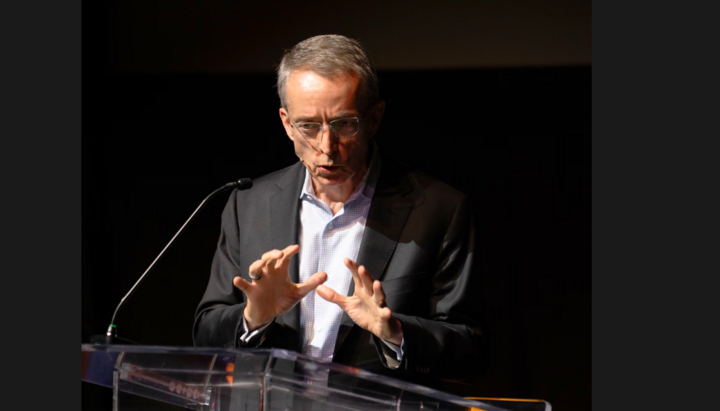
Patrick Gelsinger at the "AI for Humanity" seminar at Colorado Christian University. Photo: The Guardian
On October 28, 2025, former Intel CEO Patrick Gelsinger announced the launch of a project to create the so-called "Christian AI", which, according to him, should promote the spread of faith and spiritual values, reports The Guardian.
After leaving Intel in March 2025, Gelsinger headed the technology company Gloo, which develops digital platforms for churches and Christian organizations. The firm creates chatbots and AI assistants designed to support pastoral ministry and missionary work.
According to Gelsinger, the project's goal is related to faith: "My life mission has been [to] work on a piece of technology that would improve the quality of life of every human on the planet and hasten the coming of Christ’s return."
Speaking at the AI for Humanity seminar at a Christian university in Colorado, he compared the development of artificial intelligence to the invention of Gutenberg's printing press, which sparked the Reformation: an epochal shift as important as the Reformation. In the same way that a “plump little monk”, Martin Luther, used the printing press to catalyze “the greatest period of human invention”, he sees a similar faith-driven opportunity today to change the course of history through AI.
Gloo is actively promoting its ideas in the tech community and the US Congress. According to Gelsinger, his "Christian AI" initiative is attracting interest from politicians, and Gloo's products are already being tested in some religious organizations. At the same time, the firm positions itself as open to different denominations and even allows its solutions to be used by Muslim and secular structures.
"We’re not trying to take a theological position: we’re building a technology platform, and then giving enough customization capability that the Lutherans can be good with it, the Episcopalians can be good with it, the Catholics can be good [with it], the Assemblies of God can be good with it,” Gelsinger explained. According to him, the project's goal is not to replace spirituality but to "help people seek God through technology".
Earlier, the UOJ reported that an Orthodox AI was launched in Greece.
Read also
BOC Patriarch: Bartholomew cannot be anathematized without conciliar decision
Patriarch Daniel said that no Local Orthodox Church has anathematized the Patriarch of Constantinople, warning that misguided zeal can lead people to place themselves above the Church.
Church сonflicts in Ukraine are not particularly bloody, DESS head says
Viktor Yelensky claimed that tensions between Orthodox Christians in Ukraine are "far from dramatic" and that parish transfers to the OCU generally take place without conflict.
Bulgarian Patriarch: Athos monasteries do not admit OCU clergy
The Bulgarian Primate noted that the monasteries of Iviron, Vatopedi, Hilandar, and Zograf do not admit OCU clergy but remain in communion with Patriarch Bartholomew.
Rivne Eparchy of UOC marks 290th anniversary of Bilashiv church
Metropolitan Pimen led a festive Liturgy marking the 290th anniversary of the founding of the Church of the Nativity of Theotokos in Bilashiv.
UOC priest killed in war laid to rest in Kovel
The Volodymyr-Volynskyi Eparchy bid farewell to Archpriest Andriy Korinchuk, rector of several parishes, who was killed in the war.
Vyshhorod mayor accused of damaging monument to Sts. Boris and Gleb
The creators of the monument to Sts. Boris and Gleb accused the Vyshhorod mayor of damaging it and demanded that it be restored to its original appearance.