The litany of fervent supplication and the “Nunc Dimittis”
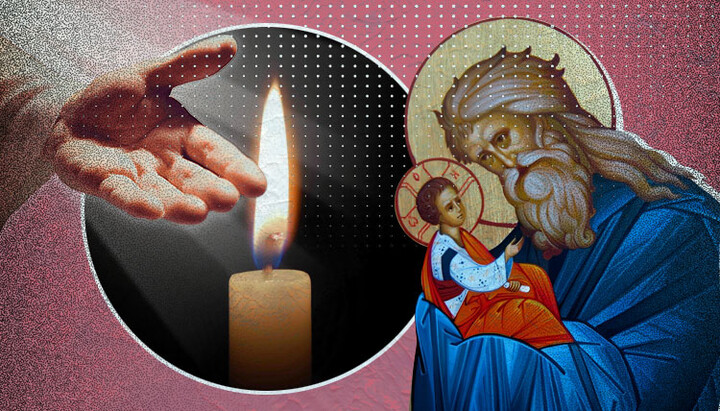
"Now You are releasing Your servant, Master." Photo: SPZh
Earlier we explored the first part of the Vespers service with its key elements. Now we turn to the second part, whose internal composition resembles the Liturgy – which is not surprising if we remember the ancient origin of the office of Vespers discussed previously. Here we find the same litanies as in the Liturgy – the Fervent Litany and the Litany of Supplication – along with Psalm 33 (at the Vigil) and the concluding prayers: the “Nunc Dimittis”, the Trisagion, and the troparia.
The Fervent Litany – why does “let us say” repeat?
The Fervent Litany begins with the words: “Let us all say with all our soul and with all our mind, let us say.”
The repeated “let us say” is not a careless tautology, but the result of two originally distinct phrases being joined into one.
Initially, after the Scripture reading, the deacon would come out onto the ambo and call the people to prayer with the words, “Let us all say: Lord, have mercy,” and only then would he begin the first petition: “With all our soul and with all our mind let us say.”
The faithful, already instructed, would answer three times: “Lord, have mercy.”
Over time, the invitation and the beginning of the petition fused into a single expression, creating the double phrase.
The next petition is taken from the prayer of King Manasseh (2 Chron. 20:6): “O Lord Almighty, God of our fathers, we pray Thee, hear us and have mercy.”
The concluding prayers: from “Vouchsafe, O Lord” to “Now lettest Thou Thy servant depart”
After this comes the prayer “Vouchsafe, O Lord”, which the Typikon counts among the most important, assigning it to the rector of the church, though in certain circumstances allowing a reader to recite it.
It is also called the “evening doxology”, for it recalls the Great Doxology of Matins – similar in content and repeating many of the same petitions.
In this prayer we ask God to grant that we may pass the evening without sin, and that He may teach, enlighten, and illumine us by His divine Light.
Then comes the Litany of Supplication. Its petitions continue the same theme: to grant a peaceful evening, forgiveness for every fault of the day, and a worthy answer at the hour of the Last Judgment. The priest in the altar completes this section with the Lamp-lighting Prayer, similar in meaning.
“Now lettest Thou Thy servant depart”: the ending of the day and of life itself
On feast days, another form of prayer is added – the Litiyá.
Originally this referred to a special procession to local shrines, churches, or cemeteries, with prayers and the commemoration of names. What remains of that ancient custom today is the singing (or reading) of the stichera at the stichera verses, which once were sung upon returning to the church after the Litiyá.
Vespers concludes with the prayer “Now lettest Thou Thy servant depart in peace...” – the words of the righteous Simeon the God-Receiver.
This prayer recalls the end of the day and, at the same time, the end of human life itself.
Just as Simeon considered his life fulfilled because he had encountered Christ, so our day is not lived in vain if we, too, have encountered Christ in it – in prayer, in repentance, in faith, in works of love.
This prayer reminds us of the meaning of each day and of human death. If a person, like Simeon, has lived the day in Christ and in prayer to Him, then such a day is meaningful and not wasted. At the same time the prayer highlights Vespers as a service imbued with the theme of awaiting the coming of the Savior – a theme to which we will return later.
At the end of Vespers the troparia of the day are sung – short hymns expressing the spiritual essence and theological meaning of the liturgical day – followed by the Fervent Litany and the concluding prayers.
Saint Cyprian of Carthage wrote of the meaning of the evening service:
“We ought to pray at the setting of the sun and at the end of the day, for Jesus Christ is the true Sun and the true Day. Thus, praying at sunset and at the day’s end and asking that light may shine upon us again, we thereby pray for the coming of Christ, that it may bring us the grace of eternal light.”
After Vespers, according to the Typikon, comes the meal and the service of Compline, after which monks are forbidden to converse:
“It should also be known that after the dismissal... monks ought not to engage in conversation with one another, but should depart to their cells in silence, applying themselves to prayer and reading, and thus take their rest – so that with attentiveness they may rise for the morning doxology.”
Read also
Why were holy monasteries turned into state prisons?
The history of Christian Europe preserves the memory of times when monasteries served as places of exile imposed by the state. Within their walls, the fates of monarchs and righteous men were decided.
A shepherd boy with a letter from Christ to French king
In the summer of 1212, thousands of pilgrims carrying staffs waited for the sea to part before them. Later chroniclers added ships, slave traders, and a pope's lament to their story.
Facade of bones and facade of light
Antoni Gaudí spent forty-three years building a church in Barcelona, knowing that this construction was for the ages.
Trial of a dead pope
Once in Rome, the body of a deceased pope was seated on the throne and put on trial. The accusation relied on a church canon that had once saved his see.
Monastery built in defiance of king
When Orthodox believers in Minsk were left with just one church, townspeople decided to build another – and even a royal decree did not stop them.
Young Mother and Sleeping Christ
Michelangelo carved a Virgin Mary who looks younger than her Son – and signed his name in marble for the only time in his life. Neither of these peculiarities was accidental.