On Constantinople Patriarchate’s decision to honor head of organized crime group
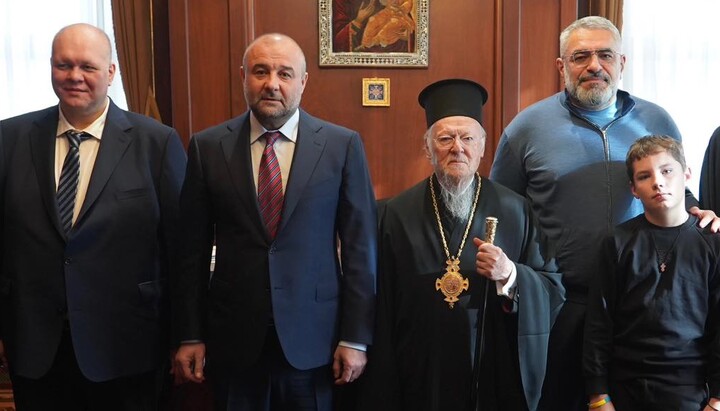
The reception of Petrovsky and Arutiunian at the Phanar. Photo: Press Service of the Ecumenical Patriarchate
Metropolitan Arsenios of Austria (Kardamakis) has awarded Oleksandr Petrovsky, a major sponsor of the OCU, the highest distinction of the Metropolis – the “Golden Cross.” And as a bonus, he brought Petrovskyi and his business partner Arutiunian to an audience with Patriarch Bartholomew, where they discussed new projects to support the Ecumenical Patriarchate.
According to Metropolitan Arsenios, such an honor was bestowed on Petrovsky “for all his donations to this day, and for his willingness to help and support us in the future.” The hierarch even went so far as to call the businessman “our Archon.”
And here one cannot help but marvel. The title of Archon is certainly not handed out to just anyone; it is reserved for the most respected and pious laypeople whose service to the Church is truly distinguished. Oleksandr Petrovskyi and Emil Arutiunian, with all due respect, hardly seem to fit such definitions.
Former Interior Minister Lutsenko once claimed that Petrovsky, “known in certain circles as ‘Narik’,” is listed in the ministry's files as the leader of an organized crime group. The same applies to Arutiunian, who is known in similar “business ventures” as “Emil.”
So how appropriate is it to call such individuals Archons and bring them into close proximity with the Ecumenical Patriarch? Is the mere fact of regular donations really enough?
Of course, one might object that Petrovsky and Arutiunian, like the Good Thief, have repented, reconsidered their lives, and now devote themselves entirely to the Church. Yet certain recent facts – both open and not-so-open – make this rather doubtful. It seems far more plausible that, through a sudden burst of piety, the new benefactors are purchasing reputations and entrance into high society. And we cannot exactly condemn them for that; business has its own rules.
The real questions here concern the hierarchs of the Ecumenical Patriarchate and their regard for their own reputation.
In 2018, they called individuals with no valid ordination “bishops” and received them into Eucharistic communion. Now they grant awards, bestow the title of “Archon,” and bring close to themselves men with deeply questionable backgrounds.
The ancient Greek dramatist Euripides is credited with the words: “Tell me who your friends are, and I will tell you who you are.”
Even more to the point is the Apostle Paul’s warning to the Corinthians: “Do not be deceived: Bad company corrupts good morals.”
A line written, it seems, as though expressly for the Ecumenical Patriarchate.
Read also
Ternopil post on Feast of Intercession: Has calendar reformn failed?
A significant number of believers have rejected the new church calendar introduced by the OCU and UGCC with government support.
Shoulder straps or a cassock: who writes the script for UOC "fighters"?
Everything indicates that both Veliar and Pshenychny are ordinary performers of someone else's script. There is only one question – does the scriptwriter wear shoulder straps or a cassock?
Why is it legal to kill a person before birth but not after?
Children are the most privileged members of society. Yet that same society officially permits children to be killed – and on a massive scale.
Honoring the Bolsheviks’ successors at Kyiv Lavra
It was under the Reserve that the relics of the saints were desecrated, Lavra churches were turned into an atheism museum, and toilets were installed in sanctuaries.
"Degenerates" and "stupid animals": anti-UOC activists turn on children
Future historians will wonder how a vast country’s information agenda could have been shaped for so long by people so petty, vicious, and utterly contemptible.
Zelensky sees murder of Polish priest but not of Sviatohirsk monk
Why does Zelensky react so emotionally and swiftly to the murder of a Catholic cleric while remaining completely silent about the murder of an Orthodox monk?