Opinion polls on the war and Zelensky: a case study in manufactured consent
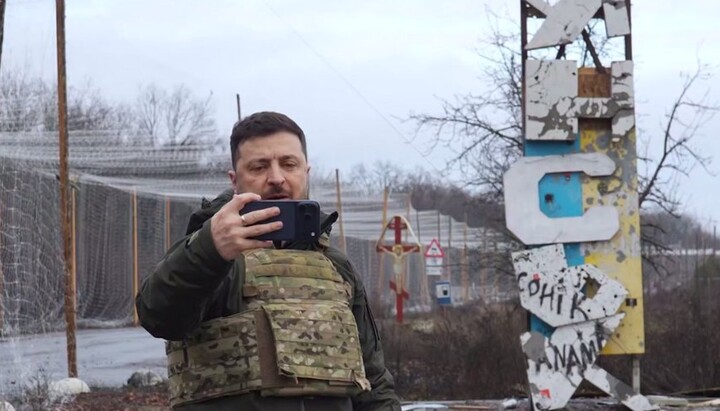
According to KIIS, Ukrainians have become even more supportive of Zelensky. Photo: BBC
The Kyiv International Institute of Sociology (KIIS) has published the results of a new survey on attitudes toward the war and public support for the Ukrainian authorities. The figures are striking – not because of what they reveal, but because of how sharply they diverge from observable reality.
Two findings are particularly noteworthy.
First, KIIS claims that 63 percent of Ukrainians are prepared to endure the war “for as long as it takes” (marked in blue color in the diagram below – Ed.) and that this figure has increased since September. This assertion raises an obvious methodological question: what exactly is being measured – public sentiment, or rhetorical compliance amid fear and pressure?
Since September, living standards for millions of Ukrainians have deteriorated significantly. Large cities, including Kyiv, now experience daily blackouts lasting 15–17 hours. Entire residential districts are left without electricity, water supply, sewage systems, elevators, or basic means of preparing food. Families with children, the elderly, and people with disabilities are forced to adapt to conditions that resemble a humanitarian emergency rather than normal civilian life.
At the same time, mass mobilization practices have intensified, with widespread reports of arbitrary detentions by Territorial Recruitment Centers. Under such circumstances, the claim that public willingness to “endure indefinitely” has been on the rise does not merely invite skepticism – it demands a serious explanation. Without one, the figures fail the basic smell test.
The second claim is even more difficult to reconcile with recent events. According to KIIS, public support for President Volodymyr Zelensky rose from 60 percent in October to 65 percent in December.
This period coincided with the eruption of the Mindichgate scandal, in which individuals from Zelensky’s closest circle were accused of corruption on an extraordinary scale, involving hundreds of millions of dollars. Crucially, the alleged embezzlement occurred in the energy sector – precisely the area responsible for protecting Ukraine’s power infrastructure from Russian attacks. The political climax of the scandal was the dismissal of the head of the Presidential Office, Andriy Yermak.
The material implications of this corruption are not abstract. They are visible in darkened apartments, cold homes, and prolonged blackouts affecting millions of citizens. Under such conditions, the assertion that presidential approval increased rather than collapsed requires either extraordinary evidence or extraordinary assumptions about public psychology. Neither is provided.
KIIS further reports that 59 percent of Ukrainians perceive “positive shifts” in the government’s fight against corruption. This claim stands in stark contrast to the growing number of investigations, indictments, and public allegations issued by NABU against senior government officials. Taken together, these data points suggest not a society convinced of reform, but one confronted with a widening gap between official narratives and lived experience.
This is not the first time KIIS surveys have raised such concerns. In church-related matters, its polling data were repeatedly cited by representatives of the Orthodox Church of Ukraine (OCU) as definitive proof of overwhelming public support. These figures were even incorporated into official synodal documents, despite their evident disconnect from on-the-ground realities within religious communities.
The pattern is difficult to ignore. The same polling instruments that once produced convenient numbers for ecclesiastical legitimization now generate equally convenient figures for political stabilization. In both cases, the results describe a population that appears curiously immune to corruption scandals, economic hardship, infrastructural collapse, and institutional coercion.
One is left to conclude that these polls describe not Ukrainian society as it exists, but a constructed public – a statistical abstraction designed to validate predetermined conclusions. In political theory, this phenomenon has a well-known name: manufactured consent. It's about those who believe that a corrupt government is sincerely fighting corruption; who believe that bees are against honey; who are ready to sit in darkness “for as long as it takes”; and who continue to support the man ultimately responsible for this reality.
If this is sociology, then its primary function is not to measure reality, but to replace it.
Read also
Who destroyed and restored Kyiv Lavra? MinCulture's video reveals the truth
The Culture Ministry’s propaganda about the Kyiv-Pechersk Lavra has inadvertently revealed the truth.
Ternopil post on Feast of Intercession: Has calendar reformn failed?
A significant number of believers have rejected the new church calendar introduced by the OCU and UGCC with government support.
Shoulder straps or a cassock: who writes the script for UOC "fighters"?
Everything indicates that both Veliar and Pshenychny are ordinary performers of someone else's script. There is only one question – does the scriptwriter wear shoulder straps or a cassock?
Why is it legal to kill a person before birth but not after?
Children are the most privileged members of society. Yet that same society officially permits children to be killed – and on a massive scale.
Honoring the Bolsheviks’ successors at Kyiv Lavra
It was under the Reserve that the relics of the saints were desecrated, Lavra churches were turned into an atheism museum, and toilets were installed in sanctuaries.
"Degenerates" and "stupid animals": anti-UOC activists turn on children
Future historians will wonder how a vast country’s information agenda could have been shaped for so long by people so petty, vicious, and utterly contemptible.