Blood on the foundation of our native Christianity
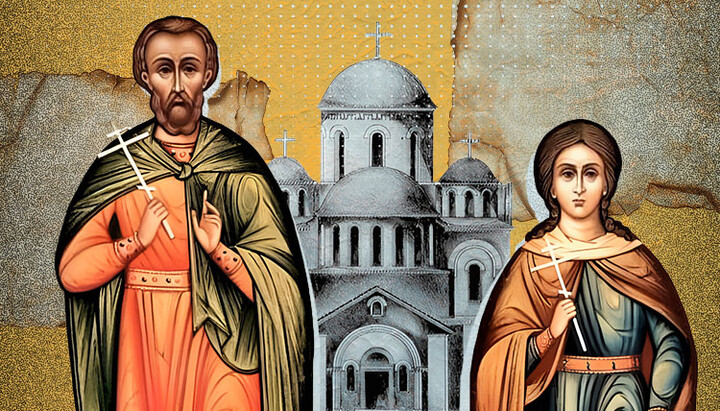
Holy Martyrs Theodore and John. Photo: UOJ
Kyiv, the summer of 983. The city is suffocating under a heavy, damp heat and the thick stench of raw meat. This is not the golden-domed Kyiv known from textbooks. It is a dense wooden town of several thousand homesteads, pressed between earthen ramparts and the Dnipro. On Starokyivska Hill, towering above the residential quarters, stands a new pagan pantheon erected by Prince Volodymyr only three years earlier. The golden moustache of Perun glitters in the sun, but the foot of the idol is drenched in the blood of sacrificial animals. The city lives in a state of perpetual debt to the forces of nature – and that debt is constantly growing.
Prince Volodymyr has just returned victorious from a campaign against the Yotvingians – a fierce Baltic tribe that took no prisoners and had terrorized the borders for decades. The prince’s retinue rejoices, the wagons are heavy with plunder, and captive slaves trudge gloomily toward the slave market in Podil.
In that age, success was not considered the merit of a commander. It was the result of a successful bargain with higher powers. The gods granted victory – the gods demanded payment.
The priests and elders responsible for the “religious security” of the state cast lots. They need not a sheep, but the finest human blood to seal the pact with heaven. The lot – that diabolical lottery – points to the estate of the Varangian Theodore. The appointed sacrifice is his son, the young John.
The economy of loyalty and the price of blood
Theodore was a visible figure in Kyiv, yet deliberately apart. A professional mercenary, a veteran who had served in the Byzantine formations of Miklagard (Constantinople), he brought back from his campaigns not only gold, but faith. His status allowed him to own a fortified homestead on the Hill.
By the standards of the time, Theodore was a wealthy man – the value of his mail shirt, his sword bearing a Carolingian mark, and his warhorse equaled the annual income of a small village.
When the messengers of the pagan priests knocked at his gates, a legal collision arose that turned into a massacre. For the pagan community, refusing to surrender one’s son was an act of state terror. If the gods did not receive their due, they would turn away from Kyiv – pestilence would begin, livestock would perish, hail would ruin the fields. Theodore had the option of buying his way out with slaves or gold, but the lot was personal. It was a challenge thrown at the very identity of the Christian.
The Varangian stepped out onto the gallery of his house. His estate was built in the Scandinavian manner – on a high stone substructure, with an open gallery on the upper level. From there he looked down at the crowd slowly boiling below.
At that moment a speech was delivered that became the first public manifesto of Christianity in Rus’.
There was no meekness of a victim in it – there was the steel voice of a soldier.
“They are not gods, but wood,” said Theodore, as preserved by the Primary Chronicle, his words cutting the air like a blade. “Today they exist, tomorrow they rot. They neither eat nor drink nor speak, but are made by human hands from wood. God is one – Him the Greeks serve and worship. He created heaven and earth and man. And what have these gods done? They themselves are made. I will not give my son to demons!”
This was not merely a theological dispute. Theodore tore the mask of sacredness from Volodymyr’s state ideology. He declared it outright – your foundation is rot. Your gods are logs.
The mechanics of murder – the assault on the house
The crowd did not engage in an open fight. The enraged Kyivan pagans knew that Varangians would fight to the last. In a narrow doorway or on a staircase, two trained warriors could hold off a hundred attackers, turning the entrance into a slaughterhouse. Feeling threatened, the pagan system resorted to collective violence without direct contact.
People began chopping through the supporting pillars of the gallery. Imagine the sound – the synchronized blows of dozens of axes against dry oak. Splinters flew in fountains. The house creaked, sagging to one side. This was not an execution – it was dismantling. Theodore and John stood above, cut off from the ground.
The walls of the house, meant to protect, became instruments of murder.
When the supports finally failed, the gallery collapsed with a thunderous crash. Tons of logs, beams, and earth – used as roof insulation – fell upon the martyrs. The chronicle laconically records the result: “And no one knows where they were laid.” Most likely, their bodies were simply left beneath the rubble. The crowd dispersed, believing order restored. Yet it was precisely at that moment that the old world of Kyiv began to crack.
A turning point for Volodymyr
Prince Volodymyr was in his residence at the time. We can only guess what this pragmatic and brutal ruler felt when the details of the killing were reported to him. Volodymyr respected strength and professionalism. Theodore had been one of his elite warriors. And that warrior had been killed by a mob in the name of a wooden idol.
For Volodymyr, this became a moment of truth.
He realized that the system he had built was a dead end. Paganism destroyed loyal subjects, turned the people into an uncontrollable element, and deprived the state of its intellectual and military elite.
Moreover, Kyiv was economically bound to Byzantium. Trade along the route “from the Varangians to the Greeks” required not only swords, but a shared cultural code with Constantinople. With gods demanding the blood of children, one was not welcomed into respectable trading houses of Europe.
The blood of the martyrs Theodore and John became the substance that dissolved the prince’s pagan self-assurance. He saw that Christianity gave a man an inner support that even a collapsing house could not break. Five years later, Volodymyr would make a decision that changed the map of the world.
A church at the site of the crime
The link of times does not end there. Years after the official Baptism of Rus’ in 988, Volodymyr began building the Church of the Tithes – the first stone храм of the state. It was a grand project, funded by a tenth of the prince’s revenues. Architects from Constantinople used Byzantine plinth brick and marble brought from Crimea.
Tradition tells us that the Church of the Tithes was erected on the very spot where the house of the Varangian Theodore may have stood – or nearby.
Volodymyr literally cleansed the place of a bloody lynching and set an altar there. The altar where the Bloodless Sacrifice is offered was placed where pagans had demanded the blood of a child.
Today, only the foundation of the Church of the Tithes remains, preserved by archaeologists. But when we stand on those stones, we stand at the site of the first victory of the spirit over a totalitarian system on our land. Theodore and John lost physically – their house was destroyed, their bodies crushed. But they won historically.
A thousand years later, their names resound in prayers, while the golden moustache of Perun has long since rotted in the Dnipro’s silt. Their death became the very cornerstone on which all native Christian culture was built. It is a reminder to us today – empires collapse, regimes change, but fidelity to Truth remains embedded in the foundation of eternity.
Read also
Why holy monasteries turned into state prisons
The history of Christian Europe has preserved the memory of times when monasteries became places of state exile. The fates of monarchs and righteous men were decided there.
A shepherd boy with a letter from Christ to French king
In the summer of 1212, thousands of pilgrims carrying staffs waited for the sea to part before them. Later chroniclers added ships, slave traders, and a pope's lament to their story.
Facade of bones and facade of light
Antoni Gaudí spent forty-three years building a church in Barcelona, knowing that this construction was for the ages.
Trial of a dead pope
Once in Rome, the body of a deceased pope was seated on the throne and put on trial. The accusation relied on a church canon that had once saved his see.
Monastery built in defiance of king
When Orthodox believers in Minsk were left with just one church, townspeople decided to build another – and even a royal decree did not stop them.
Young Mother and Sleeping Christ
Michelangelo carved a Virgin Mary who looks younger than her Son – and signed his name in marble for the only time in his life. Neither of these peculiarities was accidental.