Holy Family’s golden reserve: How Magi's Gifts saved them from poverty
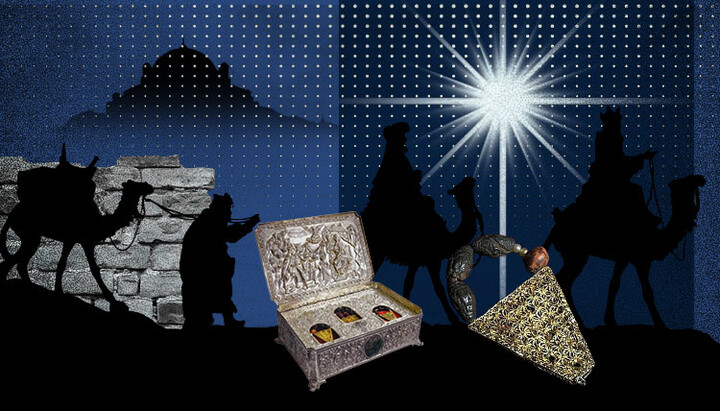
A history spanning millennia. Photo: UOJ
We are accustomed to seeing Christmas through the lens of a cozy, almost fairy-tale aesthetic: the nativity scene, the star, the shepherds, mysterious kings in brocade robes. In our imagination, the Gifts of the Magi – gold, frankincense, and myrrh – have turned into elegant symbols: gold for the King, frankincense for God, myrrh for the Man destined to die. This theological interpretation is correct, yet it often obscures the blunt, tangible substance of history.
If we were transported to Mount Athos, to the Monastery of St. Paul, and, by special mercy, were brought an ancient silver reliquary, we would see not symbols, but material evidence. In the velvety half-dark of the casket lie twenty-eight gold plates. These are neither coins nor shapeless ingots. They are jewelry of the highest craftsmanship – triangular, rectangular, and trapezoidal pendants covered with the finest filigree. The ornamentation is intricate and refined; experts discern in it an ancient Persian or Babylonian school. Attached to these gold plates by silver threads are dark, olive-like beads. This is a mixture of two precious resins – frankincense and myrrh.
The most astonishing thing about this relic is not the gleam of gold, but the scent.
Twenty centuries later, the chemistry of ancient resins is still at work. When the reliquary is opened, the room fills with a dense, complex aroma, utterly free of the mustiness of museum storage. This is the smell of history itself, having survived the rise and collapse of humanity’s greatest empires.
The economics of the Divine plan
Looking at these delicate gold plates, a pragmatic mind asks a blunt question: why were they needed by the Infant Christ? God has no need of gold, and the Holy Family, living in simplicity, hardly required Persian jewelry for vanity. The answer lies not in mysticism, but in the harsh economics of survival.
On the very night the Magi departed Bethlehem, an Angel appeared to Joseph the Betrothed in a dream with a command: “Rise, take the Child and His Mother, and flee to Egypt” (Matt. 2:13). Consider what this meant for a simple carpenter. Egypt was another country, another jurisdiction, another language. It was a long journey, requiring the hiring of a caravan or at least the purchase of hardy animals. It meant renting shelter in a foreign land for an unknown length of time, buying food, paying border duties, and perhaps bribing Roman guards or bandits for safety.
A poor Galilean carpenter’s family could not possibly have possessed such savings. Flight into Egypt without money would have been doomed – they would have perished in the desert or fallen prey to slave traders. And here we see Providence acting through matter.
The gold of the Magi became the financial safety cushion the Lord sent to the Holy Family at the precise moment it was vital.
These twenty-eight plates are the remnant of the capital that allowed the Son of God and His Mother to survive the years of exile. We may reasonably assume there was more gold, part of which was spent on daily life in a foreign land. The remaining plates the Mother of God preserved throughout her life, not as wealth, but as a memory of Christ’s first encounter with the pagan world that bowed before Him.
An odyssey through the ruins of empires
The subsequent fate of the Gifts reads like a high-stakes historical novel. Material objects tend to be lost, melted down, or vanish in the fires of war. Yet the Gifts of the Magi passed through the needle’s eye of history.
According to tradition, shortly before her Dormition, the Most Holy Theotokos entrusted these relics to the Jerusalem community.
They were kept there for several centuries, passed from generation to generation as the greatest shrine. The situation changed when Christianity became the state religion of Rome. In the early fifth century, under Emperor Arcadius, son of Theodosius the Great, the Gifts were solemnly transferred to Constantinople.
Byzantium knew how to guard holy treasures. The Gifts were placed in the treasury of Hagia Sophia, the Empire’s principal cathedral. There they remained for about eight hundred years, witnessing imperial triumphs and ecumenical councils. But in 1204 disaster struck. The Crusaders, forgetting the Cross, stormed Constantinople, plundering and profaning Orthodox sanctities. In that chaos, the Byzantines achieved the unthinkable – evacuating the most precious relics, including the Gifts, to Nicaea.
For some sixty years the Gifts lived in exile, until Michael VIII Palaiologos reconquered Constantinople in 1261 and returned the shrine to Hagia Sophia. It seemed they had come home forever. Yet in 1453 the Second Rome fell to the Ottoman Turks. Mehmed the Conqueror rode into the cathedral on horseback, and it appeared the traces of Christian sanctities would be lost in sultans’ harems and treasuries.
The diplomacy of a Serbian princess
Salvation came from an unexpected quarter. Sultan Murad II, father of Mehmed the Conqueror, was married to Mara, daughter of the Serbian despot George Branković – known at baptism as Maria. Though the sultan’s wife, she remained a faithful Christian and enjoyed immense respect at court. She was not merely “one of the wives”; she was a diplomat and stepmother to the future Sultan Mehmed II, who called her “my mother”.
After the fall of Constantinople, many relics from the looted Byzantine treasuries passed into Mara’s hands.
As a Christian, she understood that the sultan’s treasury was no place for gifts offered to God.
Around 1470, Mara took a bold step. She set out for Athos, to the Monastery of St. Paul, traditionally supported by Serbian rulers.
Here legend and history converge. According to tradition, Mara intended to carry the Gifts into the monastery herself and place them on the altar. But halfway from the harbor to the gates she suddenly stopped. The tradition says a voice from above addressed her – the voice of the Mother of God herself: “Do not approach. Another Queen reigns here.”
Mara, despite her exalted status as sultana, humbly obeyed. She handed the reliquary to the monks who came out to meet her. On the spot where she stood, a chapel was later built, preserved to this day. That gesture of Mara Branković became the final point in the wanderings of the Gifts. For more than five hundred years now, they have not left the monastery walls.
A touch of reality
The modern world tries to turn Christmas into an abstract holiday of “goodness and light”, stripped of historical concreteness – a winter fairy tale. But fairy tales are ephemeral. Cinderella left no glass slipper that could be subjected to spectral analysis.
The Gifts of the Magi are an anchor that holds us in reality.
The existence of these gold plates with ancient ornament proves this: the Gospel is not a myth. The star truly led a caravan. The Magi were real people who crossed a real desert, wearing out their feet and risking their lives. God truly entered our rough, dust- and resin-scented history.
These objects, which passed through the hands of the Mother of God, Byzantine emperors, and a Serbian princess, tell us that gold can serve not mammon, but God. And the fragrance of frankincense and myrrh still exuded by those dark beads is the scent of eternity’s victory over time. Empires collapsed, palaces turned to dust – yet the Gifts brought to the Infant in a cave endured, so that today we may touch them and say: God is with us.
Read also
Why holy monasteries turned into state prisons
The history of Christian Europe has preserved the memory of times when monasteries became places of state exile. The fates of monarchs and righteous men were decided there.
A shepherd boy with a letter from Christ to French king
In the summer of 1212, thousands of pilgrims carrying staffs waited for the sea to part before them. Later chroniclers added ships, slave traders, and a pope's lament to their story.
Facade of bones and facade of light
Antoni Gaudí spent forty-three years building a church in Barcelona, knowing that this construction was for the ages.
Trial of a dead pope
Once in Rome, the body of a deceased pope was seated on the throne and put on trial. The accusation relied on a church canon that had once saved his see.
Monastery built in defiance of king
When Orthodox believers in Minsk were left with just one church, townspeople decided to build another – and even a royal decree did not stop them.
Young Mother and Sleeping Christ
Michelangelo carved a Virgin Mary who looks younger than her Son – and signed his name in marble for the only time in his life. Neither of these peculiarities was accidental.