Four notes of immortality: How the author of “Shchedryk” died and why he won
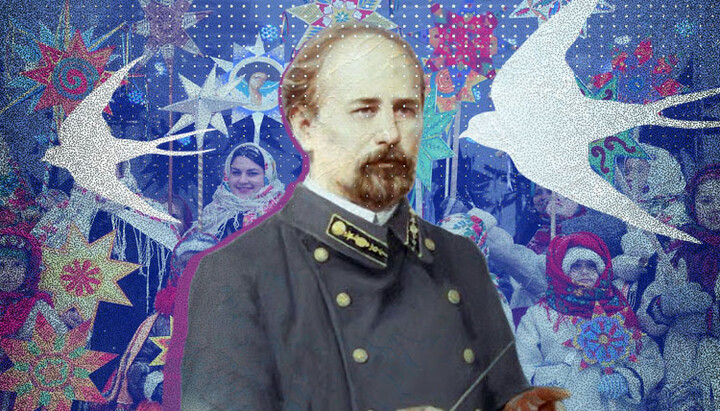
“The Swallow” by Mykola Leontovych. Photo: UOJ
New York. Tokyo. London. Berlin. Late December. Wherever you find yourself these days – in a vast shopping mall, in a cozy coffee shop, or in front of the television where little Kevin is once again “Home Alone” – you will hear it.
Four notes. Ta-da-da-dam. Ta-da-da-dam. A swift, bell-bright rhythm, rising, tightening, gathering force.
For billions of people on the planet, this melody is Carol of the Bells – the hymn of Western Christmas. It is associated with joy, with mountains of gifts, with the happy ending of a Hollywood film. It feels as though this music was born somewhere in well-fed, comfortable America, created simply to drape the world in festive cheer.
But if we mute the commercials. If we wipe from the staff the English words about “silver bells.” If we look deeper, to the place this sound came from – we will not see garlands. We will see blood on white snow.
Because these four notes are not a little song.
They are the prayer of a Ukrainian swallow – interrupted by a point-blank shot.
The Podolian Bach
The man who gave the world this masterpiece was named Mykola Leontovych. He did not look like a celebrity. Modest, quiet, well-bred – an educated, delicate man with sorrow in his eyes. The son of a village priest, he spent his life teaching children to sing, conducting eparchial choirs, and hearing music where others heard only noise.
They call him “the Ukrainian Bach.” And that is no exaggeration. Leontovych did with folk song what a jeweler does with a diamond. He took a melody simple and ancient as the earth itself – and began to facet it.
“Shchedryk” was not written in a single evening. Leontovych returned to it for years. He rewrote it five times. He searched for the perfect braid of voices.
At the heart of this music lies an ancient refrain, older than Christianity itself – a little pagan chant. It has only three or four notes. Our ancestors sang it in spring, when the swallows returned. They believed this bird carried on its wings the new year, new life, a “generous evening” – the time when the world renews itself.
Leontovych, a deeply believing man, poured a new and lofty meaning into that archaic seed. In his arrangement, a simple spring song became a polyphonic cathedral. The voices answer one another, chase one another, shimmer and ring – like life itself, conquering winter’s frozen stupor.
He wanted to give people spring.
But winter was thickening all around him.
It was 1921. The world was breaking apart. War, revolution, terror. The air smelled of smoke and fear. And Leontovych went on writing music, trying to set harmony against chaos.
Judas knocks at the door
January. The village of Markivka, Podolian Governorate. Mykola Leontovych has come here, to his parents’ home, for Christmas (Old Style) – to rest, to see his priest-father, to see his little daughter. Outside, the snow is sweeping and blind. Inside, it is warm; the house smells of wax and oven bread.
On January 22, toward evening, a cart rolled into the yard. There came a knock at the door. On the threshold stood a man in a leather jacket with a rifle. Young – barely over twenty.
“I’m a Chekist. I fight banditry. I need a place to spend the night,” he said.
His name was Afanasiy Hryshchenko.
In a priest’s home there was an unwritten law of hospitality: a traveler must be let in, warmed, fed. No one knew that at that moment they were opening the door to death itself.
They sat the guest at the table. They gave him tea. The conversation, relatives would later recall, was peaceful. Leontovych, whose soul did not know how to see evil, even sat at the piano and played for him.
Imagine the scene. Divine music fills the room. And beside it sits a man who knows exactly what he will do in the morning. He listens. He nods. Perhaps he even smiles.
It is a biblical scene.
The kiss of Judas.
The breaking of bread with the one who will betray you.
They all went to sleep. Hryshchenko was placed in the same room as Mykola. Early in the morning, January 23, around seven o’clock, a dry, harsh crack tore the silence.
A shot.
The father rushed into the room and saw his son on the divan. Blood flooded the pillow. Hryshchenko stood over him, working the bolt of the rifle.
“What have you done?!” the old priest cried.
The Chekist calmly aimed the rifle at the old man and demanded money. And then began the kind of looting whose squalor is almost unbearable. The man who had shot a genius started robbing the house. He bound the composer’s sister’s hands. He dug through chests.
What did he take – gold? diamonds?
He took a sheepskin coat.
He took underwear.
And he pulled from the feet of the still-warm, dying Leontovych his boots. The genius was bleeding out beneath the music of his uncompleted spring, while the murderer tried on another man’s shoes.
Leontovych did not die at once. His father managed to read the prayers for the departing soul over him. The last thing he heard in this world were Gospel words – and the weeping of his family.
Later, in an official report, Hryshchenko would write a cynical lie about an “accidental shot.” But the archives preserved the truth. This was not simply a robbery. In those years they were eliminating the best – eliminating those who carried culture, faith, vibe: the spirit of a people.
The flight of the swallow
The murderer put on the boots and vanished into the snowy gloom. He thought he had killed a man and muffled his music.
How wrong he was.
A body can be killed. Boots can be stolen. But a swallow cannot be stopped.
In 1919, two years before the tragedy, at the initiative of Symon Petliura, the Ukrainian Republican Capella was created under the direction of Oleksandr Koshyts. Their mission was diplomatic: to show Europe that Ukraine was not merely a territory on a map, but a nation with a great culture.
While Leontovych lay in the grave, his music began its triumphal march. Prague. Vienna. Paris. Berlin. Halls rose to their feet. Critics wrote rapturous reviews. And then came the ocean.
October 5, 1922. New York. Carnegie Hall. Koshyts’s choir sings “Shchedryk.” America goes still. That rhythm – ta-da-da-dam – struck the very nerve of the age.
In the hall sat Peter Wilhousky, an American choirmaster of Ukrainian origin. The melody shook him so profoundly that he decided it must live here for good. He understood it would be hard to explain to Americans the swallow, the coming of spring in January.
And so he wrote a new text. Not a translation – a poetic variation. Those small, rhythmic sounds reminded him of the ringing of little bells.
Thus “Shchedryk” became Carol of the Bells. The swallow turned into a bell.
But the soul of the music remained what it had always been – music of light overcoming darkness.
The victory of the victim
A hundred years have passed. Where is Afanasiy Hryshchenko now?
We know his name only thanks to meticulous historians who dug through Cheka archives. He died somewhere in obscurity, ground up in the millstones of the very system he served. Nothing remains of him but the disgrace of a murderer and a looter. No one cares where he is buried. The boots he stole have long since rotted to dust.
And where is Mykola Leontovych?
Turn on the television. Open YouTube. Step outside on Christmas Eve. He is everywhere.
His music sounds in Hollywood blockbusters and at children’s holiday performances. It is played by symphony orchestras and dribbled by NBA stars on basketball courts. It is sung in churches and in public squares.
Every performance of Carol of the Bells is Hryshchenko’s defeat.
Every note is proof that a bullet is powerless against the spirit.
So the next time you hear that famous melody, do not rush to switch to another channel. Stop for a second. Remember the quiet, snowbound house in Markivka. Remember the modest music teacher with sorrow in his eyes. And hear in that bright, ringing cascade not only the joy of the holiday, but a great victory.
The swallow has made it.
Spring has come.
Read also
How a wedding stopped a war
The young princess of Slutsk was married off to keep two powerful noble families from drowning the city in blood. Soon afterward, a Uniate metropolitan complained that Orthodoxy had been reborn in Slutsk.
Man before the forces of nature
A solitary figure on the shore seems insignificant before the immense power of the sea, yet it is he who stands before the Creator.
The mysteries of Golgotha in the light of archaeology
The veil of centuries obscures what really happened in the fourth century. Archaeology and ancient texts shed light on the true history of one of Christianity’s greatest sacred sites.
Zaporozhian Cossacks defend the persecuted faith
The story of how Cossacks drew their sabers to defend abused priests – while sometimes causing violent disturbances inside churches themselves.
A forgery at the foundation of Mohyla Academy
For centuries, historians have repeated an appealing story about a wealthy benefactor’s generous gift. Archival documents, however, paint a very different picture of what happened.
Theology of worn-out shoes
A painting of a pair of old shoes in a Dutch museum preserves the memory of an ordinary working person and a life of hard labor.