A shrine in your pocket: Why Christians wore lead flasks around their necks
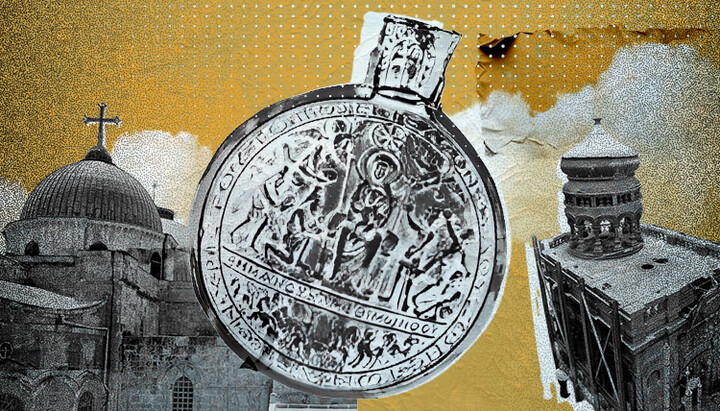
Monza Ampulla – 6th century artifact. Photo: Union of Orthodox Journalists
Imagine someone places a cold, heavy disk in your palm. It is about the size of a cookie – maybe two or three inches across. Dingy gray. Rough and gritty to the touch. It is not gold. Not silver. It is a cheap alloy of lead and tin – late antiquity’s mass-produced “everyday junk.”
On the sides are pressed naïve, almost childlike images: little figures with halos, a Cross, women at the Tomb. At first glance, it looks like a stamped trinket churned out in bulk.
But if you had shown this object to a person in the sixth century, he would have given you everything for it. Because inside that ugly little lead blister is a frozen drop of oil – oil that burned in a lamp above the Holy Sepulcher fifteen hundred years ago.
This is the “Monza ampulla,” a signature relic of an age when the world was tumbling into the abyss.
A one-way ticket
To understand what that lead was worth, you have to breathe the air of that time.
Late sixth century. Europe looks like an agitated anthill being drenched with boiling water. The Great Migration of peoples is grinding borders into dust. The Roman Empire – which once seemed eternal – is cracking, and its plaster is falling away. The Lombards invade Italy – fierce, merciless, ruthless. And from the East creeps an invisible killer – the “Justinianic Plague,” wiping cities clean.
In that world, a human life costs less than a pair of boots. And in that world, a person decides to go to Jerusalem.
This is not tourism. It is a deadly quest.
He writes a will. He says goodbye to his children as if they are already lowering him into the grave. He knows the odds of returning are about fifty-fifty. Roads swarm with bandits. Inns breed typhus. Crossings are stalked by slave traders.
Why did Christians go on pilgrimage in those days? Because when fortress walls collapse and doctors are powerless, hope has only one place left to go – a miracle. They did not go for impressions. They went for life. To touch the place where death had been defeated not as an idea, but as a fact.
A lead first-aid kit
And then the traveler makes it. Feet rubbed raw to meat. Skin burned by the sun. He stands at the Holy Sepulcher. He has almost no money.
He buys this lead ampulla. Local monks pour into it a little oil from the unextinguished lamp. Sometimes they mix it with holy water, or even add a pinch of dust from Golgotha. The pilgrim hangs it around his neck on a coarse cord – close to the body, under a filthy, sweat-soaked shirt.
Now it is his body armor.
On the way back, when malaria starts shaking him somewhere in a ditch outside Damascus, or when a robber’s knife finds him in the mountains, he will not have antibiotics. He will not have an emergency hotline.
With a trembling hand, he will tear this lead from his neck. He will break the seal. And he will swallow a drop of oil. This is his resuscitation. His last Communion. His connection to God when every other connection has been cut.
The collection of the queen of barbarians
Why are these flasks called “Monza ampullae”? Because the largest collection is kept in the cathedral of the Italian city of Monza.
They were gathered by Queen Theodelinda – an astonishing woman. A Bavarian princess who became queen of the Lombards. A “barbarian” who embraced Christianity and tried to humanize her brutal people.
She had power. She had chests of gold and gemstones (the famous Lombard “Iron Crown” is kept there, too). And yet, with almost obsessive persistence, she collected these cheap, gray, lead little bottles.
Why? Because living in a golden palace amid bloody chaos, she understood something simple and terrifying: gold chills the hands, but these flasks warm the soul. She knew the real value was not the metal, but the Grace sealed within. She was not collecting jewelry – she was collecting “batteries of holiness.”
The Christian’s “go-bag”
You look at these ampullae today and your skin goes cold. How painfully current it feels. We are living again in a world where stability turned out to be a house of cards. Where we have learned the word “evacuation” by heart. Where we know how to pack a “go-bag” in fifteen minutes.
Documents. Water. Medicine. A power bank. And faith?
A pilgrim’s ampulla is the blueprint for how all the holiness of the world can fit in a jacket pocket.
When your home can burn or be shattered by a missile or a drone, when a church can be closed or taken away at any moment, you learn one harsh thing: walls cannot be trusted. You cannot carry an iconostasis. You cannot load a library into a backpack.
In the end, you have only what hangs on your neck: a small cross – and an “ampulla” of faith inside your heart. The Christians of the sixth century were wiser than we are. They did not chain themselves to concrete. They knew: God is not in the beams, but in the ribs. And that little lead flask was, for them, a portable Temple.
A mobile access point to Heaven.
If you have such a thing, you can survive even in the epicenter of plague. If you do not, no walls will save you. The story of the Monza ampullae teaches the main lesson: faith must be portable – the kind that cannot be taken away, even if everything else is taken.
Read also
Trial of a dead pope
Once in Rome, the body of a deceased pope was seated on the throne and put on trial. The accusation relied on a church canon that had once saved his see.
Monastery built in defiance of king
When Orthodox believers in Minsk were left with just one church, townspeople decided to build another – and even a royal decree did not stop them.
Young Mother and Sleeping Christ
Michelangelo carved a Virgin Mary who looks younger than her Son – and signed his name in marble for the only time in his life. Neither of these peculiarities was accidental.
Orthodox books from a Uniate printing press
In the 18th century, Uniate monks at Pochaiv printed books used in prayer by Orthodox Christians and Old Believers alike.
The story of the honey brotherhood
The Mogilev Brotherhood began with members pooling money to brew honey drinks for feast days – and eventually grew to have its own printing press.
Golgotha in the midst of a pogrom
In the autumn of 1938, the Jewish artist Marc Chagall painted the crucified Christ. Synagogues burn and refugees flee around the cross, while the Crucified One Himself is wrapped in a prayer shawl.