Water for the heart: Why Exupéry wrote about Baptism without knowing it
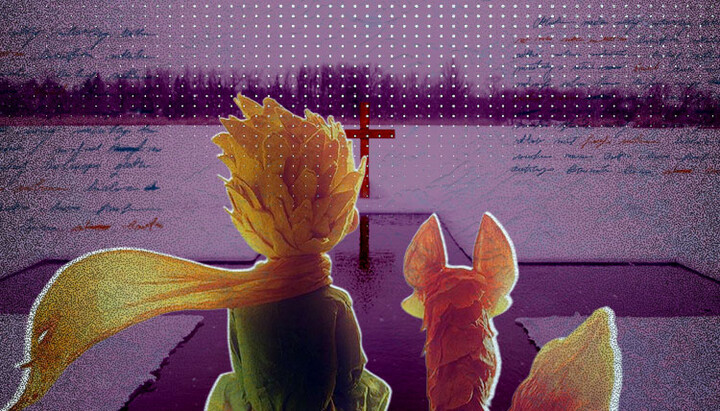
Baptismal meanings. The baptismal meanings of The Little Prince. Photo: UOJ
January has crossed its midpoint. The holiday glitter has already fallen away; the trees have been hauled out or are waiting for their fate on balconies. Ahead lies a long, gray winter. And, of course, the news – the kind that makes you want to squeeze your eyes shut.
On days like these, we all feel the same thing: thirst. Not the thirst you can settle with tea at the kitchen table, but another kind. A deeper one. A dryness in the throat from being unable to speak out. A dryness in the heart that is tired of being afraid and tired of waiting.
We resemble that Pilot from the tale that, in truth, is not a fairy tale at all. Our plane has crashed somewhere in the sands of history. The machinery of ordinary life is broken. There is enough water left in the canteen for an hour. And around us – no one. Only the endless dunes of problems.
Precisely at this moment, a couple of days before Theophany, we need to open that small book with its naïve drawings. Not to be charmed by it, but to read the most honest theological treatise ever written about Thirst.
Broken machinery
Antoine de Saint-Exupéry knew what he was writing about. In 1935 he really did crash in the Egyptian desert. He was dying of dehydration. He saw mirages. He knew the feeling of a rough tongue sticking to the roof of the mouth, and how the sun turns into a hammer, pounding at your head.
That is why The Little Prince is a chronicle of survival.
The Pilot repairs the engine. He is irritated. A bolt will not budge, and on top of it all some child keeps pestering him with questions about a sheep and thorns. The Pilot is our reason – practical, brisk, and impatient. He says, “I’m busy with something serious! We have a catastrophe!”
And the Little Prince is the soul. And it speaks softly, but insistently: “Water can be good for the heart, too.”
Remember that scene. Night. They go out to look for a well. From the Pilot’s point of view – the point of view of reason – it is madness. To search for a well in the boundless Sahara, at random, in the dark? It is “not according to the rules.” It is against logic. And yet they go.
They walk beneath the stars; the sand squeaks beneath their feet. It is an image of our faith.
Faith is not when you have the GPS coordinates. Faith is when, tired and desperate, you simply agree to keep walking beside your own soul, even if common sense is shouting that it is useless.
The squeak of an old wind vane
And they find it. Not an oasis with palms. Not a mirage. “This well was not at all like Saharan wells… It reminded one of a village well.”
Strange, isn’t it? Where did a homely, familiar village well come from in a desert where there is not a single village?
Exupéry describes the sound: “The pulley squeaked like an old wind vane that squeaks when there has been no wind for a long time.”
Do you hear it? Rusted, heavy, drawn-out – that squeal. The well had been asleep. No one had drawn from it for a long time. But as soon as effort was applied, it awakened.
In that sound is the whole essence of spiritual life. It is not given “at the snap of the fingers.” You have to turn a heavy wheel. You have to rouse what has gone dormant in you over years of bustle. It takes the exertion of hands lifting a weighty bucket from a black depth into the light.
The Pilot lifts the bucket. Water sloshes over the rim. He raises it to the Little Prince’s lips.
And here Exupéry writes words that sound like a proverb chanted in church:
“This water was not just water. It was born of a long walk under the stars, of the squeak of the pulley, of the effort of my arms. It was like a gift to the heart.”
Another water
Soon we will go to church. We will stand in lines, holding jars, bottles, canisters.
Why? Has the water supply been shut off at home? Does H₂O not run from the tap? It does. We can drink it. We can cook soup with it.
But we are going for another water. We need water that was “born of a long walk under the stars.” Water for which we stood through a long service (or at least made it to the church through the frost). Water that, as Exupéry writes, is “good for the heart.”
Holy water at Theophany is not a magic liquid. It is meaning made tangible.
It is a reminder that the world is not empty; that matter is capable of receiving God; that even simple water can become a shrine if Heaven enters it.
A drunk drinks to forget. A Christian drinks Agiasma to remember – to remember who he is; to remember that he is not merely a set of biological functions in need of moisture; to remember that he is a traveler in the desert who has a Father.
The secret of beauty
“Do you know what makes the desert beautiful?” the Little Prince said. “Somewhere it hides a well.”
Look around at our life. Does it resemble a desert? Probably. There is a lot of sand, a lot of wind, a lot of danger, and very few visible landmarks. We repair our broken “engine” – the economy, the psyche, our relationships – and we often cannot see an end to the repair.
But Exupéry gives us new sight. The desert is beautiful only because, somewhere within it, there is a hidden Well.
Take God away, and our reality becomes simply hell – a senseless heap of suffering and fear.
But if we know that somewhere here, beneath the layers, under the sand and the news, there is a Source, everything changes.
The sand begins to shine under the moon. The squeak of the pulley becomes music. The heaviness of the bucket in our hands becomes joy.
What matters most cannot be seen with the eyes. The eyes see only craters, ruins, and tired faces. But the heart knows: the Well exists.
Drink, in order to live
We often feel like that Pilot – hands in oil, the bolt refusing to yield, no water, almost no hope.
But there is always that quiet voice beside us: “Come. Water is needed for the heart, too.”
Theophany is the feast of discovering the Well. God enters the waters of the Jordan (and the waters of the Dnipro, and every drop of water on the planet) to say to us: I am here. I am not on a far-off heaven. I am woven into your life. I am ready to give you drink – if you are ready to make the effort and turn the rusty wheel of prayer.
Read also
Facade of bones and facade of light
Antoni Gaudí spent forty-three years building a church in Barcelona, knowing that this construction was for the ages.
Trial of a dead pope
Once in Rome, the body of a deceased pope was seated on the throne and put on trial. The accusation relied on a church canon that had once saved his see.
Monastery built in defiance of king
When Orthodox believers in Minsk were left with just one church, townspeople decided to build another – and even a royal decree did not stop them.
Young Mother and Sleeping Christ
Michelangelo carved a Virgin Mary who looks younger than her Son – and signed his name in marble for the only time in his life. Neither of these peculiarities was accidental.
Orthodox books from a Uniate printing press
In the 18th century, Uniate monks at Pochaiv printed books used in prayer by Orthodox Christians and Old Believers alike.
The story of the honey brotherhood
The Mogilev Brotherhood began with members pooling money to brew honey drinks for feast days – and eventually grew to have its own printing press.