Profanity is a virus: how one filthy word can kill an entire world
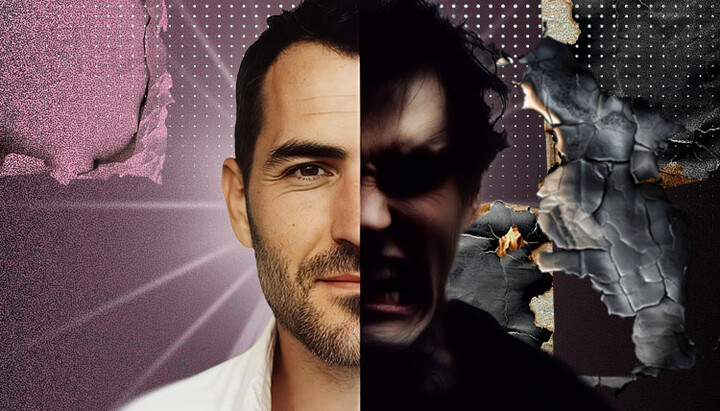
Human duplicity. Photo: UOJ
February 3 is the Day Against Obscene Language. Let us talk about the mechanism by which swearwords affect the personality – and how profanity “re-flashes” our consciousness.
Profanity is a virus. But unlike a biological virus, it does not attack the cells of the body – it attacks the cells of meaning. Profanity is not merely a set of “bad words”; it is the most widespread form of entropy in the soul.
The mechanism of this degradation is very simple. The moment a person curses, control over consciousness is seized by the limbic system. The prefrontal cortex – that is, the zone that makes us human, capable of analysis, compassion, and creativity – is switched off, and in its place the reptile brain begins to work. With constant use of profanity, a person’s emotional range narrows to a few primitive reactions.
Architectural erosion
Language is the house of Being, as Martin Heidegger thought. The word is the mirror into which we look in order to understand who we are. We do not live in a bare physical world – we live in a world we have named and described.
Imagine a person entering a magnificent cathedral. If his vocabulary contains words like “majesty,” “sacrality,” “aspiration,” “chiaroscuro,” he will live this experience with his whole being. He will see prayer frozen into stone. But if his language is limited to everyday and obscene constructions, the cathedral will remain for him merely “a big stone building.”
Obscene language works like architectural erosion. When we let profanity into our daily life, we consciously demolish the load-bearing walls of our inner castle.
Instead of halls for reflection and terraces for contemplation, a person builds a concrete bunker. A personality locked in the narrow corridor of swearing gradually grows into those walls, becoming just as coarse and primitive as the words with which it surrounds itself.
Semantic fast food
The philosophy of language calls obscene vocabulary “semantic fast food.” Why? Because finding the precise word for one’s state is labor. How do you describe the bitterness of an unfulfilled dream so that the other person tastes it? How do you express anger without losing dignity? How do you convey delight without banality?
All of this requires the work of thought, the strain of will, the richness of imagination. Profanity offers a deceptively easy path. Why painfully search for the right definition if you can fling out a universal sound-clot?
When the erosion of obscene words begins to spread freely through a society, it is a sign that a nation is rapidly losing its culture and its identity.
Because culture is the ability to restrain chaos by means of the Word. By losing the purity of speech, we open the gates to barbarism – first in words, and then in deeds.
The personality speaks itself into being through words. Each word is not merely a tool of communication; it is a semantic code that programs the neural circuits of our brain and lays down the trajectory of our behavior. We do not merely use language – we live inside it. Words are filters that shape our understanding and perception of reality, our emotions, and our behavioral model. Our “I” expresses itself verbally. The person expresses himself by word.
Linguistic amputation
Ludwig Wittgenstein, one of the greatest philosophers of language of the twentieth century, said: “The limits of my language mean the limits of my world.” Every feeling requires its own name. When we possess these names, we become masters of our inner landscape.
But look at what profanity does. It offers a “universal key” – one furious, filthy word that replaces the entire spectrum of human states.
Over time, a person who swears loses the capacity for reflection. If everything – from delight to rage – is reduced to the same lexeme, the soul becomes “flat.” This is linguistic amputation.
A soul deprived of nuance hardens. This is how the personality degrades – when a person stops distinguishing good from evil, the beautiful from the ugly, simply because his language no longer has different names for them.
Notice how a person’s gait, gaze, and even tone of voice change when he switches to coarse swearing. He literally “puts on” a different identity – a more primitive one. Obscene language is corrupted identity-code: it offers the illusion of power, but in reality it is a sign of the deepest weakness and of semantic impotence. We must not forget that we live in a reality woven from our words. Change the verbal code – and you change the vector of your destiny.
An adrenaline injection
From the standpoint of physiology, a coarse word is an injection of adrenaline. Our brain does not distinguish between a fist raised over our head and an insult shouted aloud. Both stimuli are processed by the amygdala – the center of fear and aggression. When we utter or hear crude swearing, the limbic system sends out a danger signal. Cortisol is released; the heartbeat quickens; the breathing becomes shallow.
The psyche enters “fight or flight.” If profanity becomes a habit, a person is trapped in a state of permanent mobilization. We cannot find peace simply because we ourselves constantly bombard our brain with signals of attack.
Coarse language is fuel for the bonfire of anxiety – a bonfire we ourselves keep burning in our inner house.
A person accustomed to swearing subconsciously expects an attack. His world ceases to be a safe place.
And conversely, when we remove profanity from our speech, we free space for silence. And in that silence one can hear the real needs of the soul. Choosing cultured, deep speech is always choosing inner truce. A person signs a non-aggression pact with his own psyche. It is as though we say to ourselves: “I am safe. My world is ordered. I am in control of myself.”
Scratching a wound
In philosophy there is the concept of the Logos as a rational, ordering principle. Pure speech creates a cosmos (order) within a person. Coarse speech, on the contrary, is a conduit of entropy. Profanity by its very nature is a “non-word.” It carries no unique meaning within itself.
When people replace living, deep words with swearing, they simplify their reality down to primitive chaos. A person swears to “let off steam,” but in fact he receives the opposite effect. A curse word is like scratching a wound: for a moment the acute pain brings relief, but the wound only grows deeper and never heals. An inner conflict is not resolved through profanity; it crystallizes within it.
The philosopher Merab Mamardashvili often spoke of a “philosophy of effort.” A human being is not a static condition; he is a process requiring continual effort. If we do not make the effort to be cultured, we automatically degrade into chaos.
Verbal mindfulness is the moment when a person stops being a “speaking automaton” and becomes a creator.
When words fly out before we have grasped them, that is the path of entropy. When each word passes through the filter of heart and mind, that is the path of the Logos. When we choose a word, we choose a state. Choosing purity means choosing clarity of consciousness.
This is the beginning of renewal – the return of authority over one’s own inner space. That is why, each time a person stops a habitual curse and replaces it with a precise word, a small miracle occurs in the brain. He literally re-flashes his neural networks.
Three sieves
For our part, we can offer several useful exercises that can change the culture of speech:
- FIRST. Before you begin to speak, especially under stress, make a micro-pause. Feel how the word is being born inside you. If it carries poison or filth – let it dissolve in silence. Silence is the best filter for the soul. An emotion lasts only a few minutes. It is a biochemical reaction of the body. If you allow it to run its course without feeding it with further attention, it will pass and will no longer disturb you.
- SECOND. Profanity is always a sign of lexical poverty. We must learn to find as many words as possible to describe what is happening within us. Try to find five new ways to describe your joy, disappointment, hope, and so on. The more words we have to describe our inner world, the greater our degree of freedom will be. Our personality grows along with our vocabulary.
- THIRD. Before you say anything, pass the word through three sieves:
- The sieve of truth: am I sure this is true?
- The sieve of kindness: does this word bring good or destruction?
- The sieve of necessity: do I need to say this now, or would I rather remain silent?
One saint said: “Many times I have regretted that I began to speak, and never once have I regretted that I chose to remain silent.” We should all remember these words.
***
The renewal of a profane soul begins with the first clean sentence. With the first refusal of the familiar virus of obscene speech. With the first word spoken from the depth of a loving and clear heart. This is the only path that leads to true dignity. Our soul is a garden of words we have planted. Let us not allow the weeds of foul language to choke the noble flowers of human dignity.
Read also
Young Mother and Sleeping Christ
Michelangelo carved a Virgin Mary who looks younger than her Son – and signed his name in marble for the only time in his life. Neither of these peculiarities was accidental.
Orthodox books from a Uniate printing press
In the 18th century, Uniate monks at Pochaiv printed books used in prayer by Orthodox Christians and Old Believers alike.
The story of the honey brotherhood
The Mogilev Brotherhood began with members pooling money to brew honey drinks for feast days – and eventually grew to have its own printing press.
Golgotha in the midst of a pogrom
In the autumn of 1938, the Jewish artist Marc Chagall painted the crucified Christ. Synagogues burn and refugees flee around the cross, while the Crucified One Himself is wrapped in a prayer shawl.
Stories of the Early Church. Level of governance: patriarch
How did several episcopal sees rise above the rest, why did the Church’s administrative map come to mirror that of the empire, and is the patriarchate a sacred form of Church governance?
A Chronicle without an author
We are accustomed to calling The Tale of Bygone Years the work of St. Nestor. Yet another monk left his signature on it, while the chronicle itself passed from one generation of scribes to the next.