Suspension of Metropolitan Tychikos from ministry is unlawful, lawyer says
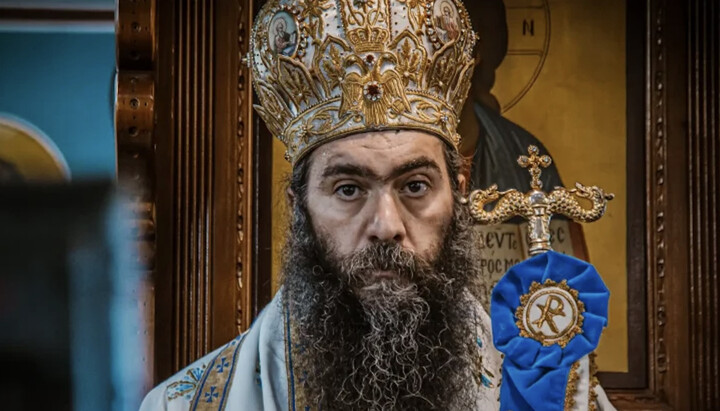
Metropolitan Tychikos. Photo: pafoslive.com.cy
The decision of the Holy Synod of the Church of Cyprus to impose “argia” (suspension from ministry) on the canonical Metropolitan of Paphos, Metropolitan Tychikos, is unlawful, anti-canonical, and contrary to the Church’s Charter. This is stated in an extensive legal-and-canonical opinion published on aktines.blogspot.com.
As the document emphasizes, the issue is not procedural mistakes, but a decision that is, in principle, devoid of canonical, legal, and institutional legitimacy. In essence, the Synod applied a punishment to the hierarch without a trial, without presenting charges, and without observing the most basic principles of church law.
The opinion states that the Orthodox Church consistently upholds a principle: no punishment may be imposed without a prior canonical court.
This is directly indicated by the 74th Apostolic Canon, which requires allegations to be examined in the presence of the accused and on the basis of evidence; the 75th Apostolic Canon, which forbids condemnation without a full vindication; and the 6th canon of the Second Ecumenical Council, which prescribes a strictly established judicial procedure.
In the case of Metropolitan Tychikos, there was no canonical court at all: there was no bill of indictment, no hearings, and no final judicial ruling. The “commission” created by the Synod is not an ecclesiastical court and cannot be regarded as an organ authorized to adjudicate the cases of bishops.
The document stresses that a ban from ministry, by its nature, is a canonical penalty, because it deprives a bishop of the ability to exercise episcopal ministry.
Consequently, such a ban cannot be applied “temporarily,” cannot have a preventive character, and cannot be imposed without a judicial decision.
Attempts to present the suspension (ban) of the metropolitan as an “administrative necessity” do not remove its anti-canonical character.
Moreover, the Charter of the Church of Cyprus guarantees every hierarch the right to be heard, guarantees the presumption of innocence, and requires that cases be considered exclusively within established procedures.
No provision of the Charter allows the suspension of a metropolitan without trial, establishes a ban on remaining within one’s own metropolis, or provides for physical or administrative removal from church buildings.
Thus, from the standpoint of the Charter of the Church of Cyprus, the adopted decision is invalid and subject to annulment.
It is separately emphasized that the Church’s canonical law is not punitive, but therapeutic in nature. Even where accusations exist, proportionality, leniency, and pastoral responsibility must be observed.
The use of harsh measures – effective exile, changing locks, restricting access, and involving state structures – crudely contradicts the spirit of ecclesial ministry and provokes temptation among the faithful.
The conclusion also notes that Metropolitan Tychikos, as a citizen, possesses rights protected by the Constitution of the Republic of Cyprus and the European Convention on Human Rights (Articles 6 and 8). Deprivation of housing, access to one’s place of ministry, and public humiliation without trial may be regarded as violations of the right to a fair hearing, respect for private life, and human dignity.
Thus, the document states, according to the legal assessment, the decision of the Holy Synod of the Church of Cyprus to suspend Metropolitan Tychikos of Paphos is anti-canonical, contrary to the Charter, legally void, institutionally dangerous because it sets a precedent for arbitrariness, and morally unacceptable.
The document emphasizes the need for the immediate lifting of the ban, the restoration of Metropolitan Tychikos to his rights, and the return of church life to the path of canonical legality.
“Without canons there is no Church – there is only power,” the conclusion says.
Earlier, the UOJ wrote that, according to Metropolitan Tychikos’s lawyers, an appeal to the Phanar suspends the ban from ministry.
Read also
Medieval сhurch сrumbles as Culture Ministry сites missing agreement
The 14th–15th-century St. Nicholas Church in Chesnyky, Ivano-Frankivsk Region, is falling into disrepair.
Poland сondemns Lviv Regional Council's decision to declare 2007 year of UPA
Polish Prime Minister Donald Tusk says the Lviv Regional Council's decision to dedicate 2027 to the UPA and Roman Shukhevych is harmful to Ukraine.
OCU seeks court recognition of ownership of seized Cherkasy cathedral
The Cherkasy Regional Commercial Court will hear an OCU lawsuit seeking ownership of St. Michael's Cathedral, which was seized from UOC believers.
Lithuanian bishop: Ukraine is no model for believers' rights
Vicar of Vilnius Diocese voices concern over attempts to import Ukraine's religious conflict into Lithuania.
Hundreds of believers honor St. Alexis of Carpatho-Russia in Khust Eparchy
At the St. Nicholas Monastery in the village of Iza-Karputlash, Metropolitan Mark of Khust led a festive liturgy, concelebrated by six metropolitans, five archbishops and three bishops.
Court upholds UOC parish appeal in Voloshky over OCU switch dispute
The Northern Commercial Court of Appeal has upheld the appeal of the St. Nicholas parish of the UOC in the village of Voloshky, Volyn region, in a dispute over a transfer to the OCU.