Scalpel and cross: A talk with a surgeon who chose God amid terror
Saint Luke of Crimea. Photo: UOJ
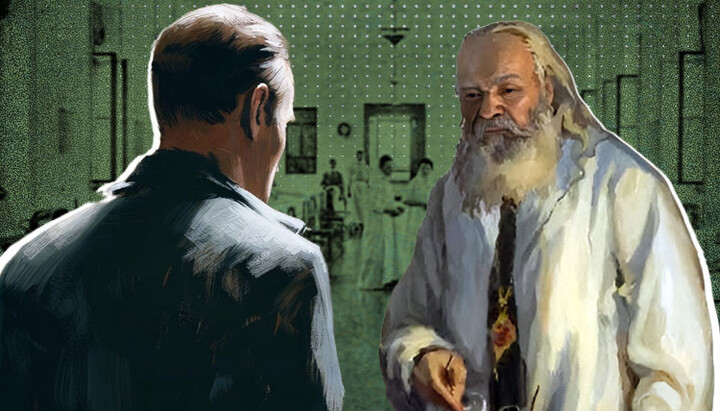
I stand in the operating room of a Tashkent city hospital and hand instruments to a man who became a priest several months ago. For this, they execute without trial. Saint Luke (Voino-Yasenetsky) works quickly and precisely. He is a professor, the author of a classic work on purulent surgery. On his chest is a cross. Large, silver. He does not hide it.
On the table is a patient with gangrene. The saint cuts, stops the bleeding, and stitches. His hands move by themselves, without hesitation. I hand him the scalpel, clamps, needles. And between these gestures I try to understand – how is it possible in 1921, when they kill for faith, to put on a cassock and go in it to lecture to Komsomol students?
– Your Grace, I begin and immediately stumble. It's strange to address a man with a scalpel in his hand this way. – Why do you need this cassock?
He does not raise his head.
– You wanted to ask: why the cross, if they shoot you for it? – his voice is calm.
I nod, though he cannot see.
– I know they execute for it.
A pause. The saint places a clamp on the vessel. That's all. He adds nothing more.
What came before
October 1919. His wife Anna dies of tuberculosis. Four children are left – the eldest is twelve, the youngest is six. Valentin Feliksovich is alone. A professor, a widower, a father. Every day he saves lives in the operating room, every evening he returns to children who have not yet understood that their mother will not return.
1921, the eparchial assembly. Bishop Innocent Pustynsky looks at the future saint and says simply: "Doctor, you need to be a priest." Not a question. A statement.
The answer is instant: "I will, Your Grace!"
Without a pause. Without "I need to think," without "I am unworthy." Two words.
A surgeon's reaction: see a problem – solve it. See God's call – respond.
I think about these two words. He has four children without a mother. If they execute him, they will become orphans. The probability of arrest is almost one hundred percent. How could he answer so quickly?
I ask aloud when the saint has almost finished the operation:
– You have children. Four of them. If they arrest you...
His Grace interrupts me:
– I entrusted them to God. And to Sofia Veletskaya, the operating room nurse. She will look after them.
I remain silent. I don't know what to say.
– Do you think I'm not afraid? the holy surgeon suddenly says. – I am afraid. Every night I think: what will happen to them if they arrest me tomorrow?
He sutures the stump with even stitches.
– But if I renounce Christ for their sake, what will I pass on? Fear? The ability to adapt?
He cuts the thread. Removes his gloves. Goes to the sink.
– I want to pass on faith to them. And faith is not words. It is life.
The story with the icon
I was told a case that shows how Saint Luke understood ministry. No one remembers the exact date, but the essence is this. An icon of the Most Holy Theotokos hung in the operating room. His Grace prayed before it before each surgery. Then he would take iodine and draw a cross on the patient's body – where the incision would be made.
A Cheka commission came and removed the icon. They said: this is a hospital, not a church.
The saint canceled all operations. He left. He said: "I won't work without the icon."
Dying people lay on the table. But he refused to treat them until they returned the icon of the Theotokos.
But then this happened. The wife of a party leader was dying. Urgent surgery was needed. No one except Saint Luke could perform it. They returned the icon.
His Grace also returned. He prayed. He drew a cross with iodine on the stomach of the woman who perhaps signed orders for the arrest of priests. He saved her.
The saint made no difference between friends and foes. There was only a suffering person.
A priest in the university auditorium
Saint Luke comes to the university to lecture. In a cassock, with a cross. The auditorium seats two hundred Komsomol students. Silence falls. No one knows how to react. To whistle? To leave?
They stay. Because this man is one of the country's best surgeons. All doctors will study his book. If you want to become a surgeon, you listen to Professor Voino-Yasenetsky. Even if he is a priest.
I imagine this scene. His Grace in a cassock draws a diagram of purulent infiltration on the board. He explains where to make the incision. He doesn't preach – he teaches. But the very fact of his presence in priestly vestments, with a cross on his chest, is testimony.
He shows: one can be a scientist and a believer simultaneously. This is not a contradiction.
Conversation during interrogation
I'll jump ahead. After arrest, the saint will be tried. The investigator is Jēkabs Peterss, one of the founders and chiefs of the Cheka. Tough and intelligent. Here is an excerpt from the interrogation protocol.
Peterss: "Tell me, priest and professor, how do you pray at night and cut people in the daytime?"
Saint Luke: "I cut people for their salvation. And you, citizen prosecutor, in whose name do you cut?"
The hall laughed.
Peterss didn't give up: "How do you believe in God? Have you seen Him?"
The saint: "I have not seen God. But I have operated much on the brain, opened the skull. I didn't see the mind there either. And I found no conscience."
This is not audacity for audacity's sake. This is the clarity of a man who has seen death too often and knows: life does not end with it.
Blood on the cassock
The surgery is finished. The patient is taken away. Saint Luke removes his surgical gown. Under it is a cassock. On it are bloodstains from previous operations. His Grace does not change clothes. He goes in the cassock to the chapel and serves a moleben. Then he goes home to the children. At night he sits down to write – sometimes theology, sometimes medicine. He sleeps four hours.
I look at this cassock with stains. I think: for confessor Luke, there was no division between the operating room and the altar.
The blood of patients, which he shed for their salvation, and the Blood of Christ in the Chalice – this is one ministry to the suffering Body of Christ, which sometimes lay on the table with gangrene, or sometimes stood in line for confession.
What I'm trying to understand
We were taught: faith is a private matter. Keep it to yourself. Don't provoke the system. You can believe quietly, not bothering anyone.
Saint Luke did not hide his faith. He wore the cross openly. He put on the cassock at the university. He prayed before operations in front of atheists. He drew the sign of the cross with iodine on the bodies of those who perhaps never prayed.
I ask:
– Your Grace, weren't you afraid of accusations of propaganda? That you were using your position as a doctor for preaching?
The saint looks for a long time. Wearily, but firmly.
– I forced no one. I simply lived as a Christian should live.
A pause.
– If a person sees that a doctor prays before surgery, and sees that the Lord helps the surgeon's hand, he draws conclusions himself. I impose nothing. I simply show: for me God is not consolation in difficulties. This is the only reality, without which I can do nothing.
I don't know what to answer. We both remain silent. In this silence I understand: the saint lives in another dimension where fear of death has no power. Because for the confessor, death is a door. And behind it stands the One to whom he said "I will" in 1921.
I stand in the empty operating room. Saint Luke has left. And I remain with questions that have no simple answers.
Such people are not explained by the logic of survival. They live by the logic of faith.
This can only be understood by trying it yourself. Wearing the cross openly. Walking with it, not hiding. Then, perhaps, you'll understand: freedom begins not when no one threatens you, but when you stop fearing threats. Because you know: even death will not separate you with Christ.
Read also
The Weeping Queen of Blachernae
On the night of the Feast of the Protection, only two people witnessed the miracle in the Church of Blachernae. Everyone else prayed and saw nothing. Yet they, too, received grace.
Deadly spiral of human hatred
The tragedy of Lebanon's civil war lays bare how dehumanization and fear can turn human beings into monsters.
Woe to expectant mothers – or to those of little faith?
God commanded one prophet not to have children, yet told his people in exile to bear sons and daughters. What does this apparent contradiction tell us today?
The help God never asked for
Uzzah wanted only to keep the Ark of the Covenant from falling into the dust. Why did this well-intentioned act cost him his life, and who was really responsible for his death?
Freedom begins when there's nothing left to take
Fear of persecutors takes root in our attachment to possessions. We turn to St. Basil the Great to understand why the prefect's threats held no power over him.
The bride in the window frame
The author of the earliest account of St. Thecla’s life was defrocked. Yet it was his book that preserved the only ancient description of the Apostle Paul’s appearance.