Archon of Constantinople proposes convening a Council of Primates
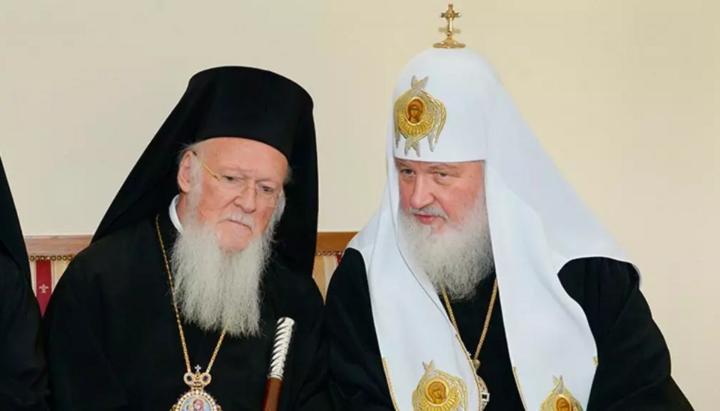
Patriarchs Bartholomew and Kirill. Photo: romfea.gr
Archon Asikritos of the Ecumenical Patriarchate, jurist Dr Anastasios Vavuskos, in a publication on the Romfea.gr portal, proposed convening a Council (Synaxis) of Primates to discuss accumulated inter-Orthodox problems. As the reason for his proposal, he cited a statement by Russia’s Foreign Intelligence Service dated January 12, 2026, in which Patriarch Bartholomew was accused of actions against the Moscow Patriarchate and described in “insulting terms.”
The Russian service’s statement claimed that after the Ukrainian church issue, Constantinople has been taking steps against the Russian Church, including in the Baltic countries. In response, the Ecumenical Patriarchate called the accusations “fabricated scenarios, fake news, insults, and information concocted by propagandists.” In Vavuskos’s view, however, the very fact of such interference by a state structure in inter-church relations testifies to the depth of the crisis.
The author emphasizes that for the first time in the history of modern inter-Orthodox relations, such harsh accusations were voiced not directly by the Russian Church, but through a state body of an Orthodox country. He believes that when ecclesiastical disagreements remain unresolved, political authorities begin to intrude into them, which only deepens the division.
As a way forward, Vavuskos proposes activating the conciliar mechanism in the format of a Council of Primates, considering this arrangement more realistic than a Pan-Orthodox Council. Among the topics he names for discussion are a revision of the rules for convening and conducting a Pan-Orthodox Council (including abandonment of the principle of unanimity), the Ukrainian issue and the canonical consequences of granting autocephaly, the establishment of parishes by the Russian Church on the territory of the Patriarchate of Alexandria, and the granting of autocephaly to the Macedonian Church by the Serbian Patriarchate.
According to the archon, convening such a Council is the right of the “First” – that is, the Ecumenical Patriarch – but in the case of an official written appeal from the autocephalous Churches, it becomes an obligation. Vavuskos expresses hope that the Council will be convened soon; otherwise, “disagreements combined with growing inner estrangement” may turn into an unbridgeable chasm, with the faithful suffering as a result.
As the UOJ previously reported, the Ecumenical Patriarch threatened his critics with Judgment Day.
Read also
Activist targeting UOC lawyers wears clothing with Nazi symbols
Davyd Pshenychnyi, a radical who opposes the UOC, was photographed wearing clothing by Svastone, a brand that describes itself as pagan.
TRC mobilizes 24-year-old UOC hieromonk on his way to study in Athens
Hieromonk Viktor (Denysov), a student at a university in Athens, said he was taken off his flight and brought to a TRC and is now serving with the 8th Special Operations Regiment.
Shevchuk thanks Catholic cardinal for visit to Russia
The UGCC head called Catholic Cardinal Matteo Zuppi’s visit to Ukrainian prisoners held in Russia an extremely important step.
‘Won’t find a girl better than you’: UGCC clergy dance on church porch
In Ternopil, UGCC clergy danced to a wedding song on the steps of a church and tossed candy into the crowd.
Metropolitan Onuphry consecrates Church of Sts. Cosmas and Damian in Kyiv
On the feast day of the “She Who Is Quick to Hear” Icon of the Mother of God, the UOC Primate consecrated a Kyiv church dedicated to the Holy Unmercenaries Cosmas and Damian.
‘This is not how freedom is done’: Met. Theodosiy on secret Phanar report
The Cherkasy hierarch said the Constantinople cleric’s report on the 2018 “council” shows that the fate of “autocephaly” was determined not by the canons but by the authorities and security services.