Anatomy of shame: why Masaccio's fresco conveys pain
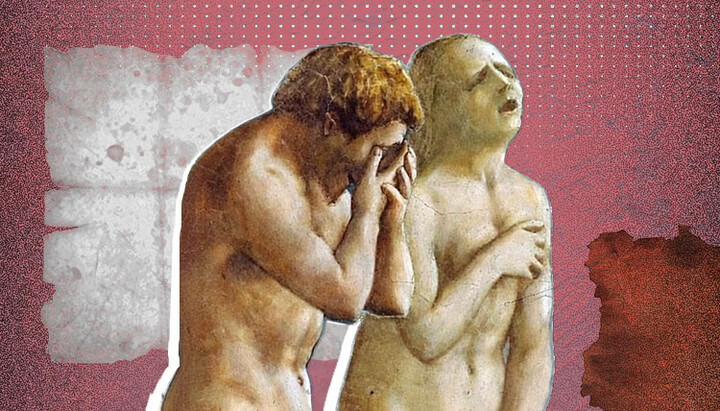
The Forefathers on Masaccio's fresco. Photo: UOJ
In the dim light of the Brancacci Chapel in the Florentine church of Santa Maria del Carmine, the gaze inevitably lingers on the narrow pier to the left. There, at eye level, unfolds a scene of two figures emerging from the narrow arch of the paradise enclosure.
Tommaso di Giovanni di Simone Cassai, who entered history under the name Masaccio, painted this masterpiece in 1426–1427 when he was twenty-five. A year later he would die in Rome, leaving the world this piercing testament, which contains more pain than in all the preceding millennium-old tradition of visual art.
The weight of exiled flesh
Gravity crashes upon the viewer at first glance at the composition. Before Masaccio, figures in frescoes seemed to float, barely touching the ground with the tips of their graceful feet. Here everything is different. Adam and Eve do not walk – they press their heels into the scorched earth.
The artist accomplished an incredible revolution for his time: he introduced a single light source.
The long, dense shadows cast by the heroes' bodies fall in one direction. This light makes them physically tangible, almost unbearably "heavy."
This weight is felt not only as physical mass, but as the burden of responsibility. On the opposite wall of the chapel remains the work of Masolino da Panicale, Masaccio's older colleague. There too the first parents are depicted, but at the moment of temptation. In Masolino's work they are graceful, their skin perfect, their poses calm, as if posing for an ancient bas-relief. In Masaccio's – what would be called expressionism. Bodies deformed by suffering. Adam's tense abdominal muscles, his hunched, compressed shoulders. This is not an athlete on a pedestal. This is a man whose legs buckled from realizing what he had done.
Two ways of being an exile
Looking at these two figures, it becomes noticeable how differently they experience shame. Adam covers his face with both palms. His eyes are not visible, but this introverted shame is palpable. He doesn't want to see the angel, he doesn't want to see the world, but above all – he doesn't want to see himself. This is the shame of conscience that suddenly realized the scale of loss. Adam hides inside his grief.
Eve is different. Her head is thrown back, her mouth wide open in a soundless howl. Art historians call this "the first scream in the history of Renaissance art." This is not a cry of indignation or protest, this is the howl of a wounded beast from whom life has been taken. Masaccio painted faces last, applying paint swiftly, as if in fever, striving to capture this impulse of pain before it cooled under the brush. Only Giotto had painted this way a hundred years before him – his grieving angels over the dead Christ in the Scrovegni Chapel cried with the same pain.
Eve tries to cover herself. Her pose – one hand on her breast, the other on her groin – is almost literally borrowed by the artist from the ancient statue of Venus Pudica, "Venus the Modest." But what an enormous difference between the Greek goddess and the first woman! Masaccio completely strips this gesture of eroticism. For Eve this is the instinct to cover a wound. Her shame is biological in nature. She suddenly realized her nakedness not as aesthetics, but as defenselessness and mortality. She feels that now she is vulnerable to cold, wind, lust, and death.
The angel who does not push
Above the heads of the exiles hovers an angel in fiery red robes with a sword in hand. But notably: the angel does not "push" them out physically. He does not touch them with the sword. He simply points the way forward.
The expulsion does not happen by external command, it is accomplished within the heroes themselves. They themselves can no longer remain in the light of grace, because darkness has settled within them.
The arch of paradise is depicted by Masaccio almost schematically – a narrow opening behind which golden light pulsates. Before them – emptiness. No trees, no flowers, no life. Only bare earth and the rarefied air of a world struck by entropy. Sin here is shown as the decay of wholeness. Adam and Eve are no longer one whole. He is locked in his shame, she – in her scream. They walk side by side, shoulder to shoulder, but each of them suffers in absolute solitude. This is the main fruit of the fall – the loss of connection, when even common misfortune does not unite but divides.
Branches of hypocrisy and the truth of nakedness
The history of this fresco contains a case that became a metaphor for human attitude toward truth. Around 1670, by order of Grand Duke Cosimo III de' Medici of Tuscany – a ruler famous for extreme piety and puritanism – the intimate parts of Adam and Eve were painted over with branches and leaves. The authorities considered Masaccio's original truth too bold and naked. For almost three hundred years people saw not a tragedy of the spirit but decoration.
Only during the major restoration of 1985–1990, the fresco was cleaned, removing these "fig leaves" of hypocrisy. And again the frightening anatomical truth was revealed. Masaccio detailed bones and ribs, making the figures almost transparent in their thinness. Historians note: this fresco was painted entirely by the artist himself, without student participation.
Every brushstroke – his own hand, his own pain.
Why did the artist make their faces so, at first glance, ugly? Perhaps because sin is ugliness. It is the distortion of that beautiful design that God placed in man. The fresco measuring only 208 by 88 centimeters – a narrow vertical wall space – but it contains the entire cosmic catastrophe of the fall.
Memory of paradise as salvation
Modern culture tries in every way to cancel shame. It persistently suggests: "don't be ashamed of your body," "don't be ashamed of your desires," "everything is normal." But Masaccio, this youth from the 15th century, reminds us of something else.
Shame is not a complex or a social construct. It is a sign that the memory of paradise is still alive within.
If a human has stopped being ashamed of sin, they have finally stopped being an exile and become part of this scorched earth.
The onset of Great Lent always returns to this fresco. The expulsion of Adam is remembered not as an ancient legend, but as an event happening here and now. Everyone has at some point covered their face with their hands, like Adam, or screamed from powerlessness, like Eve. And this path across bare earth is our present life.
But if this cold and this weight are still felt, it means the memory of where we came from is alive. To someday return to the golden light behind the arch, one must first gather courage and acknowledge oneself as an exile. Looking at Masaccio's fresco, one can learn not to look away from one's own truth, however ugly it may seem. Only through honest recognition of one's catastrophe begins the long journey home.
Read also
How a Wedding Stopped a War
A young princess of Sluck was given in marriage so that two magnate families would not drown the city in blood. Soon afterwards, the Uniate Metropolitan complained that Orthodoxy had come back to life in Sluck.
Man before the forces of nature
A solitary figure on the shore seems insignificant before the immense power of the sea, yet it is he who stands before the Creator.
The mysteries of Golgotha in the light of archaeology
The veil of centuries obscures what really happened in the fourth century. Archaeology and ancient texts shed light on the true history of one of Christianity’s greatest sacred sites.
Zaporozhian Cossacks defend the persecuted faith
The story of how Cossacks drew their sabers to defend abused priests – while sometimes causing violent disturbances inside churches themselves.
A forgery at the foundation of Mohyla Academy
For centuries, historians have repeated an appealing story about a wealthy benefactor’s generous gift. Archival documents, however, paint a very different picture of what happened.
Theology of worn-out shoes
A painting of a pair of old shoes in a Dutch museum preserves the memory of an ordinary working person and a life of hard labor.