Silver candlesticks: How mercy becomes the price of a soul’s salvation
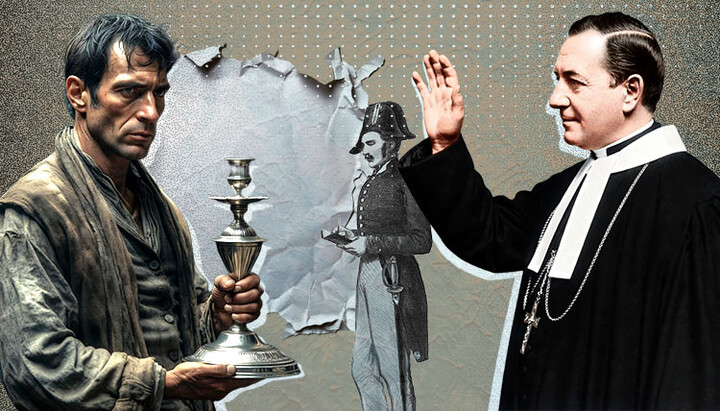
Lesson of the stolen candlesticks. Photo: UOJ
Once Dostoevsky wrote something unexpected in a letter: “Contrary to the opinion of all our experts, Les Misérables stands higher than Crime and Punishment.” It is a rare confession – to place someone else’s work above one’s own. But it says that Hugo’s novel touched in him something for which words are never quite enough.
At the center of that novel is a scene that takes only a few pages. Yet it may be more important than all the rest.
The weight of silver and the scale on the heart
In the bishop’s house in the town of Digne, there is almost nothing. A few pieces of silverware, and two candlesticks – the last remnants of an earlier life. The prototype for this bishop, Monseigneur Myriel, was drawn from a real person: the Bishop of Digne, de Miollis (1753–1843), who gave away almost his entire salary to the poor and even turned his own palace into a hospital.
When the novel appeared, de Miollis’s nephew published an indignant letter, insisting that Hugo had “maliciously distorted” his uncle’s image. But Canon Angelin, who had personally been present at the meeting between the bishop and the former convict, read the opening chapters of Les Misérables and cried out: “It’s him – it’s Monseigneur Miollis.” So it seems Hugo had not distorted him after all.
The man who comes to the bishop in the night is Jean Valjean, convict number 24601. He received nineteen years in the galleys for stealing a loaf of bread and for attempted escapes. Nowhere would anyone take him in. The soul of the criminal is covered with such a crust of hatred that neither a kind word nor a human glance can break through it.
In the night he steals the silver. In the morning the gendarmes catch him. The evidence is undeniable – the ticket back to the galleys is in his hands, now, seemingly, forever.
And then something happens that the logic of this world cannot explain.
The right to a "holy lie"
“Oh! There you are! I’m glad to see you. But didn’t I give you the candlesticks too? They’re silver as well. Why didn’t you take them along with the spoons?”
The bishop lies to the police. Theologians still argue about the moral side of the act. But here it seems less about breaking a commandment than about fulfilling it at a level beyond ordinary measure – for the sake of saving a man who was already standing on the edge of final ruin. Monseigneur Bienvenu understands: if Valjean returns to the galleys, he will become something that can no longer be called a man.
To save him, the bishop gives not only the silver – he sacrifices even his spotless honesty before the law.
Valjean stands there “trembling all over.” He cannot force out words of gratitude. And it is not hard to understand why: forgiveness can strike harder than a lash. Forgiveness burns away the hardened deposit a man has been gathering for nineteen years. It is shock therapy by love.
Buying back a soul, when the law is powerless
Then comes the most important line in the whole novel. The bishop takes Valjean by the shoulders:
“Jean Valjean, my brother! You no longer belong to evil – you belong to good. I buy your soul. I take it away from black thoughts and the spirit of perdition, and I give it to God.”
A ransom. Not “I forgive and forget,” but a redemption paid with something real, something costly, something that feels like the last one has. Without that ransom there would be no Monsieur Madeleine – the man who gave bread to hundreds of workers – no rescued Cosette, and none of the chain of good that unfolds through the remaining volumes.
Hugo leaves a bitter comment: “Release is not yet freedom. The galleys end – but the prison remains in the soul.”
To break the walls of that inner prison, it is not enough to let a man out through the gates. Someone else must take his debt upon himself.
Saint John Chrysostom wrote of forgiveness differently than we are used to hearing it: “He who has forgiven sins has benefited both his own soul and the soul of the one who received forgiveness… When we pursue those who have wronged us, we do not wound their souls as much as when we forgive them – for by forgiveness we bring them into confusion and shame.” In this understanding, forgiveness is neither weakness nor indulgence. It is the most precise weapon a person possesses.
Javert and Myriel are not merely two characters. They are two answers to one question: what is the world held together by? One answers: by law and justice. The other: by grace – “unjust” by earthly scales, because it gives not what is deserved, but what is necessary for healing.
Candlesticks as beacons in the fog of hatred
The Patriarch of Constantinople Athenagoras once said: “Above all I loved Victor Hugo and his novel Les Misérables – the book that told me then of the true bishop, of a man who knew that prayer and love oblige…” The Patriarch seems to have read the novel when he was young. And what he remembered was not battle scenes, not romance – but an old man with candlesticks.
Valjean kept those candlesticks all his life. When he became a wealthy mayor, he hid them in a cupboard like the greatest shrine. In the hardest moments, when injustice struck him in the face again, he would look at the dull gleam of the silver and remember: he had been “bought.” Someone had paid for him.
When Valjean was dying, he pointed his finger at someone visible only to him. The housekeeper asked whether she should call a priest. “I have one,” he answered. Hugo adds: “Perhaps the bishop truly was present at this parting from life.”
This is a reminder for us on Forgiveness Sunday. Are we ready to become “Myriels” for those who betrayed us or stole from us? Are we ready to give our “silver” – our time, our pride, our rightness – in order to buy back someone’s soul from the spirit of perdition?
In conditions of war, when the world hardens, when “the outcast” become ever more numerous – refugees, the branded, those whose hearts have turned to stone from pain – Hugo’s lesson does not grow quieter. It grows louder.
Christianity is not a religion of prohibitions and rules. It is a religion of wild, sacrificial love that is not afraid of risk. Monseigneur Bienvenu took that risk. And the risk was justified by the life of one man – who then preserved the lives of many others.
Read also
Golgotha in the midst of a pogrom
In the autumn of 1938, the Jewish artist Marc Chagall painted the crucified Christ. Synagogues burn and refugees flee around the cross, while the Crucified One Himself is wrapped in a prayer shawl.
Stories of the Early Church. Level of governance: patriarch
How did several episcopal sees rise above the rest, why did the Church’s administrative map come to mirror that of the empire, and is the patriarchate a sacred form of Church governance?
A Chronicle without an author
We are accustomed to calling The Tale of Bygone Years the work of St. Nestor. Yet another monk left his signature on it, while the chronicle itself passed from one generation of scribes to the next.
How a wedding stopped a war
The young princess of Slutsk was married off to keep two powerful noble families from drowning the city in blood. Soon afterward, a Uniate metropolitan complained that Orthodoxy had been reborn in Slutsk.
Man before the forces of nature
A solitary figure on the shore seems insignificant before the immense power of the sea, yet it is he who stands before the Creator.
The mysteries of Golgotha in the light of archaeology
The veil of centuries obscures what really happened in the fourth century. Archaeology and ancient texts shed light on the true history of one of Christianity’s greatest sacred sites.