King’s repentance and Uriah’s red cloak
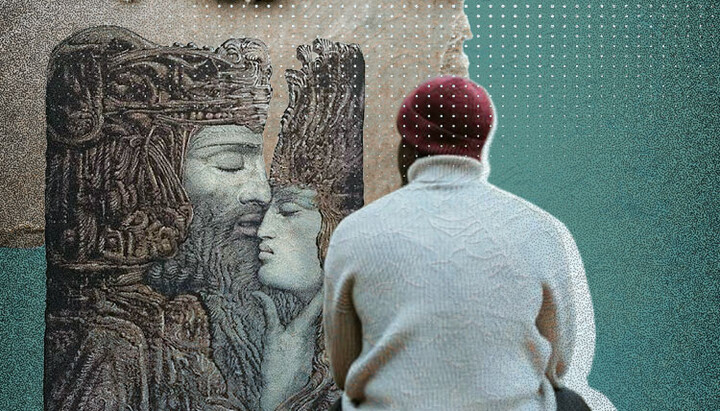
Reflection on David's sin. Photo: UOJ
There is a Rembrandt painting whose title long resisted certainty. Three figures stand there. In the foreground is a man in a purple-red cloak – fiery, almost screaming against the surrounding darkness. His right hand is pressed to his chest. His head is bowed. Behind him, in a cold shadow, stands another figure – regal, motionless, nearly dissolving into the half-light. To the side is an old man with a face carved by grief. None of the three looks at the others.
Scholars argued: who is depicted? Many assumed it was David and Uriah. That reading is the truer one. You can see that the man in red is leaving. He carries a letter, and he does not know what it says. Yet inside is his sentence.
Rembrandt painted the picture in 1665, shortly before his death, when he was ruined, alone and, they say, particularly well understood what betrayal was. Perhaps that's why he chose precisely this moment – not the murder, not the exposure, but this: a man leaves, suspecting nothing, while another watches him from the shadows.
The man we do not notice
His name is Uriah – in Hebrew it means “The Lord is light.” By origin he was a Hittite, from a people long subdued. Yet he served Israel’s God faithfully, and rose until he was included among David’s thirty-seven mighty men. He was last on the list – but he was on it. That is no small thing.
When David summoned him from the front and hinted, go home to your wife, rest, Uriah refused: “The ark, and Israel, and Judah, abide in tents… and shall I then go into mine house, to eat and to drink, and to lie with my wife?” (2 Samuel 11:11). While his comrades were in the field, he could not allow himself what they were denied.
This was the honest act of a soldier. And it was precisely that honor David used for his own advantage.
The king wrote to his commander Joab: “Set ye Uriah in the forefront of the hottest battle, and retire ye from him, that he may be smitten, and die” (2 Samuel 11:15). And David handed that letter to Uriah – so that Uriah himself would deliver it to Joab. Thus the man in red carried his own sentence in his hands, without knowing it.
Spring, when kings go out to war
The eleventh chapter of 2 Samuel begins with a short and chilling line: “At the time when kings go forth to battle…” David did not go. He sent others, and stayed in Jerusalem. It seems like a minor detail – one time he did not ride out, what is the big deal? Yet it is placed at the head of the chapter on purpose.
Then comes the evening walk on the roof. A glance. A question: who is that woman? The answer: the wife of your officer. And there is not even a second of stopping. After that, everything rolls forward on its own: pregnancy, an attempt to cover the sin, Uriah brought back to Jerusalem, his refusal to go home, his second refusal even when drunk – and then the letter.
St. Andrew of Crete, in the Wednesday of the first week, names it without softening it: “David sometimes added sin to sin, and mingled murder with adultery.”
This was not a passion that suddenly blinded the king – it was a chain of decisions. Any one of them could have been refused, if passion had not seized the royal soul.
Tu es ille vir
The prophet Nathan did not come to David with an accusation. He came with a parable. Its images are plain: a rich man and a poor man. The poor man had one little ewe lamb – beloved, hand-raised. The rich man could have slaughtered any sheep from his vast flock, but he took the poor man’s only lamb – simply because he could.
David flared at once: “The man that hath done this thing shall surely die!” Nathan replied: “Thou art the man.” In Latin it sounds brief and almost lethal: Tu es ille vir.
This is the whole method of prophetic rebuke. Nathan allowed David first to condemn another man’s sin – and thus to reveal that a judge still lived within him, a judge who knew the difference between truth and falsehood. And then that same judge pronounced the verdict over David himself.
We notice sin easily when it is someone else’s. Almost never when it is our own.
It is not hypocrisy. It is simply how a human being is built. Every time we are outraged by someone else’s lie, someone else’s betrayal, someone else’s cowardice, it is worth pausing for one second and asking: where does the same thing live in my own life?
The superscription we skip
Psalm 51, which we read every morning, has a superscription. People usually hurry past it in order to reach the familiar text. But it says: “A Psalm of David, when Nathan the prophet came unto him, after he had gone in to Bathsheba.”
This is not abstract repentance of the sort, “I am sinful like everyone else.” It is the confession of a specific man after a specific exposure – when there is no point in pretending anymore.
And this is what is striking: not a single word of self-justification appears in the psalm. No “she looked first,” no “I was under pressure.” Only: “Against Thee, Thee only, have I sinned.”
St. Innocent of Kherson, explaining this psalm, said: “I think that Satan even now shudders in horror when he hears it (Psalm 51 – Ed.).” A surprising thought, yet a true one – penitential prayer is terrifying to the dark powers. Probably because it leaves no room for the darkness that always dwells in self-justification.
“And my sin is ever before me” – always. This is not self-torment and not depression. It is sobriety. A man who has stopped assuming he is good by default is a man who is already almost impossible to deceive with his own excuses.
The question the canon asks
St. Andrew of Crete turns this whole story toward us with a few plain words, without ornament. He speaks to the soul: you have heard how David fell. You know what he did. But here is the question: “Hast thou not envied his repentance?” Have you not been jealous of his repentance?
We repeat David’s sin willingly. Not necessarily his exact sin – but his mechanism: idleness, a glance, desire, action, the attempt to cover the tracks. We know that pattern.
But his psalm – the sobbing of a man who no longer tries to look good, who begs only one thing: “Create in me a clean heart, O God” – we repeat that far more rarely. Not because we do not know the words. But because first you must stop and consent: you are precisely that man who has fallen spiritually.
Nathan came to the king not with a sword, but with a mirror. David looked into it, and from that point his life changed radically. That may be the hardest thing in repentance – and the thing every one of us most needs to learn.
Read also
Honest atheism vs. spiritual hypocrisy
The 70th anniversary of Albert Camus’s Nobel Prize recalls an uncompromising challenge to Christianity. An honest unbeliever brings theology back to the mystery of the Cross.
The valley of trouble and the gateway of hope
One soldier buried an expensive cloak and some gold beneath his tent. Because of this, all Israel lost a battle. Why did one man’s sin bring disaster upon an entire nation?
From love spells to bishop's throne
Antioch’s most powerful sorcerer sent demons against a devout young Christian woman three times – and failed every time. In the end, a demon himself revealed the truth that led to his conversion.
The Weeping Queen of Blachernae
On the night of the Feast of the Protection, only two people witnessed the miracle in the Church of Blachernae. Everyone else prayed and saw nothing. Yet they, too, received grace.
Deadly spiral of human hatred
The tragedy of Lebanon's civil war lays bare how dehumanization and fear can turn human beings into monsters.
Woe to expectant mothers – or to those of little faith?
God commanded one prophet not to have children, yet told his people in exile to bear sons and daughters. What does this apparent contradiction tell us today?