Triumph of Orthodoxy: Why disappointment often hides beneath golden vestments
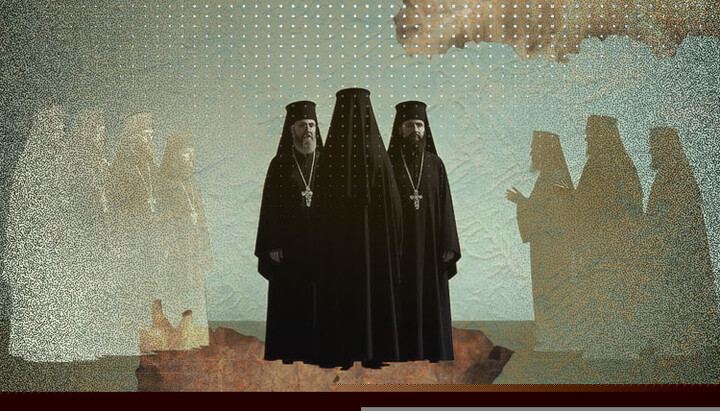
Three groups of Church servants. Photo: UOJ
Today we celebrate the Triumph of Orthodoxy, yet in real life we see a very different picture. Look at the photos or videos: how many people filled our churches in the early 1990s – and how many come now? Someone will say the reason is the war and the like. No – it isn’t the war. It is disappointment.
There are several reasons for this. On the one hand, most people in those years were seeking in the Church not what is God’s, but what is their own. They fancied that the Church would supply them with an “elixir of salvation,” that prayer would begin to flow by itself, that grace would hit them like a rush to the head, and that rivers of “living water” would pour from their hearts. And all of this was supposed to happen in an accelerated, express mode. But it did not happen and in the end, they were hit by heaviness, boredom, and disappointment.
However, there is another reason – the opposite one. People found that, beyond the revival of the Church’s outer form, there was nothing else. Even when they were searching sincerely. There was no one to take the neophyte by the hand and lead them into depth – into the hidden life of prayer of the heart; no one to show the road to the Kingdom of God that is “within you.” Instead there were moralizing sermons in the style of the cartoon cat Leopold (“kids, let’s live holy lives”) or the perpetual “sawmill” of angry scoldings, like a severe schoolmistress at an endless class meeting. It quickly became unbearable. People wanted something alive – something real.
Three colors of the earthly Church
If we want to understand the difference between stage-prop theater that calls itself “church” and the Church that truly is the ship of salvation, we first need to grasp something very simple and obvious. Look at yourself. What do we see in ourselves?
On the one hand – a sincere desire for salvation; on the other – forces acting within us that resist it and wield enormous power. The same thing happens in the earthly Church.
It can be conventionally divided into three unequal parts.
The first part (let su call it white) – people of holy life: monastic intercessors, praying ascetics, hierarchs who live as ascetics, righteous laypeople. There are not many of them in the earthly Church, but they exist. It is precisely because of them that the Church is alive.
The second part (let us call it black) – scoundrels and villains. And first of all this concerns the clergy: fornicators, perverts, those who have trampled their priesthood or their monastic vows for money, career, and a sweet life. People mortally wounded by thirst for power and personal gain. There are more of them than the “white,” but still not so many. Yet their toxicity, their stench, makes them impossible not to notice.
The third part – the largest – is bishops, priests, and laity who form a “gray-white” mass. Some are closer in spirit to the black camp, some to the white. Their position is fluid: today they sink, tomorrow, repenting, they stretch upward toward the white layer. In this mass, the spiritual level of clergy and laity is roughly the same. So do not build idols in your imagination – neither of bishops, nor monks, nor parish priests – only to be shattered later by bitter disillusionment. But do not demonize them either. In the main, they are the same as you.
The first and second parts are almost static. Or rather, they move only in one direction: the black grows ever more cynical, the white ever more pure. The real spiritual drama unfolds in the most numerous sector, where the battle for souls is waged. But today we will speak about the dark double of the earthly Church.
The dark double and its voice
The dark side has been in the Church from the beginning – from Judas onward. It has always been her shadow, her double, stalking her step for step. And the voice of that double often sounds first. The whole history of the Church is filled with such scenes – from the fourth century to our own days. The trials against John Chrysostom, Maximus the Greek, Archbishop Hermogen (Golubev); the persecutions of Maximus the Confessor, Symeon the New Theologian, Sophrony (Sakharov) – there are dozens, if not hundreds, of names.
We honor Chrysostom now. But had you lived in Constantinople in 403, to acknowledge that he was right would have meant being cast outside the boundaries of the “official structure.” The accusations would have sounded perfectly logical: “So you’re against the decision of a council of forty-five bishops? Then you’re against the Church, against Christ, against conciliar reason!” I say this so you understand: far from every decision of the ecclesiastical authorities – even decisions of synods and councils – is the true mind of the Church, not to mention the private declarations of individual hierarchs. The Church’s voice, as a rule, is heard later. Sometimes decades pass – sometimes centuries – before the genuinely conciliar word becomes clear. But we cannot wait that long. We do not have centuries.
We need to understand right now: where is the voice of the dark double – and where is the voice of the Good Shepherd?
The very first thing – like emergency first aid – is this: when you hear something that throws your soul into turmoil, ask yourself: “Could Christ say this? Could He teach this? Can we even imagine Christ acting in this way, calling people to this?” If you know the дух of the Gospel, the answer will be immediate. The heart turns away from lies and propaganda as from something dead.
Everything must be tested by the Gospel. Among the holy fathers one can find different – sometimes opposing – opinions on particular questions, but the Gospel is always unambiguous. Christ made no exceptions. He did not say: “Forgive these, but kill those; love these, but hate those…”
The pragmatics of the system against the Spirit
The dark double of the Church is pragmatic in its very essence. In it the earthly always crushes the spiritual. It is always subordinate to external political forces, always dependent on them. Its judgments and priorities are horizontal – worldly. Its chief values are power and money. This is the real core of the struggle for “rights of ownership” over territories. There is nothing here about the salvation of souls – only financial and administrative control over parishes. And of course this struggle is waged under the banner of defending “purity of faith” or “the will of God.”
Moreover, this double is frightened of everything thoughtful and alive. I heard from one propagandist of this system that everything necessary in the Church has already been created before us and that nothing new can exist. In other words, for such people the Holy Spirit has “died.” He no longer acts, no longer inspires. And so the system lives in yesterday: it celebrates long-departed events and feeds on what someone once made, long ago. It is a life with its head turned backward. Such a system cannot, by its own nature, give birth to anything living in the present.
The moment something new and authentic appears in the Church, the hunt begins. A close example is the theological depth of the heritage of St. Sophrony (Sakharov). The servants of the “black double” mocked his works in every imaginable way – I heard it with my own ears. But time passed: the elder’s books found readers, he himself was canonized, and his critics were shamed. Now they have turned their malice toward his disciples.
A system masquerading as the Church cannot endure criticism. In it, barracks discipline reigns – thinly disguised as obedience. It is a “cemetery of dead souls” from which cold breathes. Where there is totalitarianism, the absence of freedom, slavery before authority, contempt for the human person – there is not the Church. There is a system.
People of light and the silence of hesychia
The bright, pure side of Church life, on the contrary, almost always remains in the shadows. The lives of such people are quiet and non-public. No monk who has the fear of God will chase career or episcopacy; he will flee from it. The one who has tasted – even “at the tip of a finger” – the sweetness of prayerful solitude will not exchange it for any palaces. Whoever has learned the flavor of hesychia, inner stillness, will avoid publicity. A Christian in whose heart a spark of the Holy Spirit has been kindled will not step out into the “wind” of outward bustle, lest that lamp be extinguished.
The dark double teaches us to fight evil in the world and build a “kingdom” here on earth. The saints teach us to withdraw in mind from this world and seek the Kingdom of God within the heart.
They teach watchfulness over thoughts, walking before God, and that inexpressible spirit of life that is transmitted in Holy Tradition. In that spirit is true Orthodoxy. It is grasped not by calculation, but by a purified heart.
People of light are modest. For the powerful of this world they are “trash by the roadside.” But what amazement will come when it turns out that those who seemed to be “nothing” suddenly shine like the sun. They are that Church which the gates of hell will not prevail against – because her Head is Christ, her garments are grace, her light is the radiance of the Trinity. And the fact that thick darkness always stands close to that light should not unsettle us. Those who have chosen the path of perdition must also manifest themselves somehow somewhere. God is their Judge. Our task is to strive toward the light.
Read also
Honest atheism vs. spiritual hypocrisy
The 70th anniversary of Albert Camus’s Nobel Prize recalls an uncompromising challenge to Christianity. An honest unbeliever brings theology back to the mystery of the Cross.
The valley of trouble and the gateway of hope
One soldier buried an expensive cloak and some gold beneath his tent. Because of this, all Israel lost a battle. Why did one man’s sin bring disaster upon an entire nation?
From love spells to bishop's throne
Antioch’s most powerful sorcerer sent demons against a devout young Christian woman three times – and failed every time. In the end, a demon himself revealed the truth that led to his conversion.
The Weeping Queen of Blachernae
On the night of the Feast of the Protection, only two people witnessed the miracle in the Church of Blachernae. Everyone else prayed and saw nothing. Yet they, too, received grace.
Deadly spiral of human hatred
The tragedy of Lebanon's civil war lays bare how dehumanization and fear can turn human beings into monsters.
Woe to expectant mothers – or to those of little faith?
God commanded one prophet not to have children, yet told his people in exile to bear sons and daughters. What does this apparent contradiction tell us today?