Longinus' spear: Who stole an instrument of mercy from the Church – and why
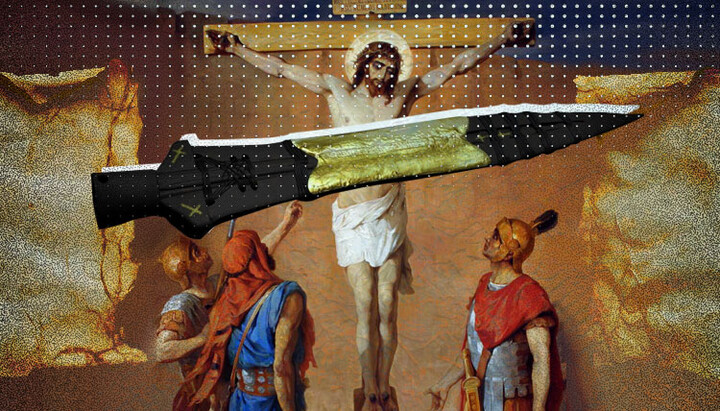
A disputed relic – the spear of the centurion Longinus. Photo: UOJ
The Evangelist John – the only one of the four who stood at the Cross and saw everything with his own eyes – recorded a detail he could not have invented: “One of the soldiers pierced His side with a spear, and at once there came out blood and water” (John 19:34). John was not a physician and did not know what the mixture of blood and clear fluid from a chest wound signified. He simply wrote down what he saw. Nineteen centuries later, pathologists explained: “blood and water” corresponds to the outflow of blood from the right atrium and serous fluid from the pericardial cavity, accumulated as a result of shock and asphyxiation. Thus medicine described the clinical picture of a real, not apparent, death.
That thrust of the spear was not an act of killing. By that moment, Christ had already died. Roman execution prescribed crurifragium – the breaking of the legs to hasten death by suffocation. The soldiers broke the legs of the two thieves crucified beside Him, but when they came to Jesus, they saw that He was already dead. The spear thrust became a final verification – a juridical confirmation of death for the report to Pilate. And at the same time, it fulfilled the prophecy of the Lamb of God: “Not a bone of Him shall be broken” (John 19:36). His legs were not broken. The spear entered His side.
Saint John Chrysostom saw in this wound a profound symbolism: “From both – the blood and the water – the Church was formed. For from His side Christ created the Church, as from Adam’s side Eve was created.”
The blood became Communion, the water – Baptism. The spear that pierced a lifeless body opened a source of life for all humanity.
A reliquary with a mystery inside
Several objects in the world claim to be that very spear. One is preserved in Etchmiadzin in Armenia, said to have been brought there by the Apostle Thaddeus. Another is a fragment kept in the pier of the dome of St. Peter’s Basilica in the Vatican – a gift from Sultan Bayezid II to Pope Innocent VIII in 1492. And the most famous of all is the Vienna spear from the Hofburg Palace, around which, over a thousand years, such a mass of legends has accumulated that the object itself is almost obscured.
The Vienna spear, upon close examination, turns out not to be a Roman weapon. It is a Carolingian lance head typical of the eighth century – beautiful, formidable, but too late in date. Yet in the center of its blade a cavity has been cut, into which an iron spike is firmly embedded, bound with silver, copper, and gold wire adorned with tiny brass crosses. According to tradition, this spike is a nail from the Cross of the Lord. The spear itself is thus merely a medieval reliquary – a richly adorned casing created to hold the crucifixion nail. But the golden sleeve added by Charles IV around 1354 states plainly: LANCEA ET CLAVVS DOMINI – “the spear and the nail of the Lord.”
In 2003, English metallurgist Robert Feather was granted access to the Vienna spear for X-ray fluorescence analysis. He was allowed to remove its gold and silver coverings – an unprecedented event. The result confirmed what was already visible: the blade was forged no earlier than the seventh century. Yet the iron core inside, in length and form, proved compatible with Roman nails of the first century used in executions. Science dismantled the legend of the spear, but left open the question of the nail. Later, Viennese researchers from the Institute of Archaeological Sciences challenged even this conclusion, arguing that the metal of the nail is identical to that of the blade. The dispute continues.
How a scalpel ended up in the hands of the deluded
For a thousand years – from Otto I to the Habsburgs – the Vienna spear was woven into the coronation ritual of the Roman Empire. The emperor who received power also received the spear.
Around it formed a sacral formula: “He who possesses the spear possesses the world.”
A formula pagan in essence, clothed in Christian language – and utterly false, for not one of the empires that held the spear endured.
In 1938, Hitler annexed Austria and removed the imperial regalia from Vienna to Nuremberg. Not for occult magic, as later claimed by esoteric writers, but for stark political symbolism: the Third Reich declared itself the direct heir of the Holy Roman Empire and required its attributes. The myth that a young Hitler stood for hours in a trance before the spear in Vienna in 1912 and launched the Anschluss because of it was invented in 1973 by the British mystic Trevor Ravenscroft in his book The Spear of Destiny. The book became a bestseller, spawning films, games, and novels – but contains not a single reliable source.
Reality was simpler: the spear lay in a bunker beneath Nuremberg Castle when, in April 1945, it was discovered by a group led by American Lieutenant Walter Horn. The supposed magical object, said to grant dominion over the world, did not help the Third Reich last even twelve years.
An instrument of mercy mistaken for a weapon
What has happened over these centuries is this: the spear that pierced the lifeless body of the Savior was transformed into a pagan talisman of power. Emperors saw in it a weapon that had pierced the “armor of God” and desired that same penetrating force for themselves. Twentieth-century occultists carried this logic to absurdity, attributing to an iron blade the power to alter the course of history.
The relic was stolen not physically, but in meaning. It was torn out of the context of Golgotha and thrust into the context of geopolitics.
But the Church remembers something else. God was not defeated by Roman iron. He allowed His heart to be pierced so that from it might flow blood and water – Communion and Baptism, the two sources by which the Church lives to this day. The spear of Longinus became the scalpel of a surgeon who opened the chest of God so that life might pour forth from the wound. To seek earthly power in it is like stealing a scalpel from an operating room and waving it in the public square, demanding immortality. The deluded have done exactly that for a thousand years.
Science cannot definitively prove or disprove that the artifact belongs to the first century. But even if it is nothing more than a piece of iron, it reveals a truth: the God who was crucified does not take revenge. He gives His blood for our salvation. And in this lies the whole difference between the Gospel and the politics of any empire that has ever tried to appropriate Christian relics.
Read also
Facade of bones and facade of light
Antoni Gaudí spent forty-three years building a church in Barcelona, knowing that this construction was for the ages.
Trial of a dead pope
Once in Rome, the body of a deceased pope was seated on the throne and put on trial. The accusation relied on a church canon that had once saved his see.
Monastery built in defiance of king
When Orthodox believers in Minsk were left with just one church, townspeople decided to build another – and even a royal decree did not stop them.
Young Mother and Sleeping Christ
Michelangelo carved a Virgin Mary who looks younger than her Son – and signed his name in marble for the only time in his life. Neither of these peculiarities was accidental.
Orthodox books from a Uniate printing press
In the 18th century, Uniate monks at Pochaiv printed books used in prayer by Orthodox Christians and Old Believers alike.
The story of the honey brotherhood
The Mogilev Brotherhood began with members pooling money to brew honey drinks for feast days – and eventually grew to have its own printing press.