How monks hewed a monastery into a chalk cliff
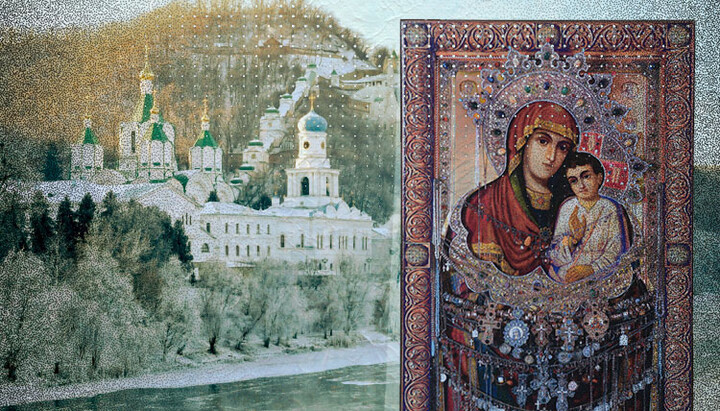
Holy Dormition Sviatohirsk Lavra. Photo: UOJ
Chalk clings to everything: clothes, hands, a backpack – brush against a wall, and you are marked. In the narrow corridors of the Lavra’s caves, where the ceiling sometimes forces you to stoop, chalk settles into the folds of the skin and dusts the eyelashes. The rock is soft, yielding – it can be scratched with a fingernail. On this fragile foundation, eight centuries ago, monks began carving out a labyrinth from which the Lavra itself would grow.
Seventeen years of seclusion in a cell the size of a closet
The first to come here were fugitives. According to one account – monks fleeing iconoclasts in the eighth–ninth centuries; according to another – those escaping the Mongol invasion after the destruction of Kyiv in 1240. They found a white chalk cliff above the Siverskyi Donets and began to bite into it with picks. Without plans – by touch, by candlelight, in a rock that hardens when exposed to air but is, at the moment of work, as pliable as clay. Every handful of white dust was carried out by hand. Eight hundred meters of underground passages – tons of chalk removed, basket by basket, year after year, generation after generation.
The cells carved into the rock are tiny: a bed hewn into the wall, a niche for an icon, a small opening through which barely any light enters. In the nineteenth century, St. John the Recluse lived in such a cell for seventeen years – without sunlight, in a space no larger than a wardrobe. With his own hands, he carved a chalk altar in the underground church of Saints Anthony and Theodosius. When he was later moved from his seclusion to an infirmary, he was carried in the same wooden coffin that had stood in his cell all those years – he had grown so accustomed to it in life that he was buried in it as well.
A cinema in the cathedral and paint that suffocated the walls
From the cramped darkness of the caves, one emerges into the open air, where the scent of pine resin and river water fills the lungs. The contrast is blinding: after the chalky twilight – a dazzling whiteness of cliffs reflecting the southern sun so fiercely that one must squint as in snow. Here, at the foot of the mountain, the Dormition Cathedral began to be built in 1859. It took nine years to complete, finished in 1868. Fifty-three meters high, five-domed, vast – designed for thousands of worshippers.
The scale overwhelms when one remembers how it all began: people who once huddled in cracks of stone raised, for God, an entire palace.
Before the First World War, about six hundred monks lived in the monastery. The brotherhood’s choir was renowned for its ancient chants, and pilgrims came here from across the empire.
St. Philaret (Gumilevsky), Archbishop of Kharkiv, wrote of the Holy Mountains with the wonder of one captivated by their spiritual beauty: “This place is so fair, so exalted, that it seems of itself to draw the mind toward heaven… He who has not seen the Holy Mountains has not seen an earthly paradise.”
In 1922, the monastery was closed. A cinema was installed in the cathedral, and the cells were turned into a sanatorium for Donbas miners. The cathedral walls were coated with thick oil paint, destroying the stone’s ability to breathe. The building quite literally suffocated: beneath the impermeable layer, the walls grew mold and began to rot from within. When the monastery was returned to the Church in 1992, the first obedience of the returning brotherhood was to take up scrapers. For months, centimeter by centimeter, they stripped away the Soviet paint – peeling off this suffocating skin so that the stone could dry and breathe again.
A church without a foundation on the edge of the abyss
A steep path leads to the summit of the chalk peak, and the climb is not easy.
But at the top, one’s breath is taken away: the seventeenth-century Church of St. Nicholas stands on the very edge of a precipice, as if without foundation.
Its eastern part – the altar – is carved directly into the mountain itself, while the domed portion projects outward, hanging over the void. It does not seem to stand upon the rock, but to grow from it, like a shoot from a fissure.
During the years when the monastery served as a sanatorium, vacationers and Pioneer camps carved their names into the soft chalk – “Vasya was here, 1954.” But chalk has a quality the vandals did not reckon with: it renews itself. To restore the cliff’s pristine whiteness, the monks in the 1990s needed only to shave off a few millimeters of the damaged surface. The mountain shed the Soviet era as a snake sheds its old skin.
From the summit, everything is visible: the bend of the Donets, pine forests on the far bank, the white walls and golden domes below. The sound of bells carries for miles across the river. During the years of persecution, the bells were cast down or melted for industry. But when, in 1992, the first Divine Liturgy was celebrated here again – without bells, in an empty and stripped church – the prayer rising above the cliff proved more eloquent than any ringing.
The Psalmist prayed: “Lead me to the rock that is higher than I, for You are my refuge, a strong tower against the enemy” (Ps. 61:2–3).
The monks of the Holy Mountains climbed the rock – from the dark caves in its depths to the cathedral on its slopes, from the cathedral to the Church of St. Nicholas on the summit – and with every step upward they drew nearer to the One who stands above every mountain.
The stone on which they built their monastery is fragile. Yet what they built has outlived empire, war, and seventy years of godlessness. The chalk proved stronger than steel – because in its softness it was shaped not by machines, but by the prayer of monks.
Read also
Young Mother and Sleeping Christ
Michelangelo carved a Virgin Mary who looks younger than her Son – and signed his name in marble for the only time in his life. Neither of these peculiarities was accidental.
Orthodox books from a Uniate printing press
In the 18th century, Uniate monks at Pochaiv printed books used in prayer by Orthodox Christians and Old Believers alike.
The story of the honey brotherhood
The Mogilev Brotherhood began with members pooling money to brew honey drinks for feast days – and eventually grew to have its own printing press.
Golgotha in the midst of a pogrom
In the autumn of 1938, the Jewish artist Marc Chagall painted the crucified Christ. Synagogues burn and refugees flee around the cross, while the Crucified One Himself is wrapped in a prayer shawl.
Stories of the Early Church. Level of governance: patriarch
How did several episcopal sees rise above the rest, why did the Church’s administrative map come to mirror that of the empire, and is the patriarchate a sacred form of Church governance?
A Chronicle without an author
We are accustomed to calling The Tale of Bygone Years the work of St. Nestor. Yet another monk left his signature on it, while the chronicle itself passed from one generation of scribes to the next.