Wooden prayer of the Carpathians: The secret of mountain church architecture
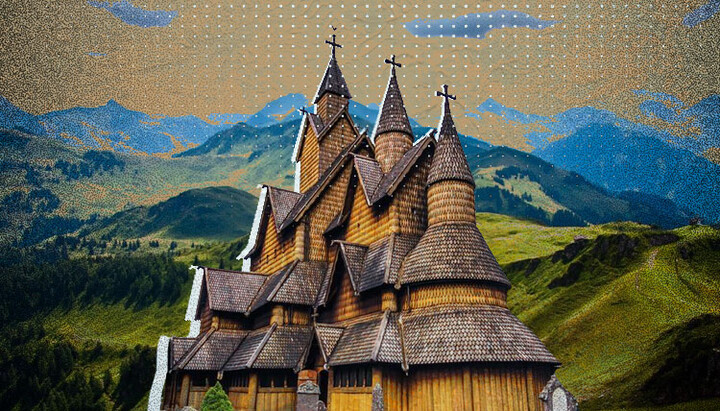
Churches in the Carpathians. Photo: UOJ
A palm laid against the wall of a Carpathian church feels warmth. Wood is always slightly warmer than stone; it holds temperature like a living body. Spruce is felled in winter, when the sap stops flowing and the trunk freezes through. Carpathian master builders cut timber only in hard frost: winter wood contains very little moisture and resists rot. Over three centuries, a log darkens to the color of burnt sugar. Its surface becomes a dense web of cracks – fine along the edges, jagged and deep nearer the center. But this is not decay: the wood splits itself on the outside, releasing the inner tension of its fibers in order to protect the core. Drops of petrified resin seep from the cracks.
Now lower your gaze to the corner where two logs meet in an “oblo” notch, their ends projecting outward. These churches were built without nails, for dead iron in living wood is a slow poison: amid the Carpathians’ sharp swings in temperature and humidity, metal rusts and begins to chemically burn the wood around it. So the courses of logs were fastened with wooden dowels – pegs made from the same species of timber. Such a joint swells in spring, shrinks in summer, and moves like a single organism. The groove where two tiers meet is fitted so precisely that not even a knife blade can pass between them.
Now lift your eyes to the roof. It is covered with shingles – split wooden boards, each working like the scale of a pine cone. When a downpour begins, the shingles swell and lock tightly together, so water runs down their channels without penetrating inside. But as soon as the sun appears, the wood dries, the edges of the boards lift slightly, and microscopic gaps open between them. The roof begins to breathe, airing out the church from within. It is a living membrane that has inhaled and exhaled for centuries in rhythm with the Carpathian sky.
Why churches echo the silhouette of the mountains
We take a step back – and only then can we take in the whole building. The Boyko, Hutsul, and Galician churches of the Carpathians are almost always tripartite: they consist of a narthex, a nave, and an altar – three volumes rising toward the center and narrowing as they ascend.
They repeat the outlines of the Carpathian ridges behind them – three mountains reaching toward heaven. It is a visible image of the Holy Trinity, not painted on a board, but built from logs and set on a mountain slope.
In 2013, sixteen such churches – eight in Ukraine and eight in Poland – were added to the UNESCO World Heritage List. Four architectural schools of one people – Boyko, Hutsul, Galician, and Lemko – have all been preserved in timber from the sixteenth through nineteenth centuries. More than two and a half thousand wooden churches stand in Ukraine. We are used to thinking of “world heritage” as something distant and monumental – and yet here it is: an ordinary little village church, reached by a broken dirt road.
How tin smothers wood
In the twentieth century, many Carpathian communities made a mistake that looked like an act of care. They removed the wooden shingles and covered the roofs with cheap, gleaming sheet metal – “rich-looking,” reliable, permanent. But the metal created a greenhouse effect. Wood that had stood for three hundred years stopped breathing, began to sweat with condensation, and within a single decade turned to dust. Restorers working on churches in Nyzhnii Verbizh and in the Lviv region found beneath the metal what had once been the toughest Carpathian spruce – now a wet sponge crumbling in their hands. This metallic “armor” did not protect the church; it suffocated it alive.
Today, the chief feat of those saving these churches is to tear off the dead metal and restore the roof’s ability to breathe.
There is something else wood gives a church that stone takes away. In a stone cathedral, the priest’s voice ricochets again and again from the walls, becoming a long, commanding, almost overwhelming echo. God in marble and granite is a fearsome Almighty, speaking from an inaccessible height. Wood works differently. It partly absorbs sound, making it warm, intimate, velvety. In a wooden church, the priest is no thunderer; his voice sounds close at hand – like the quiet, serious conversation of a father at the family table. Wood, incidentally, also lined the interior of Solomon’s Temple, as the Bible testifies: “all was cedar; there was no stone seen” (1 Kings 6:18). We do not know how the psalms sounded within those walls. But we can hear it for ourselves by stepping into any surviving Carpathian church during Sunday worship.
A church that cannot be abandoned
There is a piercing truth in wooden architecture: it makes no claim to the eternity of stone. A church assembled without a single nail can sway in mountain winds – the logs shift slightly in their grooves and then return to their place. A rigid structure breaks; a yielding one survives. In this lies a distinctive architectural philosophy.
The stone cathedrals of Europe were built with the proud idea that they would outlast millennia. A wooden Carpathian church lives, at most, three to five hundred years. It is vulnerable to fire, wood-boring beetles, and damp. Since 1991, more than seventy wooden churches have burned down in Ukraine – each of them older than any of us.
Yet it is precisely in this fragility that wooden churches possess what stone giants lack.
A wooden church cannot simply be built and forgotten. Its roof must be redone, its lower rotting logs replaced – year after year, generation after generation.
When the village empties out, the church dies with it. A church lives exactly as long as the community that cares for it.
Read also
Young Mother and Sleeping Christ
Michelangelo carved a Virgin Mary who looks younger than her Son – and signed his name in marble for the only time in his life. Neither of these peculiarities was accidental.
Orthodox books from a Uniate printing press
In the 18th century, Uniate monks at Pochaiv printed books used in prayer by Orthodox Christians and Old Believers alike.
The story of the honey brotherhood
The Mogilev Brotherhood began with members pooling money to brew honey drinks for feast days – and eventually grew to have its own printing press.
Golgotha in the midst of a pogrom
In the autumn of 1938, the Jewish artist Marc Chagall painted the crucified Christ. Synagogues burn and refugees flee around the cross, while the Crucified One Himself is wrapped in a prayer shawl.
Stories of the Early Church. Level of governance: patriarch
How did several episcopal sees rise above the rest, why did the Church’s administrative map come to mirror that of the empire, and is the patriarchate a sacred form of Church governance?
A Chronicle without an author
We are accustomed to calling The Tale of Bygone Years the work of St. Nestor. Yet another monk left his signature on it, while the chronicle itself passed from one generation of scribes to the next.