The iota that almost destroyed Christianity
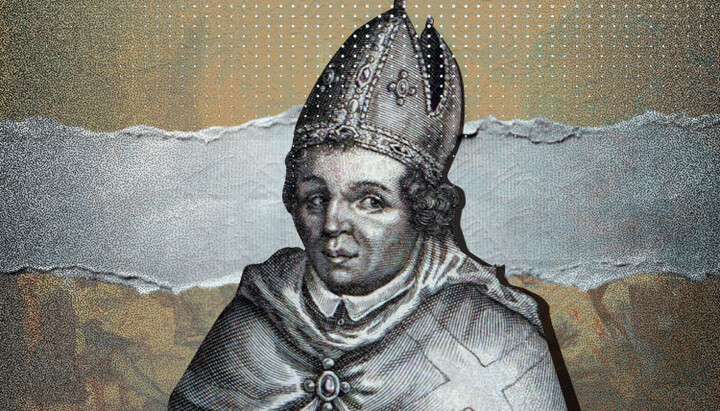
Arian, the Alexandrian heretic. Photo: UOJ
On parchment dry as old leather, one can almost make out a drop of ink, barely visible in the light. Into that drop, if history is to be believed, slipped the iota – a tiny letter, the most inconspicuous in the Greek alphabet. Without it, the word sounds like homoousios – of one essence. With it, it becomes homoiousios – of like essence. The difference seems pitiful, almost absurd. The eye glides past it, the hand does not tremble, a merchant in the marketplace would not even notice. And yet it is precisely there, in that microscopic slit, that a theological nuclear blast lies hidden.
Because this is no mere philological nuance. If Christ is of one essence with the Father, then He is not some useful heavenly go-between, but God Himself, who entered human flesh. But if He is only “like” God, then He becomes someone else entirely: the highest of creatures, a perfect messenger perhaps, but still not the One who can lead man out of slavery to death. The word changes by one letter – and with it, the destiny of salvation changes too.
The city where bread was sold with theology
Arius was a presbyter of Alexandria, and his heresy was born there – in that port city where theological arguments never really fell silent. He operated like a man who knew how to reduce the complex to a slogan. In his songs – above all in his most famous one, the Thalia – the thesis came packaged almost like a street refrain: there was a time when the Son was not. Simple rhythm, easy repetition, instant memorability. That kind of merchandise sells well in a port, in a workshop, on the road. It flatters the intellect, relieves the strain of mystery, and promises that God can be broken down into understandable pieces, the way a shopkeeper arranges his wares on a counter.
By the time the controversy had ripened into an empire-wide crisis and rolled on toward Constantinople, theology had already settled firmly into the streets of the capital.
St. Gregory of Nyssa left behind an almost indecently domestic picture of this hysteria: “The whole city is full of it – the alleys, the markets, the squares. The dealers in clothes, the money changers, the sellers of food – all of them are at it. Ask about the exchange rate, and someone starts philosophizing to you about the Begotten and the Unbegotten; inquire about the price of bread, and the answer comes: ‘The Father is greater, the Son is less’; ask for the bath to be heated, and you are told that the Son was made out of nothing.” Theology was not an occupation for scholars tucked away in study chambers. It spilled into the marketplace, into taverns, into the insults of the street.
And that was exactly the bait of Arianism. It did not require from man any inward humility before the incomprehensible. It offered a tidy scheme. At the top – a distant Deity. Below – the finest of created beings, through whom one might appeal to heaven. Everything neat, nothing offensive to the eye. For flat ideas always sell more easily than terrifying truth.
Constantine wanted not truth, but silence
At first, Emperor Constantine the Great looked at the whole dispute with something close to irritation. What he needed was not dogmatic purity, but order. A united empire does not enjoy theological war – it prefers intact roads, collected taxes, and provinces that are not on fire. He even wrote two separate letters – one to Alexander of Alexandria, one to Arius – dismissing their disagreement as a “small and insignificant quarrel” and a vain argument over words, urging both sides to reconcile so that he might recover his “pleasant days and peaceful nights.”
But the letters did not help.
The Church refused to sacrifice truth on the altar of state comfort.
At Nicaea, the controversy could no longer be reduced to a debate over technical terminology. What was at stake was whether Christianity would become a religion devoted to the memory of a great Teacher – or faith in the living God who had truly entered our flesh. St. Athanasius the Great saw this with merciless clarity: if Christ is not God, then Golgotha does not save. A creature cannot liberate creatures from the captivity of death. The finite cannot conquer infinite corruption. The Nicene word consubstantial turned out to be no academic whim, but the last line of defense.
A counterfeit banknote
Arianism was far too elegant not to become popular. It bore the defining mark of every dangerous counterfeit: outwardly, it looked almost indistinguishable from the real thing. Christ remained great. One could respect Him, even love Him, even build a moral system around Him. One simply could not pay with that currency. It was beautifully printed, but under ultraviolet light – empty.
That is exactly what the holy fathers would later keep saying, though not with banking metaphors, but with far harsher precision. St. Athanasius wrote in On the Incarnation of the Word: “He became man that we might become god; He manifested Himself through a body that we might receive an idea of the invisible Father; He endured the insolence of men that we might inherit immortality.” There is no ornamental rhetoric here.
If the Savior is not God, His Cross is only a tragedy. If He is God, the Cross becomes victory over death.
And what Arianism cannot bear is the scandal of the Incarnation. It wants to preserve the dignity of the Godhead from contact with our filth. It is willing to leave us a beautiful intermediary, but it does not wish to admit that the Absolute Himself took on a human body, hungered, shivered, wept, and died. To the tidy mind, that looks improper. To the Gospel, that is precisely where the mystery of salvation opens.
Arius’s trap has never closed
The most disturbing thing in this whole story is that Arius never really disappeared. He simply changed clothes.
Whenever Jesus is called a great moral teacher, an enlightened sage, or a spiritual reformer, without the next step being taken – the confession that He is God – the same mechanism is at work, only in new packaging. Man is willing to respect Christ right up to the line beyond which Christ begins to demand something of him. He remains useful and safe – so long as there is no breath of Golgotha and Resurrection about Him, things that cannot be explained in the language of everyday logic.
“The dispute about Christ is always a dispute about the nature of man and his destiny,” Protopresbyter Alexander Schmemann wrote in The Historical Road of Orthodoxy. It is an exact formula. Arianism always promises clarity. Orthodoxy, by contrast, answers not with clarity, but with truth – the kind of truth that shatters pride.
God did not explain Himself to the end. He simply came. And that is far more terrifying than any theological system.
One letter once shook an entire empire. But something even more troubling remains: every time man wants a Christ without the Cross and without divinity, the iota steps back onto the stage – not as a philological detail, but as bait. That same counterfeit banknote, so very convenient to spend – right up until the moment the subject turns to life and death.
Read also
Trial of a dead pope
Once in Rome, the body of a deceased pope was seated on the throne and put on trial. The accusation relied on a church canon that had once saved his see.
Monastery built in defiance of king
When Orthodox believers in Minsk were left with just one church, townspeople decided to build another – and even a royal decree did not stop them.
Young Mother and Sleeping Christ
Michelangelo carved a Virgin Mary who looks younger than her Son – and signed his name in marble for the only time in his life. Neither of these peculiarities was accidental.
Orthodox books from a Uniate printing press
In the 18th century, Uniate monks at Pochaiv printed books used in prayer by Orthodox Christians and Old Believers alike.
The story of the honey brotherhood
The Mogilev Brotherhood began with members pooling money to brew honey drinks for feast days – and eventually grew to have its own printing press.
Golgotha in the midst of a pogrom
In the autumn of 1938, the Jewish artist Marc Chagall painted the crucified Christ. Synagogues burn and refugees flee around the cross, while the Crucified One Himself is wrapped in a prayer shawl.